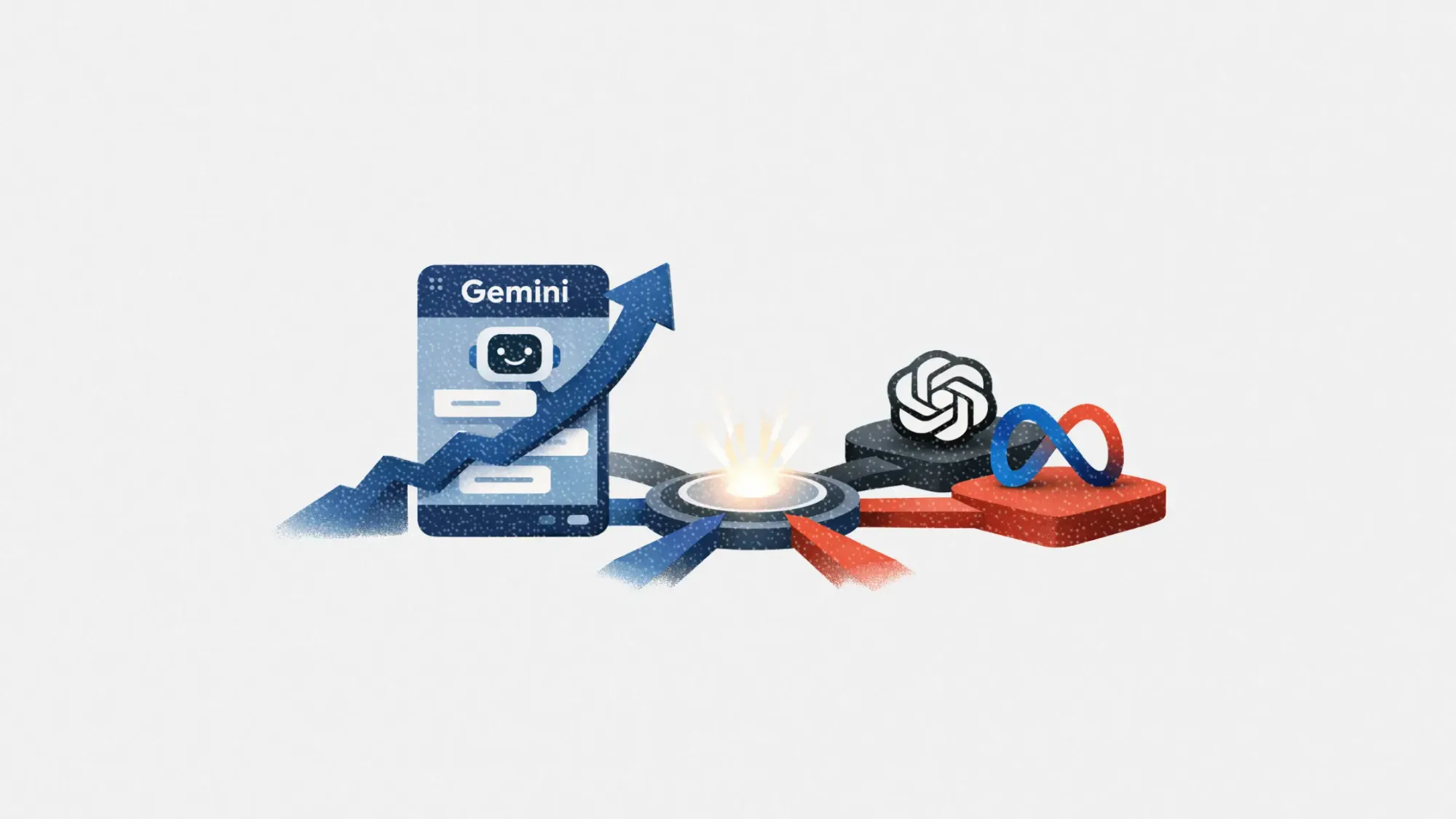
Google’s Gemini app has surged past 750 million monthly active users (MAUs), marking a sharp 100 million user increase from the previous quarter.
The latest figure, revealed during Google’s Q4 2025 earnings, highlights the increasing consumer appetite for generative AI interfaces. Google’s newly launched Gemini 3 model, a more advanced AI system with better reasoning and fluency, is credited as a key driver of the recent growth. But the numbers also point to a shifting landscape where platform powerhouses are converging on AI as the next battleground for user engagement, retention, and monetization.
This article explores what’s fueling the chatbot’s momentum, how it stacks up against rivals like ChatGPT and Meta AI, and what the rise of Gemini means for marketers and platform strategists alike.
Short on time?
Here’s a table of contents for quick access:
- What’s behind Gemini’s user surge
- How Gemini compares to ChatGPT and Meta AI
- What marketers should know
 Patrecia Meliana
What’s behind Gemini’s user surge
Google first reported 650 million MAUs for Gemini in Q3 2025. Now, just one quarter later, the figure has ballooned to over 750 million. This spike coincides with two key product shifts: the release of Gemini 3 and the introduction of a more affordable subscription plan, Google AI Plus, at US$7.99 per month.
According to Google CEO Sundar Pichai, Gemini 3 is the company’s “most advanced model yet,” offering a new level of depth and nuance in responses. This, along with the app’s integration into Google’s ecosystem and free access for many users, has helped the company close the usage gap with OpenAI’s ChatGPT.
Another factor is Google’s enterprise push. The company says its first-party AI models now process over 10 billion tokens per minute through direct API use. This signals strong B2B adoption beyond the consumer app, reinforcing Gemini’s relevance in both productivity and customer service contexts.
While the AI Plus plan hasn’t yet influenced the quarterly results, its low price point suggests a mass-market push—likely aimed at price-sensitive segments still sitting on the sidelines.
How Gemini compares to ChatGPT and Meta AI
Gemini is now the second most-used AI chatbot globally, trailing OpenAI’s ChatGPT, which was estimated to have around 810 million MAUs as of late 2025. Meta AI, which is integrated into services like WhatsApp and Instagram, reportedly serves around 500 million monthly users.
While ChatGPT maintains the lead, the race is tightening. Unlike OpenAI, which has focused heavily on its paid tiers and enterprise integrations, Google is pushing on both consumer and developer fronts. By contrast, Meta AI’s user base, while significant, is primarily tied to social and messaging contexts—limiting its utility for productivity or search-driven use cases.
Gemini’s broader integration across Google Search, Workspace, and Android devices offers unique reach, making it a key lever in Alphabet’s strategy to monetize AI at scale.
What marketers should know
For marketers and platform strategists, Gemini’s growth carries several key implications:
- AI distribution is now a platform game
Google’s ability to scale Gemini across its ecosystem shows how incumbents can quickly turn distribution power into AI adoption. This matters for anyone betting on app-based AI tools—expect more friction unless they play nicely with major platforms.
- Consumer trust and utility are driving adoption
The jump in MAUs suggests that users are increasingly relying on Gemini for daily queries, planning, and content generation. Marketers should begin exploring AI-native SEO and content strategies that reflect this behavioral shift.
- Freemium is winning
Gemini’s tiered model, especially with a strong free offering, echoes the freemium playbooks that helped platforms like Spotify and Dropbox scale. AI tool providers may need to rethink gated features if they want to stay competitive.
- B2B traction is growing fast
Google’s API usage stats hint at increasing enterprise reliance on Gemini. Marketing and CX leaders should evaluate whether Gemini-based tools can support automated customer interactions, lead scoring, or content personalization.
As generative AI matures from novelty to infrastructure, understanding where and how users engage with these platforms will become critical for content, ad, and product strategies alike.
Gemini’s explosive growth is more than a vanity milestone—it signals a broader platform shift where AI is becoming a default layer in consumer and business workflows.
For marketers, the rise of Gemini offers both an opportunity and a wake-up call: AI fluency, multi-platform strategies, and integration readiness will increasingly determine competitive edge.

Leave a Reply