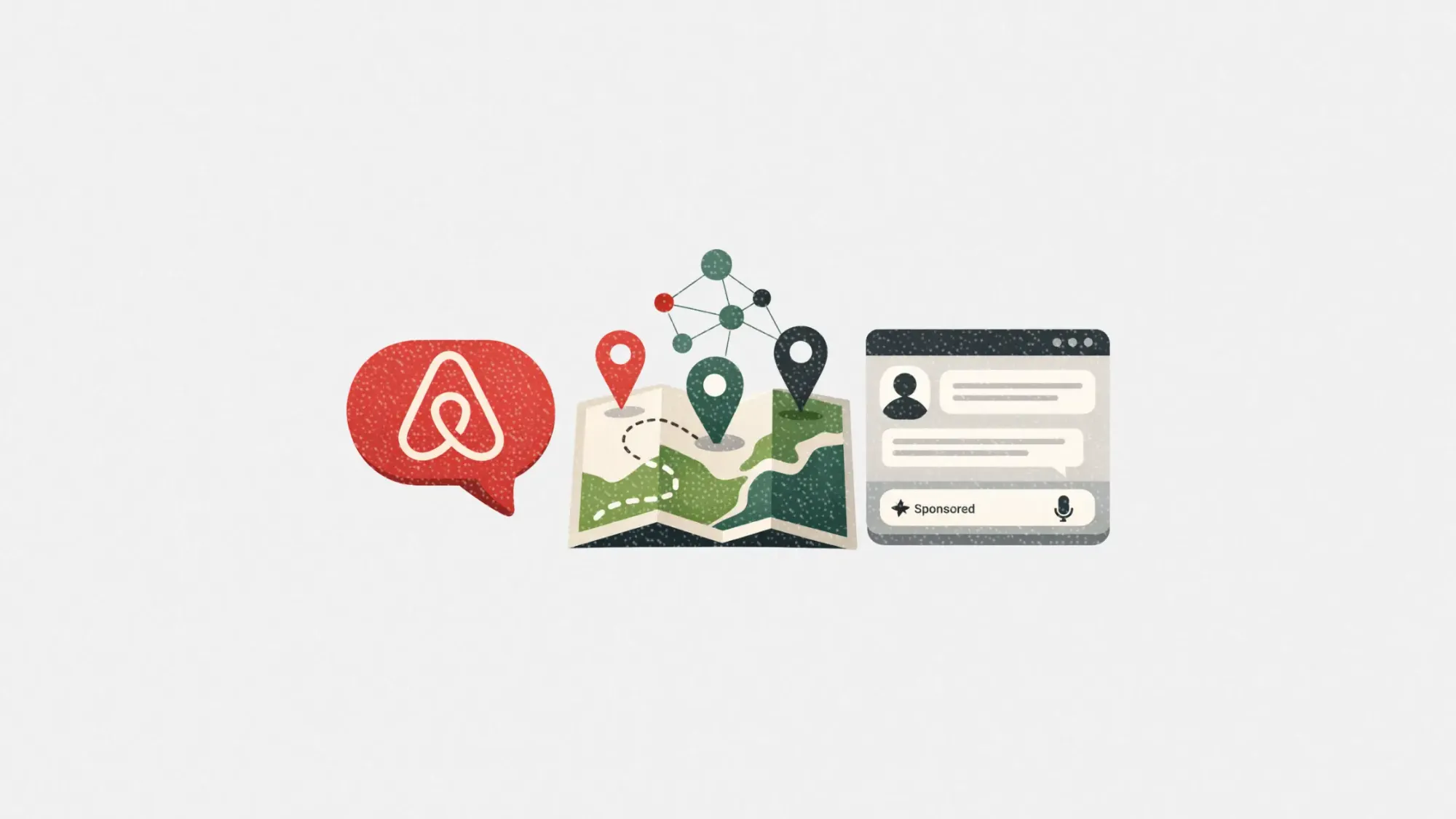
Airbnb is finally going all-in on generative AI. After years of cautious experimentation, the company has announced plans to embed large language models (LLMs) across search, trip planning, host operations, and customer service — signaling a significant platform shift that could redefine how users interact with the app.
This article explores Airbnb’s AI rollout, what’s in play for marketers, and how conversational discovery may open new opportunities for sponsored placements and travel personalization at scale.
Short on time?
Here’s a table of contents for quick access:
 Patrecia Meliana
What Airbnb just announced
Speaking during its Q4 earnings call, Airbnb CEO Brian Chesky unveiled the company’s broader ambition to become an “AI-native” platform. The company is integrating LLM-powered features across:
- Search and discovery: A natural language search interface is currently being tested on a small percentage of traffic. The goal is to evolve toward a “comprehensive and intuitive” search that extends through the trip.
- Trip planning: Future AI tools will learn user preferences to suggest activities, accommodations, and itineraries.
- Host support: AI will assist hosts in managing operations more efficiently, potentially through automation and predictive insights.
- Customer service: Airbnb’s existing AI-powered support bot already resolves around 30% of issues without human intervention in North America. The company aims to increase that share through voice support and multilingual capabilities.
The AI-powered search experience is currently experimental, with no timeline yet for broader rollout. However, Airbnb confirmed it’s also exploring monetization angles — including the future possibility of sponsored listings integrated into conversational queries.
Inside Airbnb’s AI-native strategy
Unlike competitors that rushed generative AI tools into production, Airbnb is positioning itself to deeply rewire the product experience around LLMs.
Chesky emphasized that AI won’t just surface results — it will “know the user,” helping them plan full journeys, while giving hosts and internal teams smarter, more efficient tools.
Key pillars of this strategy include:
- AI-first design: Airbnb’s new Chief Technology Officer, Ahmad Al-Dahle — a former Meta executive with experience on Llama — is leading the push. The company is prioritizing product redesigns where AI is core to functionality, not just a layer on top.
- Data advantage: With years of structured identity, review, and behavioral data, Airbnb has a potential edge in training and refining AI models for personalization and support.
- Workforce integration: Around 80% of Airbnb’s engineers already use AI tools. The company aims to reach 100% adoption to accelerate internal efficiency.
Chesky indicated that the end vision is a platform where AI handles everything from guest trip planning to dynamic host support, with minimal user friction.
What marketers should know
If Airbnb’s AI-native approach succeeds, the implications for marketers — especially in travel, hospitality, and local experiences — are significant.
Here’s what to watch:
- Conversational discovery = new real estate for paid media
While Airbnb hasn’t launched sponsored AI slots yet, the CEO confirmed it’s under consideration. If conversational search becomes a primary navigation method, marketers will need to rethink how they surface listings or experiences in this flow.
- AI-powered personalization may boost ROI for travel partners
With LLMs capable of refining recommendations based on user history and behavior, travel brands that align with user preferences could see stronger organic placements — or be better positioned for future ad targeting.
- Customer service AI is setting new expectations
Airbnb’s AI bot already handles a third of customer issues without human agents. As it expands to voice and multilingual support, marketers may want to benchmark support experience expectations for their own platforms.
- Opportunity for toolmakers and support platforms
Airbnb’s internal AI use case could spark demand for B2B tools that enable better AI adoption for engineering, localization, or support automation in hospitality and adjacent verticals.
For now, the monetization aspect remains exploratory — but brands operating in travel discovery or experience curation should monitor closely.


Leave a Reply