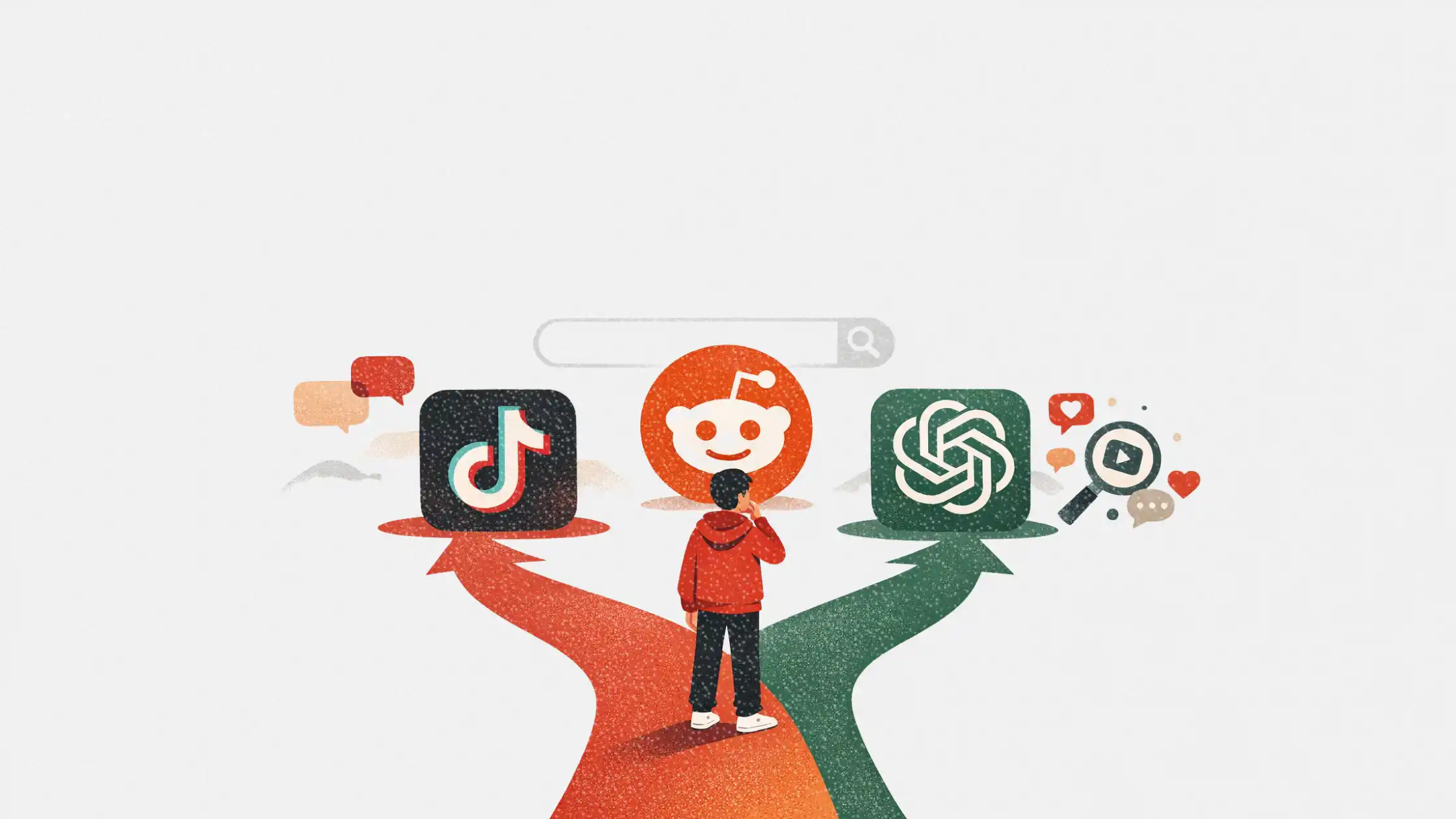
Traditional search is no longer the starting point for Gen Z. According to new research from Resolve, more than half of Gen Z users now prefer social-first or conversational tools like TikTok, Reddit, and ChatGPT to get their questions answered.
And I get it—as a Gen Z user myself, I instinctively open ChatGPT or TikTok when I need quick news updates, product reviews, or just a real take on something. Google feels like a backup, not a first stop. This shift reflects a broader change in how Gen Z searches online. Instead of relying on a single search engine, younger users move across platforms such as TikTok, Reddit, YouTube, and AI tools like ChatGPT depending on what they want to learn.
For marketers, this means visibility is no longer just about Google rankings. It is about showing up across an entire search ecosystem that includes social platforms, communities, and AI assistants. In this article, we unpack how Gen Z search behavior is evolving, why younger users are moving beyond Google search, and what marketers can do to stay visible where discovery actually happens.
Short on time?
Here’s a table of contents for quick access:
- Gen Z search behavior is changing fast
- Why Gen Z is turning away from Google search
- TikTok, Reddit, and AI are becoming search engines
- The new Gen Z search journey
- What is social search optimization (SSO)?
- What marketers should do next
- Why Google still matters in the search ecosystem
- The future of search is multi-platform
 Patrecia Meliana
Gen Z search behavior is changing fast
Resolve’s survey of 1,000 people shows a major shift in how younger users search online. Many Gen Z users now rely on social platforms and AI tools instead of starting with Google.
Key findings include:
- 53% of Gen Z search TikTok, Reddit, or YouTube before Google
- 61% regularly use generative AI tools for search-related tasks
- 41% of users rely on ChatGPT for deeper answers and explanations
Instead of typing keywords into a traditional search box, younger users increasingly rely on platforms that deliver visual explanations, conversational answers, or community-driven recommendations.
 Patrecia Meliana
Why Gen Z is turning away from Google search
Gen Z’s rejection of traditional search stems from a growing frustration with the results they’re getting. The survey of 1,000 people across generations show:
- 86% of users said Google’s answers often feel repetitive
- 45% actively avoid links that seem AI-generated or formulaic
- 61% leave the top result if their question isn’t answered fast
Many search results today are heavily optimized for algorithms rather than readers. For Gen Z users who grew up with personalized feeds and creator-led content, that experience can feel slow and generic.
Younger users increasingly expect answers that are:
- Visual and easy to understand
- Conversational rather than formal
- Based on real experiences or community insights
That expectation is pushing discovery toward platforms built around creators, conversations, and communities.
 Patrecia Meliana
TikTok, Reddit, and AI are becoming search engines
TikTok’s rise as a search engine is no longer just hype.
Whether someone is searching for “how to write a resignation email” or “best ramen in Tokyo,” Gen Z often prefers short videos that show the answer directly rather than blog posts that require scrolling.
Reddit plays a different role. It acts as a validation layer for search.
Many users append “Reddit” to their Google searches because they want honest discussions and firsthand experiences rather than polished brand messaging.
Meanwhile, AI tools like ChatGPT are becoming powerful discovery tools.
Instead of scanning multiple websites, users can ask a single question and receive a summarized answer in seconds. AI assistants synthesize information, explain complex topics, and often recommend additional resources.
For Gen Z, that is simply a faster way to search.
 Atikah Amalia
The new Gen Z search journey
Search today is no longer a single step. It is a multi-platform journey.
A typical Gen Z search flow might look like this:
- Discovery: TikTok, Instagram, Youtube
- Explanation: ChatGPT or AI assistants
- Validation: Reddit or online communities
- Final research: Google or brand websites
For marketers, this means that visibility across platforms matters more than ranking on a single search engine.
Brands that only focus on traditional SEO may miss the discovery stage entirely.
What is social search optimization (SSO)?
As discovery shifts to social platforms, marketers are starting to adopt a new approach called social search optimization (SSO).
While traditional SEO focuses on keywords, backlinks, and website authority, SSO focuses on making content discoverable on platforms like TikTok, Reddit, and YouTube.
Social search optimization often includes:
- Optimizing TikTok captions and hashtags
- Creating searchable video tutorials and explainers
- Participating in relevant Reddit communities
- Encouraging user-generated content and reviews
- Producing creator-led content that feels authentic
In many cases, social search results appear before traditional search results, especially for product discovery or lifestyle questions.
What marketers should do next
To meet Gen Z where they are, marketers need to shift their mindset—from search engines to search ecosystems. Here’s where to start:
1. Invest in creator-powered content
Want to show up in Gen Z’s TikTok searches? Partner with creators who speak their language. UGC-style videos, authentic voiceovers, and how-tos outperform glossy ads.
Make your content easy to remix, react to, and reshare. Think formats that fit TikTok, Reels, or Shorts—not just Google snippets.
2. Build credibility on Reddit for relevance
Reddit operates differently from most social platforms.
Communities reward useful insights and quickly reject overt promotion. Brands that participate in discussions, host AMAs, or provide helpful answers can build credibility over time.
You can’t fake authenticity on Reddit. But if you’re helpful, the audience notices.
 Atikah Amalia
3. Optimize content for conversational search
AI assistants and voice tools rely heavily on natural language queries.
Your content should answer questions the way people ask them. Use tools like AlsoAsked or ChatGPT itself to uncover natural language queries, then write content that sounds like a conversation—not a content brief.
Bonus: optimize your help docs or FAQ pages to show up in ChatGPT plug-ins or voice assistants.
4. Use AI as a creative partner—not a content farm
Gen Z is skipping bland, AI-written content. But smart brands are using AI tools to brainstorm ideas, streamline summaries, or personalize user journeys—not to bulk-create blogs. Know the difference.
For Gen Z, search isn’t dead—it just looks nothing like it used to.
Why Google still matters in the search ecosystem
Despite these shifts, Google is far from irrelevant.
Even Gen Z users still rely on Google for several types of searches, including:
- Navigating to specific websites
- Researching brands before purchasing
- Finding local businesses
- Comparing products and services
In many cases, Google acts as the final step in the discovery journey, even if the initial inspiration came from TikTok or Reddit.
For marketers, the takeaway is not to abandon SEO but to expand it.
The future of search is multi-platform
Search is no longer defined by a single engine.
Instead, discovery now happens across a network of platforms that combine:
- Creator content
- AI assistants
- Online communities
- Traditional search engines
For Gen Z, the question is no longer “What does Google say?”
It is “What do creators, communities, and AI say together?”
Marketers who want to stay visible need to think beyond rankings and focus on participating in conversations across the entire search ecosystem.
Search is not dying. It is simply evolving.


Leave a Reply