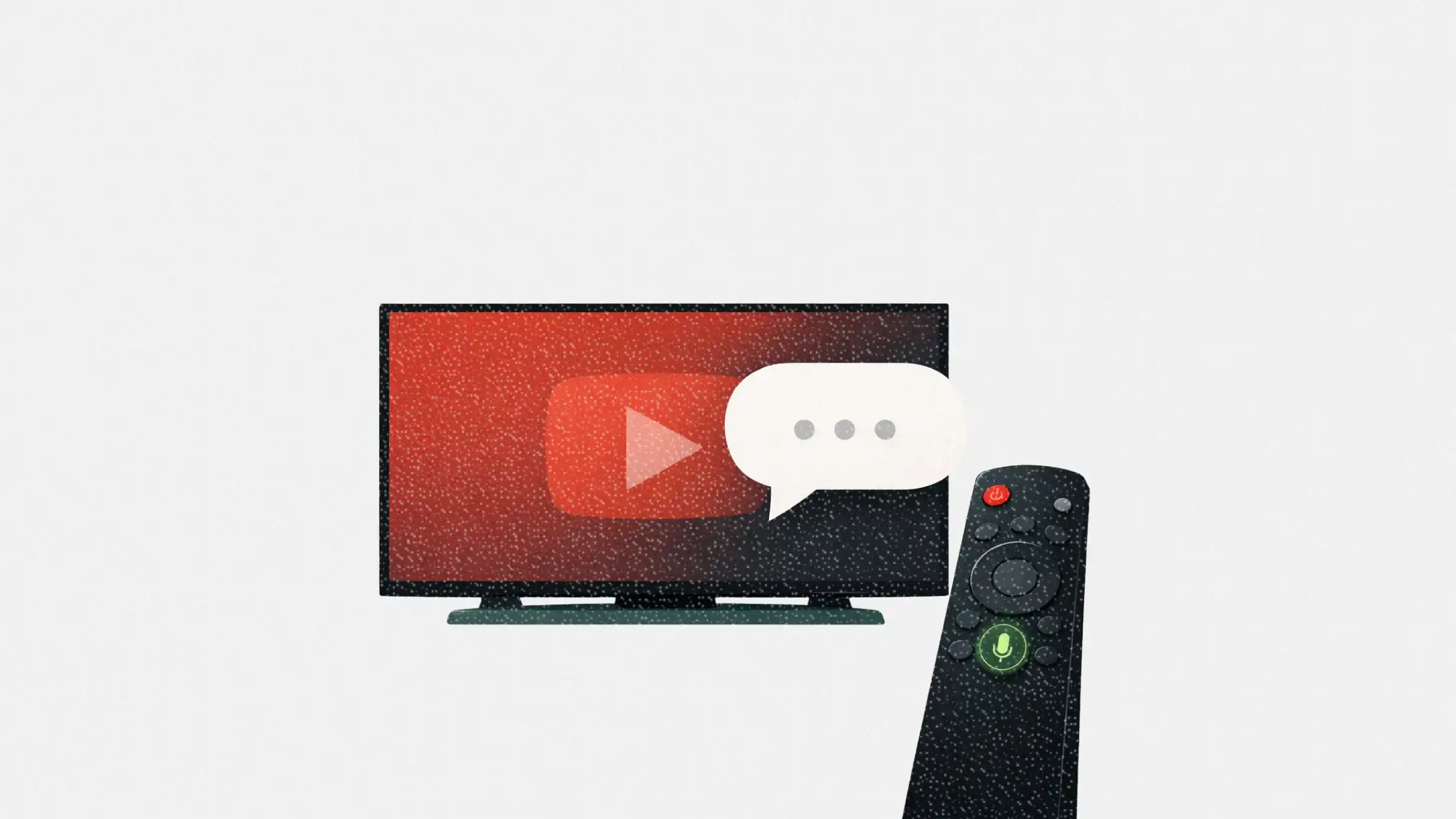
YouTube is taking its conversational AI tool to smart TVs, gaming consoles, and streaming devices, bringing interactive, in-video assistance to the living room.
For marketers, this is not just a product tweak. It is another signal that search, discovery, and audience engagement are becoming conversational across every screen.
This article explores what YouTube’s TV-based AI experiment actually does, why it matters now, and how brands should rethink content strategy as viewers start asking questions instead of simply watching.
Short on time?
Here’s a table of contents for quick access:
- What YouTube’s conversational AI on TVs actually does
- Why YouTube is doubling down on the living room
- How competitors are reshaping conversational AI on TV
- What marketers should know about AI-powered viewing
 Patrecia Meliana
What YouTube’s conversational AI on TVs actually does
YouTube is experimenting with bringing its conversational AI tool, first launched in 2024 for mobile and web, to smart TVs, gaming consoles, and streaming devices.
Eligible users over 18 can select an “Ask” button while watching a video. From there, they can choose suggested prompts or use their remote’s microphone to ask questions related to the content. Examples include asking about recipe ingredients in a cooking video or the background story behind a song’s lyrics.
The key detail is this: viewers can ask and receive answers without leaving the video or app. The experience remains immersive, but now layered with real-time context and explanation.
At launch, the feature supports English, Hindi, Spanish, Portuguese, and Korean, and is being rolled out to a limited group of users.
Alongside this, YouTube continues expanding AI features across its ecosystem. It recently introduced automatic video enhancement to full HD for lower-resolution uploads, an AI comments summarizer, an AI-driven search results carousel, and tools that will allow creators to generate Shorts using AI versions of their own likeness. It also launched a dedicated app for Apple Vision Pro, reinforcing its push into immersive viewing environments.
Why YouTube is doubling down on the living room
This move is not happening in isolation. According to a Nielsen report from April 2025, YouTube accounted for 12.4% of total US television audience time, surpassing platforms such as Disney and Netflix.
More Americans now watch YouTube on TVs than on mobile devices. That shift changes how brands should think about YouTube. It is no longer just a social video platform. It is a dominant TV network with algorithmic distribution and now conversational overlays.
By embedding AI into the TV interface, YouTube is effectively turning passive viewing into interactive discovery. Instead of searching before watching, viewers can search during watching. That blurs the line between content, search, and assistant.
For marketers, this creates new moments of intent. A viewer asking about ingredients, product names, or music context signals active curiosity. The long-term implication is that YouTube could capture deeper behavioral signals directly from the biggest screen in the home.
How competitors are reshaping conversational AI on TV
YouTube is not alone in this race.
Amazon has rolled out Alexa+ on Fire TV devices, enabling natural conversations, tailored content recommendations, scene searches within movies, and contextual questions about actors and filming locations.
Roku has upgraded its AI voice assistant to handle open-ended questions such as “What’s this movie about?” or “How scary is it?” Netflix is also testing an AI-powered search experience.
The competitive pattern is clear. Streaming platforms are evolving from static catalogs into interactive assistants. The interface is shifting from scroll and click to ask and respond.
For brands, that means discoverability may increasingly depend on how well content can be parsed, summarized, and surfaced by AI systems.
What marketers should know about AI-powered viewing
This shift has several practical implications for Marketing Directors, Content Strategists, and Brand Managers.
- Optimize for conversational queries
Think beyond traditional YouTube SEO. If viewers can ask about specific ingredients, product features, or backstories, your content needs to clearly state those details on-screen and in metadata. AI systems rely on structured, explicit information.
- Treat YouTube as a TV and search hybrid
YouTube now behaves like a streaming service and a search engine combined. That hybrid model favors educational, explainer, and utility-driven content that can trigger follow-up questions.
- Expect new intent signals
If YouTube eventually surfaces aggregated AI interaction data, marketers could gain insight into what viewers are asking in real time. That could inform product messaging, FAQ content, and campaign angles.
- Prepare for AI-mediated brand interpretation
When AI answers questions about your brand or product within a video, it becomes an intermediary. Clarity and accuracy in your content become critical to avoid misinterpretation.
For more on how AI is reshaping platform dynamics, see our coverage of YouTube’s AI-powered creator tools and Shorts expansion and our analysis of AI search and discovery shifts across streaming platforms. You may also find our breakdown of how AI assistants are changing content marketing strategy useful.
YouTube’s expansion of conversational AI to TVs may start as a limited experiment, but the direction is clear. The living room is becoming interactive, searchable, and assistant-driven.
For marketers, this is not just about another feature rollout. It signals a broader shift in how audiences discover, question, and engage with content. As AI moves onto the biggest screen in the house, brands that design for conversational intent, not just passive reach, will be better positioned for what comes next.


Leave a Reply