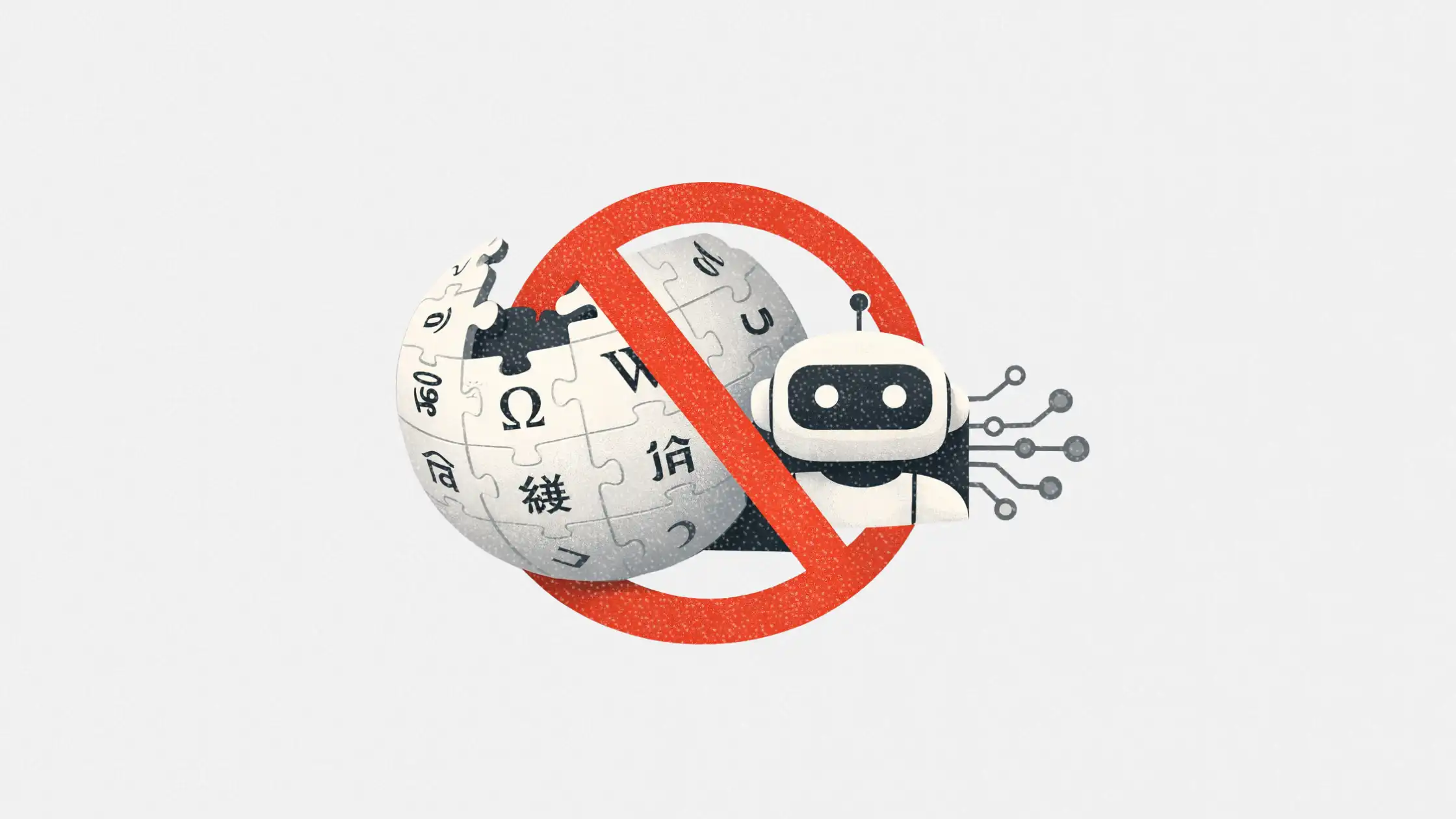
Wikipedia has officially banned the use of AI-generated text in article creation, intensifying the debate over generative tools in editorial workflows. While the platform still allows limited AI assistance for editing, the new rule blocks the use of large language models (LLMs) for writing or rewriting core article content.
This move reflects growing concerns around the reliability and accuracy of AI-generated information, especially within open-source knowledge platforms. For marketers and content strategists, the update reinforces the need for transparency and trust—particularly as AI-written copy becomes more prevalent in public-facing content.
This article explores the details of Wikipedia’s policy update, what prompted the decision, and what marketing and content teams should keep in mind as AI becomes a bigger part of their publishing stack.
Short on time?
Here’s a table of contents for quick access:
- What changed in Wikipedia’s AI policy
- Why this matters for trust and sourcing
- What marketers should know
 Patrecia Meliana
What changed in Wikipedia’s AI policy
In a recent community vote, Wikipedia editors passed a new policy that explicitly bans the use of LLMs to generate or rewrite article content. The updated language replaces a previously vague guideline and now reads:
“The use of LLMs to generate or rewrite article content is prohibited, save for the exceptions given below.”
The exceptions are narrow. Editors may use AI to suggest minor copyedits to their own writing, but only if the final result is carefully reviewed and doesn’t introduce new, unsupported information. Translation using LLMs is permitted under specific guidance for cross-language content, but still requires strict oversight.
The vote passed overwhelmingly, with 40 editors in favor and only 2 opposed, according to reporting from 404 Media.
 Patrecia Meliana
Why this matters for trust and sourcing
At the heart of Wikipedia’s decision is the issue of trust. AI-generated text has been shown to confidently fabricate facts, misrepresent sources, or subtly shift meaning—a major problem for a platform built on community verification and citation.
The new policy reiterates that:
“LLMs can go beyond what you ask of them and change the meaning of the text such that it is not supported by the sources cited.”
This move signals a clear stance: even partial AI-generated rewrites may compromise Wikipedia’s editorial integrity. That stance aligns with concerns raised across the media industry about hallucinated facts, weak sourcing, and lack of accountability in AI-generated outputs.
 Atikah Amalia
What marketers should know
For marketers, publishers, and PR pros, Wikipedia’s policy update is a timely reminder to approach AI-assisted content with caution. Here’s what to keep in mind:
1. AI is a tool, not a source
Treat LLMs as a starting point, not a content engine. Final outputs must be based on verified information and reviewed with editorial rigor.
2. Human review is non-negotiable
Whether you’re writing blog posts, whitepapers, or Wikipedia edits, content must be fact-checked and attributed. Generative tools should never replace human oversight.
3. Be transparent about AI use
Internal teams and external partners should align on when, how, and why AI tools are used. Consider establishing your own editorial guidelines, much like Wikipedia just did.
 Patrecia Meliana
4. Reputation matters
Publishing AI-written content that introduces inaccuracies—even unintentionally—can damage brand trust. Make sure your AI workflows don’t cut corners on quality control.
As AI content generation becomes more accessible, the line between speed and credibility will be tested. Wikipedia’s updated policy is a clear example of an organization drawing that line—and marketers would do well to take note.


Leave a Reply