B2B software evaluation is being reshaped not by a single tool or platform, but by a broader shift in how buyers research, compare, and validate decisions.
A new Software Finder report, based on traffic analysis, AI citation data, and a survey of 556 B2B buyers, shows that the evaluation journey is now distributed across Google, AI tools, peer input, and vendor content.
This article explores how buyers actually compare software today, how AI fits into that process, and why trust still anchors around human validation rather than machine-generated summaries.
Short on time?
Here’s a table of contents for quick access:
- Where buyers go to compare B2B software today
- How AI tools are being used in software evaluation
- Why buyers still trust reviews pricing and demos over AI summaries
- The gap between AI usage and AI trust
- What marketers should know about AI driven buyer journeys
 Patrecia Meliana
Where buyers go to compare B2B software today
The traditional comparison stack has shifted. Buyers are no longer relying on a single source. Instead, they triangulate across multiple tools.
According to the Software Finder study , the most-used tools for comparing B2B software are:
- Google: 68.3%
- AI chatbots: 55.2%
- Peer recommendations: 49.6%
- AI overviews: 31.3%
- Aggregator sites: 24.1%
- Social media: 22.7%
- AI on vendor sites: 17.1%
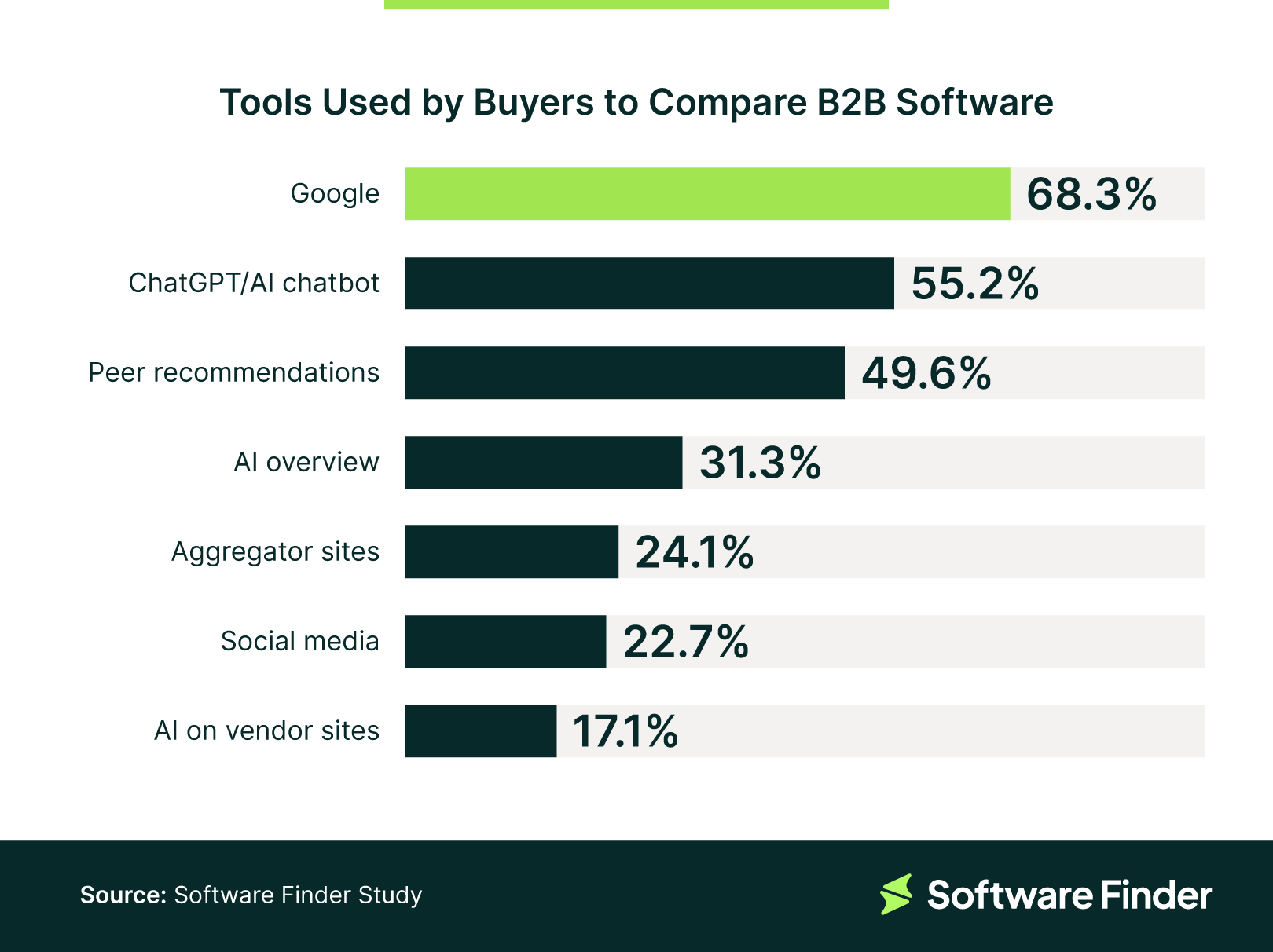
This ranking reveals a clear hierarchy. Search and AI dominate early comparison. Peer input remains critical. Aggregators, once central, now sit mid-pack.
The implication is straightforward. Comparison is no longer centralized. It is distributed across interfaces, with AI acting as a key layer in the process.
Patrecia Meliana
How AI tools are being used in software evaluation
AI is not just a discovery tool. It is now embedded in how buyers evaluate options.
Across respondents, 74.5% reported using AI chatbots during the evaluation process, and 92.2% said they found them useful .
The most common use cases highlight AI’s role as a research accelerator:
- Comparing tools side by side: 66.7%
- Summarizing reviews: 53.1%
- Explaining how tools work: 48.8%
- Finding pricing and feature details: 48.8%
- Identifying alternatives: 41.1%
These functions closely mirror what aggregator platforms traditionally offered.
The difference is speed and interface. AI compresses multiple steps into a single interaction, reducing friction in early and mid-stage research.
Patrecia Meliana
Why buyers still trust reviews pricing and demos over AI summaries
Despite high usage, AI is not the final authority in decision-making.
When buyers were asked what content influences their purchase decisions most, AI-generated summaries ranked low compared to traditional sources:
- User reviews: 47.5%
- Feature comparisons: 39.2%
- Pricing transparency: 35.6%
- Free trials or demos: 35.3%
- Video walkthroughs: 25.4%
- Analyst reports: 23%
- AI summaries: 21%
This creates a clear divide. AI helps buyers understand options faster, but it does not replace the need for proof.
Buyers still rely on:
- Verified experiences from other customers
- Transparent pricing
- Hands-on validation through demos
In other words, AI informs decisions, but it does not finalize them.
The gap between AI usage and AI trust
The most interesting insight is not adoption. It is the gap between usage and trust.
While AI usage is widespread, sentiment remains cautious:
- 42.1% say AI comparisons are helpful but not actively sought
- 30% actively seek AI-generated comparisons
- 38.7% say AI improves understanding
- 26.1% say it speeds up research
- 12.6% express concerns about bias or accuracy
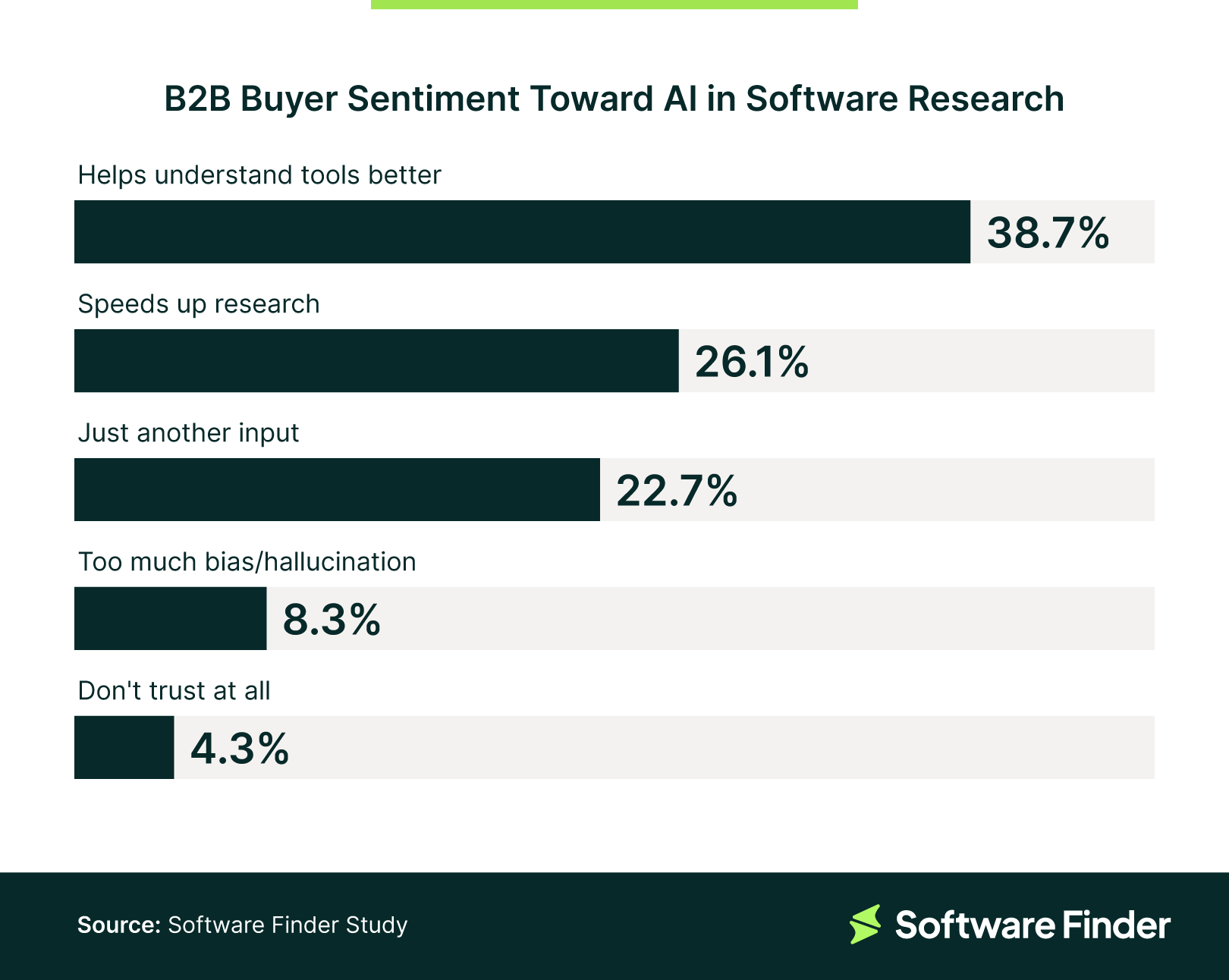
This reflects a transitional phase. Buyers are comfortable using AI, but they are not fully delegating judgment to it.
Instead, AI plays a supporting role:
- It frames the shortlist
- It accelerates understanding
- It reduces research time
But trust still resides in human-generated signals.
Patrecia Meliana
What marketers should know about AI-driven buyer journeys
This shift in evaluation behavior has direct implications for B2B marketing strategy.
1. You are competing inside AI interfaces now
Your content is no longer just competing for clicks. It is being summarized, compared, and interpreted by AI tools.
2. Comparison content needs to go deeper
Surface-level listicles are easy for AI to replicate. Detailed comparisons, pricing breakdowns, and use-case guidance are harder to replace.
3. Reviews and proof points are more valuable than ever
As AI abstracts information, buyers look for signals they can trust. Verified reviews and real-world outcomes become differentiators.
4. AI is a distribution layer, not just a tool
Think of AI as a new channel where your content is surfaced, not just a feature buyers use.
5. The goal is not visibility, it is credibility
Being mentioned by AI is useful. Being trusted by buyers is what drives conversion.
Patrecia Meliana
Buyers are using AI to move faster, compare more options, and reduce friction. But when it comes to making decisions, they still rely on human validation, transparent data, and real product experience.
For marketers, this creates a dual challenge. You need to be visible in AI-driven workflows while also delivering the kind of content that AI cannot replace.
Because in this new evaluation journey, speed comes from AI. Confidence still comes from proof.

Leave a Reply