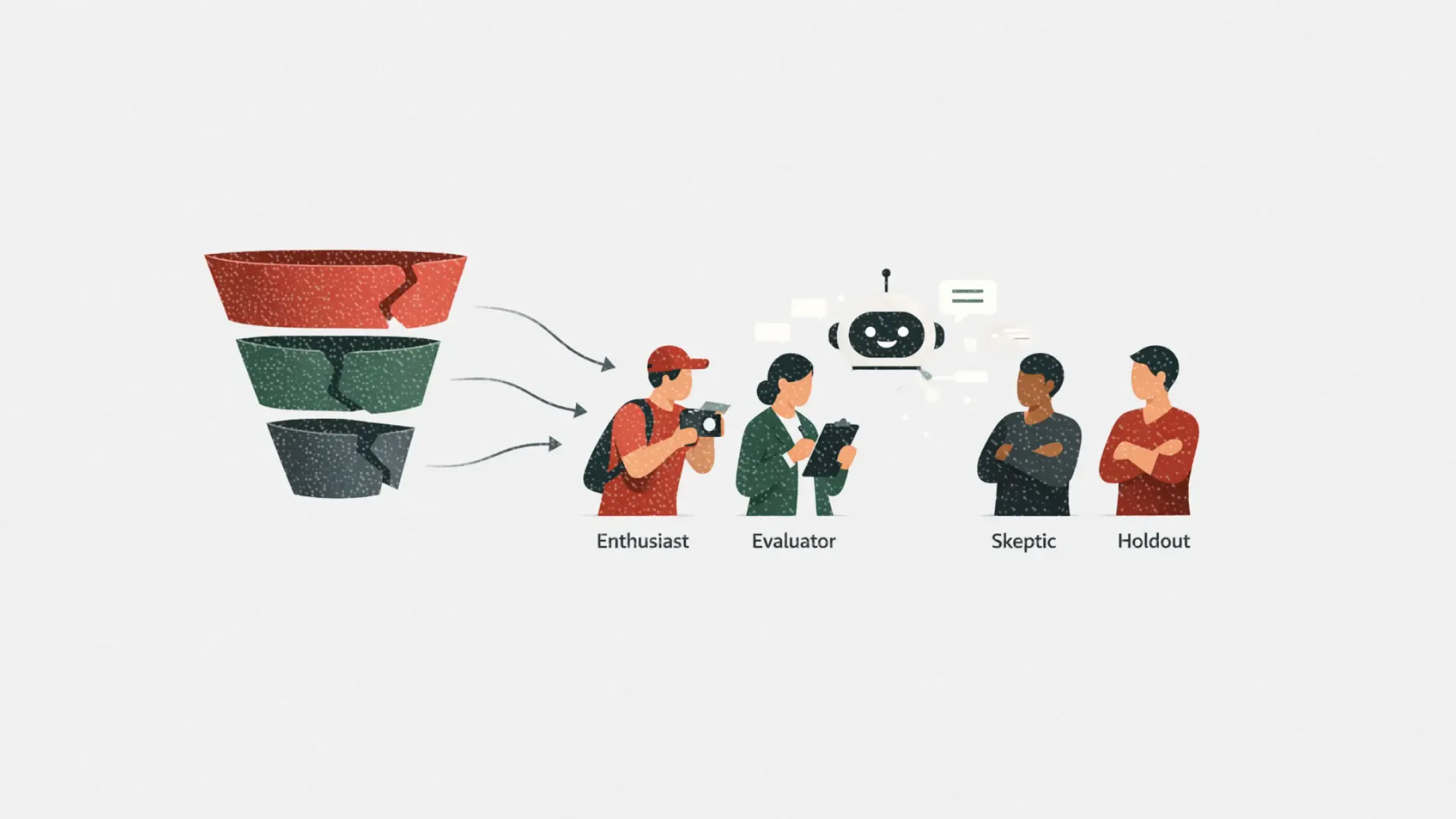
Klaviyo’s latest AI Consumer Personas Playbook introduces something more fundamental than a new way to personalize campaigns. It proposes a shift in how marketers should define and segment their audiences in an AI-driven landscape.
This article explores why traditional segmentation models are breaking down, how AI behavior is emerging as a new segmentation layer, and what this means for marketers trying to stay relevant as customer expectations evolve.
Short on time?
Here’s a table of contents for quick access:
- Why traditional segmentation is breaking in the age of AI
- How AI consumer personas introduce a new segmentation model
- What this shift means for modern marketing strategy
- What marketers should do next
 Patrecia Meliana
Why traditional segmentation is breaking in the age of AI
Traditional segmentation assumes that customers with similar profiles behave in similar ways. AI is breaking that assumption.
The report shows a widening behavioral gap. Some consumers now rely heavily on AI tools for research and decision-making, while others avoid them entirely. That divergence creates fundamentally different paths to purchase.
For example:
- 96% of AI Holdouts don’t use AI when shopping, effectively opting out of AI-driven journeys
- In contrast, AI Enthusiasts actively rely on AI and treat it as a decision-making partner. The report shows that 85% have used AI while shopping in the past six months, and 43% have already purchased a product based on AI recommendations.
This means two customers with identical demographics can behave completely differently depending on their relationship with AI.
The result is a segmentation blind spot. Traditional models cannot explain:
- Why some users trust AI recommendations instantly
- Why others validate every output before acting
- Why certain audiences lose trust when AI is visible
Segmentation based on identity alone is no longer enough.
How AI consumer personas introduce a new segmentation model
Klaviyo’s framework organizes consumers into four personas: Enthusiasts, Evaluators, Skeptics, and Holdouts. But the real value lies in how these personas are constructed.
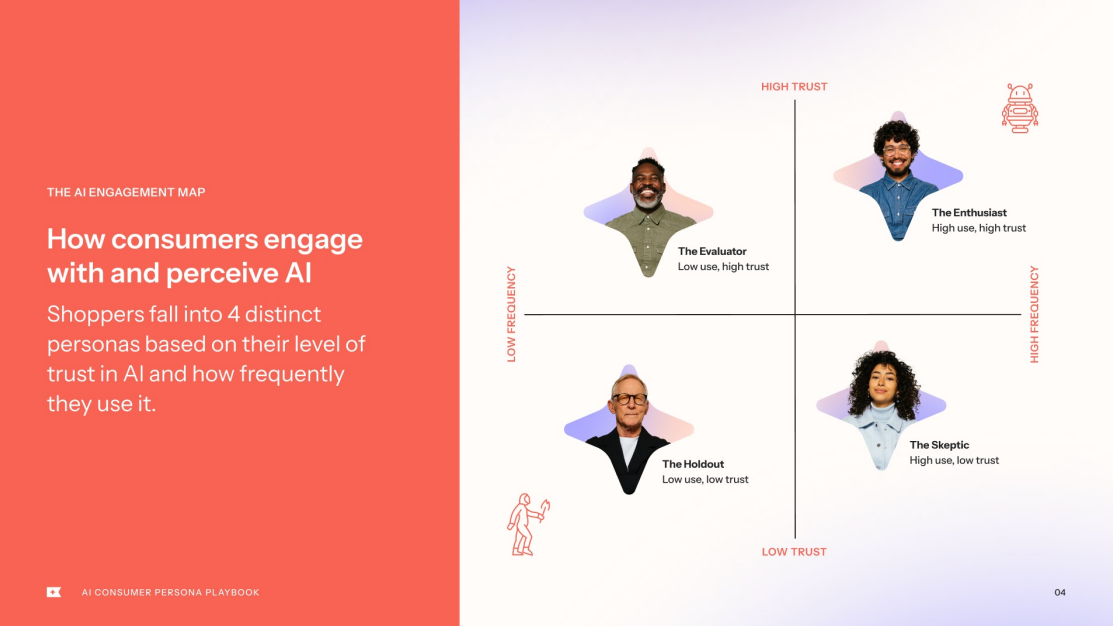
They are based on two measurable dimensions:
- Trust in AI
- Frequency of AI usage
This creates a behavioral segmentation model that explains real-world differences in marketing performance.
AI Enthusiasts show strong positive sentiment:
- 81% say AI improves product recommendations
- 74% say it improves customer support
- 72% say it improves marketing relevance
At the same time, AI Skeptics show clear resistance:
- Only 25% have purchased AI-recommended products
- Just 19% trust those recommendations
And AI Holdouts go further:
- Only 1-4% believe AI improves their experience
- 58% trust brands less when AI-generated content is used
But the most revealing group sits in the middle.
AI Evaluators use AI frequently, yet hesitate to rely on it:
- 54% are less likely than Enthusiasts to use AI for decision-making
- 74% feel neutral about AI-generated content
- 42% are unsure whether they can distinguish AI from human output
They don’t reject AI, but they don’t fully trust it either.
This is not a marginal difference. It is a segmentation-level divide. The same AI-powered campaign can perform exceptionally well with one group and fail completely with another.
What this shift means for modern marketing strategy
This shift has immediate implications for how marketing teams think about segmentation, targeting, and experience design.
- Segmentation becomes dynamic and behavioral
Instead of grouping users by static attributes, marketers need to account for how customers interact with AI across the journey.
- Personalization is no longer one-dimensional
The report highlights that personalization depth should align with trust levels. AI Enthusiasts respond well to predictive recommendations, while Skeptics and Holdouts require more restraint and transparency.
- The customer journey itself is changing
The report notes that AI is effectively “splitting the funnel,” with discovery happening across LLMs, search engines, and traditional channels simultaneously. This makes it harder to rely on linear funnel assumptions.
 Patrecia Meliana
Taken together, this suggests a broader shift: segmentation is no longer just about grouping audiences. It is about adapting experiences to different levels of AI comfort and expectation.
What marketers should do next
For marketers, the takeaway is not to abandon existing segmentation models, but to extend them.
Here are a few practical ways to start:
- Layer AI behavior into your segmentation
Track signals such as AI-assisted discovery, interaction patterns, and response to automated content.
- Adjust personalization depth, not just messaging
Move beyond “more personalization” and focus on the right level of AI involvement for each audience.
- Test for trust, not just performance
Monitor negative signals such as disengagement, opt-outs, or reduced interaction with AI-driven experiences.
 Patrecia Meliana
- Optimize for AI-driven discovery
Ensure your brand is discoverable across AI tools, not just traditional search or paid channels.
Atikah Amalia
- Rethink content strategy for AI visibility
As AI tools become discovery engines, content needs to be structured and optimized for machine interpretation as well as human consumption.
Atikah Amalia
- Reduce volume, increase relevance
The report emphasizes that highly engaged AI users respond better to fewer, more relevant messages rather than generic high-frequency campaigns.
For teams that get this right, the opportunity is significant. Segmentation becomes more predictive, experiences become more relevant, and marketing becomes more aligned with how customers actually behave in an AI-first world.
AI is not just another channel or tool. It is reshaping how customers think, decide, and interact with brands.
Klaviyo’s AI consumer personas highlight a deeper shift: segmentation is moving from static identity-based models to dynamic, behavior-driven frameworks rooted in trust and usage. Marketers who adapt early will have a clear advantage. Those who don’t risk applying outdated models to a rapidly changing customer landscape.