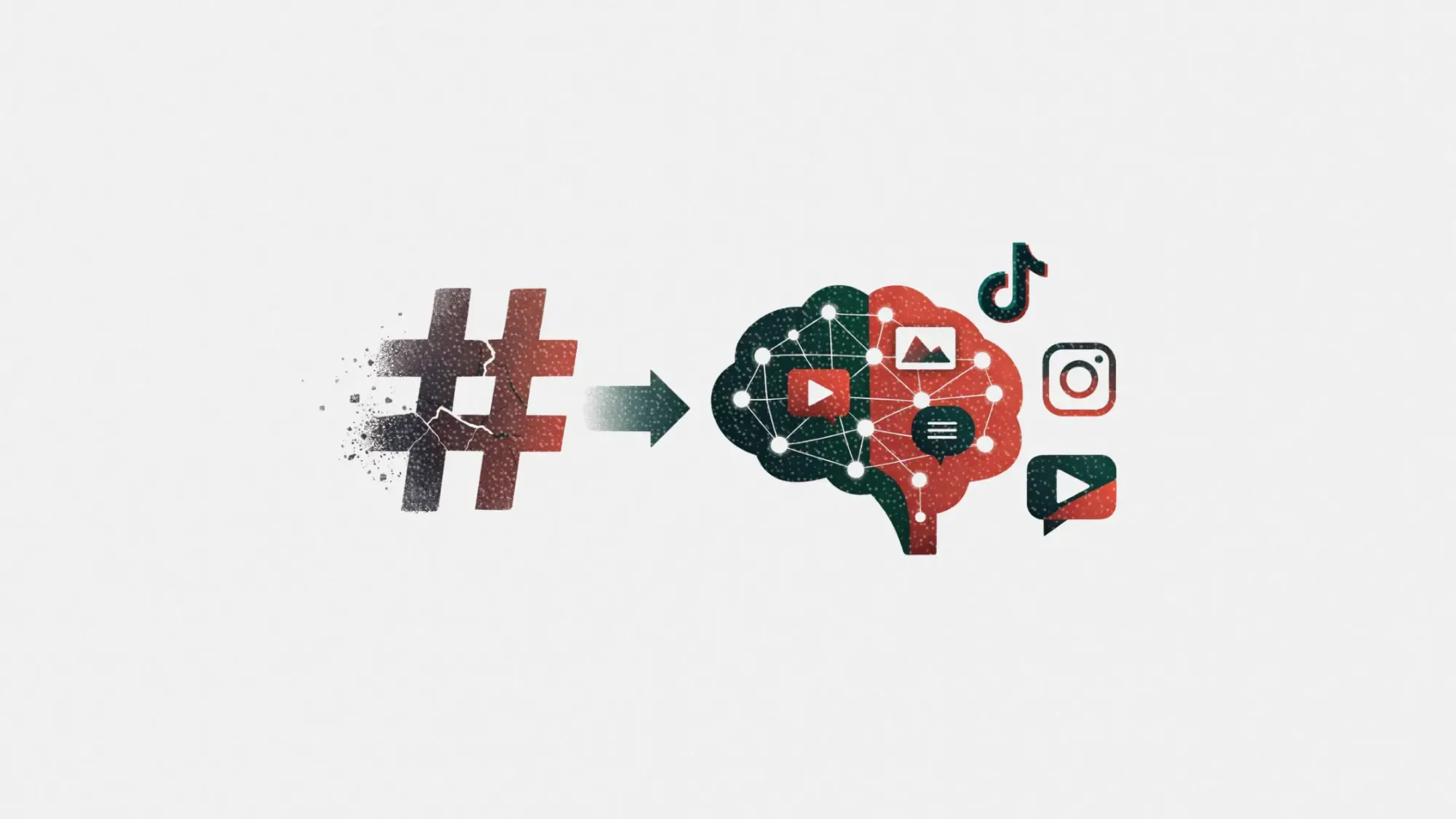
Hashtags once sat at the center of social media strategy, acting as the primary way marketers signaled what their content was about. That era is quietly ending.
For B2B marketers and PR professionals, this is not just a tactical update. It is a structural change in how visibility is earned.
As Marcus Willis, CEO of Kill Boring Dead, puts it: “Hashtags aren’t dead, but they’re on life support.”
This article explores how AI-driven algorithms are replacing hashtags with deeper content understanding, and what that shift means for marketers navigating modern discovery systems.
Short on time?
Here’s a table of contents for quick access:
- Why hashtags are losing relevance in AI-driven discovery
- How platforms now interpret content without manual tagging
- Why context and engagement signals now drive performance
- What marketers should know about content strategy in the AI era
 Patrecia Meliana
Why hashtags are losing relevance in AI-driven discovery
For years, hashtags acted as a form of manual metadata. Marketers used them to categorize content and help platforms match posts with the right audiences. That system worked when algorithms needed explicit signals to understand content.
That dependency is now largely gone.
Experts interviewed by MARKETING-INTERACTIVE describe hashtags as being “on life support,” reflecting how little influence they now have on visibility and reach.
“Most marketers are still treating them like it’s 2018. The platforms have moved on. The algorithms have moved on. The audience has moved on,” Willis says.
Platforms like TikTok and Instagram no longer rely on tags to determine distribution. Instead, they evaluate what the content actually is and how users interact with it.
Luke Gosha, Head of Search and AI Strategy at Edge Marketing, reinforces this shift: “Historically, they were the primary way a publisher told an algorithm how to categorise a piece of content. Today, the algorithms have advanced in their ability to understand content.”
The implication is clear: tagging is no longer a growth lever. It is, at best, a secondary signal.
 Patrecia Meliana
How platforms now interpret content without manual tagging
Modern discovery systems are built on AI models that analyze content directly.
“AI can now read your content the way a human does,” Willis explains. “It understands what the video is about, what tone it’s taking, who’s likely to care.”
This includes:
- Speech-to-text analysis of spoken words
- Visual recognition of objects and scenes
- Natural language understanding of captions
- Behavioral signals like watch time, shares, and rewatches
Bryce Coombe, Managing Director at Hypetap, describes it as a fully automated evaluation process: “Content is now assessed automatically via image recognition, speech to text, caption search and a range of other signals.” Instead of indexing content based on labels, platforms interpret it holistically.
This marks a shift from explicit categorization to inferred understanding. Algorithms now assess tone, relevance, and audience fit without needing marketers to define them manually.
The takeaway is blunt, again from Willis: “You don’t need to tag it, you need to make it good.”
 Patrecia Meliana
Why context and engagement signals now drive performance
If hashtags are fading, what replaces them is harder to control and more powerful. Context.
“A piece of content that taps into something people actually care about right now will outperform a perfectly hashtagged post every single time,” Willis says.
Performance is increasingly driven by:
- Context: cultural relevance, timing, and alignment with current conversations
- Engagement: watch time, comments, shares, and saves
- Content quality: clarity of message, emotional resonance, and audience fit
A well-timed post that taps into audience interest will outperform a perfectly tagged post every time.
Miki Sim, Platforms and Culture Director at VaynerMedia APAC, frames the shift in technical terms: “The real shift is from structured tagging to behavioural and contextual signals.”
And perhaps the most confronting insight comes from performance itself.
“If hashtags disappeared tomorrow, would performance actually change? For most brands, barely,” Willis says.
Even in B2B environments like LinkedIn, the same trend is emerging. While hashtags still play a minor role, performance is increasingly tied to dwell time and meaningful interactions rather than structured tagging.
 Atikah Amalia
What marketers should know about content strategy in the AI era
This transition demands a rethink of how content is created and optimized. Here are key adjustments marketers should consider:
1. Focus on content comprehension, not categorization
Write and produce content that is inherently clear in its message. AI systems are parsing meaning directly, so clarity beats clever tagging.
2. Optimize for engagement signals
“The content that performs does so because of what it is, the hook, the context, the emotional signal, the watch time,” Willis says. Design content to hold attention. Strong hooks, storytelling, and audience relevance now matter more than keyword placement.
3. Use hashtags strategically, not habitually
Hashtags still have niche value for campaign aggregation, events, or community building. But they should not be treated as a primary discovery tool.
4. Align with real-time context
Monitor trends, audience sentiment, and cultural moments. Contextual relevance is becoming a key ranking factor.
5. Prepare for AI-driven discovery beyond social platforms
Discovery is expanding into conversational AI. When users ask AI tools for recommendations, hashtags are irrelevant. What matters is how well your content can be understood and matched to intent.
“The next frontier takes this even further. Brand discovery is increasingly happening directly on conversational AI,” Sim says.
 Atikah Amalia
Hashtags have not disappeared, but their role has fundamentally changed. They have shifted from being a core discovery mechanism to a supporting, often optional layer.
The bigger story is the rise of AI systems that interpret content like humans do, prioritizing meaning, context, and engagement over labels. For marketers, this means moving beyond tactical optimizations and focusing on substance.