If your mental image of an influencer involves a Ring light, a skincare routine, and a promo code, you are thinking about the wrong category. B2B influencer marketing looks nothing like that.
It looks like a former VP of Engineering with 6,000 LinkedIn followers whose posts consistently reach the CTOs your sales team has been trying to get in front of for six months. It looks like an independent SaaS operator whose newsletter on revenue operations lands in the inbox of the exact buyers your paid campaigns cannot reach. It looks like a supply chain analyst who turned her Substack into a community of 12,000 procurement professionals.
B2B influence is built on expertise and trust, not reach and entertainment. That distinction changes everything: how you find creators, how you brief them, how you measure success, and which platforms you prioritize. A B2B marketer who borrows the B2C influencer playbook wholesale will waste the budget and wonder why it is not working.
This guide builds the framework from the ground up: what B2B influencer marketing actually is, why the data behind it is stronger than most marketers realize, which creator types produce real pipeline impact, how LinkedIn became the defining B2B influence platform, and how to structure a program that earns budget renewal.
Table of contents
Jump to each section:
- The definition that actually matters for B2B
- Why B2B influencer marketing is no longer optional
- The five types of B2B influencers
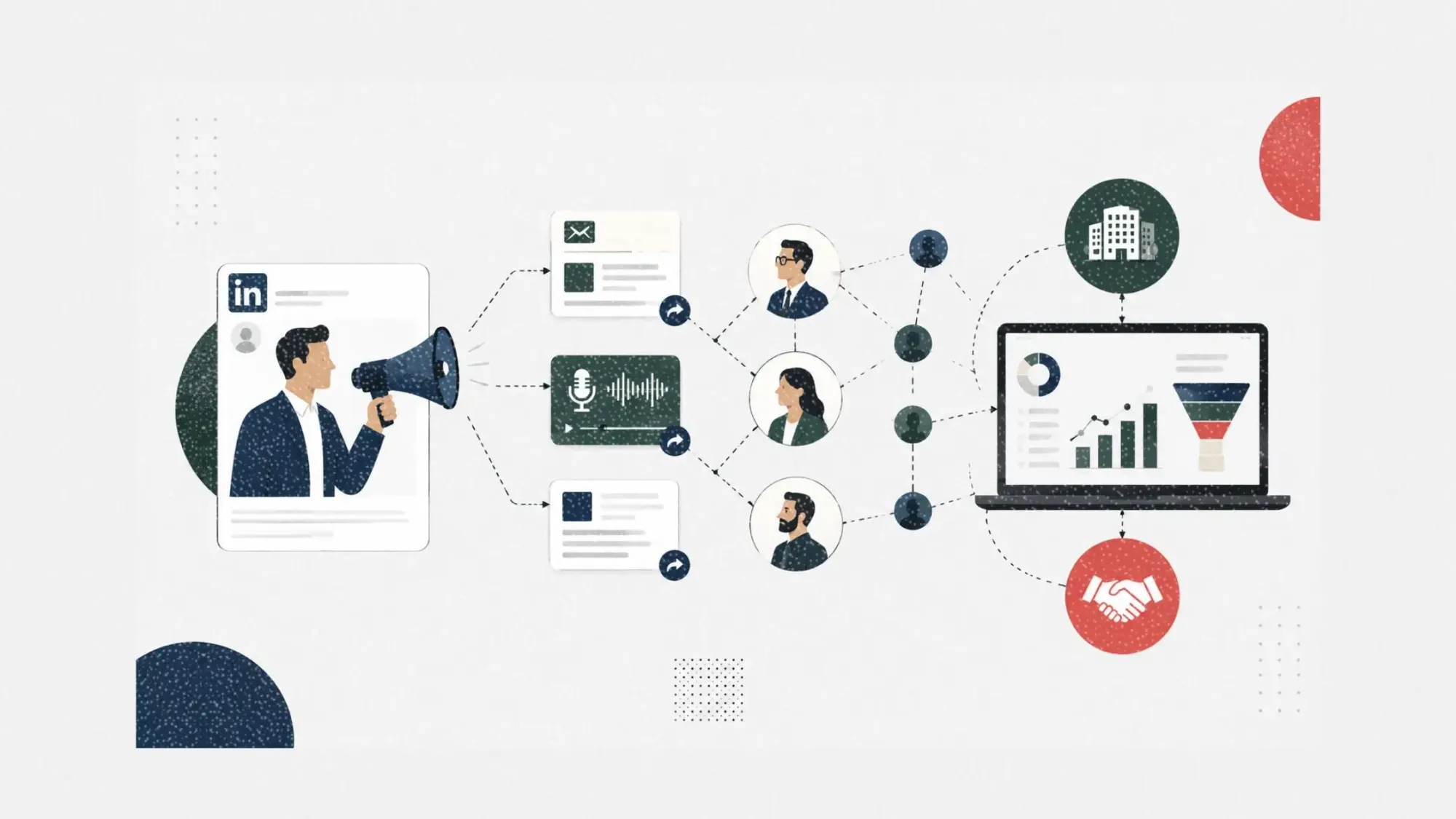
- LinkedIn as the primary B2B influence platform
- How B2B influencer marketing differs from B2C
- What B2B influencer marketing looks like in practice
- How to build your first B2B influencer program
- The metrics that prove B2B influencer value
- The category is still early enough to matter
The definition that actually matters for B2B
B2B influencer marketing is the practice of partnering with credible industry experts, executives, practitioners, or creators to reach decision-makers, build trust, and influence complex buying decisions. It relies on expertise, consistency, and relevance rather than mass reach or entertainment value.
That definition holds three important words that separate it from every B2C adjacent interpretation: credibility, decision-makers, and complex.
Credibility in B2B is earned through demonstrated expertise, professional track record, and the quality of one’s ideas, not through aesthetic consistency or follower growth. A data scientist with 8,000 followers who publishes original analysis on machine learning adoption in enterprise software has more B2B credibility than a 500,000-follower generalist business creator who posts motivational content.
Decision-makers change the targeting logic entirely. B2B purchases involve an average of six to ten stakeholders per buying committee, according to research from Gartner. Your influencer program needs to reach procurement officers, IT directors, CFOs, and heads of operations, not the broadest possible audience. Precision matters more than scale.
Complex buying decisions unfold over months, not minutes. A B2B buyer who sees a creator’s LinkedIn post in January might not enter a sales process until April and close a deal in September. The influence is real, but it operates on a timeline that bears no resemblance to an e-commerce conversion.
Why B2B influencer marketing is no longer optional
The data on B2B creator marketing has shifted decisively in the past two years. These are not emerging signals. They are documented behaviors that describe how B2B buying already works.
According to LinkedIn’s “Collaborate with Confidence: Your Guide to B2B Creator Marketing” report, as covered by Search Engine Land, 79% of B2B buyers engage with creator content at least monthly and 82% say it influences their purchasing decisions. The same report found that 87% of B2B buyers prefer insights from industry influencers over traditional brand messaging. These figures come from a survey of 1,716 B2B buyers and business decision-makers responsible for purchasing IT, telecom, and technology products and services.
That last statistic carries specific weight. Nearly nine out of ten B2B buyers would rather hear from a credible practitioner than from your brand directly. This is not a soft preference. It is a fundamental challenge to the assumption that well-produced brand content can substitute for third-party credibility in complex B2B buying.
The adoption side of the market reflects this reality. B2B influencer marketing is the fastest-growing subcategory in the broader influencer industry, expanding 47% year-over-year according to Digital Applied’s 2026 influencer marketing data compilation. Eighty-five percent of US B2B marketers incorporate influencer marketing into their strategies, and 81% had dedicated budgets for it in 2024.
The ROI data is equally compelling, though it should be read with methodological caution. B2B influencer programs have demonstrated returns of 520% according to the TopRank Marketing 2025 B2B Influencer Marketing Research Report. That figure is a blended average across programs of varying sophistication, but even discounting for outliers, the directional case is clear: well-run B2B influencer programs consistently outperform most other awareness and credibility channels on a cost-per-outcome basis.
“What the data shows is that B2B buyers have already made a decision about who they trust before they ever speak to a sales team,” says Dinda Anandita, Account Director at content-led comms agency Content Collision. “By the time a qualified lead arrives in a sales pipeline, there is a high probability that a creator they follow has already shaped their perception of the category and the vendors in it. Brands that are not part of that conversation at the creator layer are starting every sales conversation from behind.”
The five types of B2B influencers
B2B influence does not come from a single creator archetype. The category is more diverse than most practitioners realize, and each type serves a different function in the buying journey.
Industry analysts and researchers
Analysts at firms like Gartner, Forrester, and IDC have always influenced B2B buying. The shift in 2025 and 2026 is that independent analysts, those who left institutional research to publish directly on LinkedIn, Substack, and podcasts, now carry comparable authority in many categories.
A former Gartner research director who publishes independently on enterprise data strategy reaches a smaller but often more targeted audience than their institutional counterpart, with significantly less brand friction in partnership conversations.
Analysts and researchers are most valuable at the early awareness and category definition stage of the buyer journey. Their content helps buyers understand the problem space before they are ready to evaluate vendors.
Practitioner operators
This is the fastest-growing and most underutilized B2B creator type. Operator-creators are working professionals, often heads of function, founders, or senior individual contributors, who build audiences around the problems they solve every day.
A head of growth at a Series B SaaS company publishing weekly breakdowns of acquisition experiments. A fintech CFO who shares how she evaluates software vendor proposals. A DevOps lead at a mid-market manufacturer documenting his infrastructure modernization.
Operator-creators typically have smaller audiences than analysts, but their audiences are professionally specific and high-intent. A cybersecurity platform reaching 4,000 CISOs through three operator-creator partnerships is more valuable than reaching 400,000 mixed professionals through a single macro-influencer.
According to a Refine Labs study, personal profiles generate five times more engagement than company pages for equivalent content, despite having fewer followers. Operator-creators have built their audiences on this dynamic and represent the most direct access point to professional decision-makers.
Thought leaders and executives
Executive thought leaders, typically CEOs, CMOs, or board-level professionals who publish consistently on strategy, leadership, and their industry’s future, occupy a different part of the influence ecosystem. Their content operates at the category level, shaping how buyers think about broad trends rather than specific purchase decisions.
For B2B brands, executive thought leader partnerships are most valuable for category creation and brand credibility. They are less suited to late-funnel influence and more suited to building the ambient awareness and category associations that eventually pull buyers toward certain vendor conversations.
Customer advocates
Existing customers who have achieved measurable outcomes with your product and are willing to share that publicly are among the most credible B2B influencers available. LinkedIn’s “Collaborate with Confidence” report identifies customers as one of the five B2B creator types buyers are actively watching, with 33% of buyers citing customer content as influential.
Customer advocate programs are structurally different from traditional influencer partnerships in that the relationship begins with product experience rather than audience reach. But the mechanism of influence is the same: a trusted third party validating a purchase decision.
Industry journalists and newsletter writers
Specialist B2B newsletters with dedicated professional audiences represent an underexplored partnership category. A newsletter covering enterprise procurement, sent weekly to 15,000 supply chain directors, is a high-precision channel for a vendor serving that market.
The editorial independence of newsletter writers tends to produce more credible coverage than straightforward sponsored posts, though it requires a different partnership structure: editorial contributions, data sharing, and expert access rather than briefed post creation.
LinkedIn as the primary B2B influence platform
LinkedIn is where B2B influencer marketing happens at scale. No other platform combines professional identity, verified employment context, and the content distribution dynamics that make creator content reach buyers in their professional mindset.
The platform data supports this positioning unambiguously. Video uploads on LinkedIn grew 34% year-over-year, and 63% of B2B buyers say video content influences their purchasing decisions, according to LinkedIn’s creator report.
Thought Leader Ads, which amplify individual creator content rather than brand page content, deliver a 252% higher click-through rate than conventional single-image ads. Newsletters on the platform grew 150% year-over-year and now reach 450 million-plus subscribers across active publications.
The behavioral data is equally clear. Fifty-nine percent of B2B buyers say they rely on LinkedIn specifically as their primary source for credible creator content, more than any other platform. Forty-four percent of buyers report using creator content on LinkedIn to justify pricing decisions. Thirty-eight percent say creator content prompted them to connect with a salesperson.
That last figure is worth pausing on. More than a third of B2B buyers have taken a direct sales action as a result of engaging with a creator’s LinkedIn content. This is not soft awareness. It is demonstrated pipeline influence at scale.
For B2B marketers planning their first influencer program or optimizing an existing one, LinkedIn is not one channel option among many. It is where the decision-makers your business depends on spend their professional attention, and where creator content has the most direct documented path to buying influence.
How B2B influencer marketing differs from B2C
Understanding what B2B influencer marketing is requires understanding what it is not, and specifically how it departs from the B2C model that most influencer marketing infrastructure was built around.
The primary differences fall into five areas.
- Creator selection criteria are inverted. In B2C, follower count and engagement rate are the primary discovery filters. In B2B, audience quality and professional specificity are the primary filters. A creator with 5,000 followers who reaches your exact ICP is more valuable than one with 500,000 followers who reaches a broad professional audience. Many of the best B2B creators have relatively modest follower counts by B2C standards and are invisible to tools built primarily around Instagram and TikTok discovery.
- Content briefs require more flexibility. B2B creators with genuine authority have built that authority through authentic, opinionated publishing. A prescriptive brand brief that tells an operator-creator exactly what to say and how to say it produces content that their audience immediately recognizes as inauthentic. The most effective B2B creator briefs provide context, data, and a clear point of view but give the creator genuine latitude to translate that into their own voice and format.
- Attribution timelines are fundamentally longer. The 72-hour attribution window common in B2C influencer campaigns is structurally incompatible with B2B sales cycles that run 90 to 180 days. B2B influencer programs require 90-day minimum attribution windows and CRM-level tagging to produce defensible ROI data. Programs measured against 30-day windows will consistently underreport value.
- Compensation models differ significantly. B2C influencer compensation is typically a flat fee per post, correlated with follower count. B2B compensation increasingly takes a hybrid form: a base creation fee combined with performance incentives tied to MQL volume, event registrations, or demo bookings. The performance component reflects the closer connection between creator content and measurable commercial outcomes in B2B.
- Success metrics are pipeline-oriented rather than awareness-oriented. The meaningful success metrics for B2B influencer programs are pipeline influence rate, cost per influenced opportunity, deal velocity comparison, and creator-attributed MQL volume. Impressions and engagement rate are context metrics, not success metrics.
What B2B influencer marketing looks like in practice
The gap between the definition and the execution is where most B2B influencer programs stall. Here is what a functional program looks like across three common use cases.
A product-led SaaS company partners with three to five operator-creators in its target vertical, typically providing early access to new features, relevant data for content creation, and a modest content fee. The creators publish independently about their experience using the product and the problems it solves, from their professional perspective rather than a brand brief. The brand tracks demo bookings and trial signups from creator-specific UTM links over a 90-day window.
An enterprise technology vendor builds a content partnership with two independent analysts covering their category. The analysts receive proprietary research data, executive access for interviews, and a content partnership fee. In exchange, the analysts incorporate the vendor’s perspective and data into their ongoing publications, credentialing the vendor in the analyst community where B2B buyers go for unbiased category guidance.
A professional services firm identifies ten customer advocates who have achieved documented outcomes with their service. These advocates are given LinkedIn content support, invited to co-author case study content, and featured in webinars and conference presentations. Their organic LinkedIn posts about their outcomes function as the most credible possible testimonials, reaching their professional networks rather than a brand audience.
In all three cases, the common thread is the same: a credible third party, trusted by a specific professional audience, engaging with your brand in a way that carries more weight with buyers than anything your brand publishes directly.
How to build your first B2B influencer program
For teams building from scratch, five sequential decisions determine the quality of the program before any creator conversations begin.
- Define your buyer first. Which specific job titles, industries, and company sizes represent your ideal customer? This is more granular than a typical ICP exercise. For a B2B influencer program, you need to know not just the buyer profile but the professional communities where those buyers gather information and form opinions.
- Identify where those buyers already consume creator content. For most B2B markets, this means LinkedIn, Substack newsletters, industry podcasts, and niche professional communities. Platform selection should follow buyer behavior, not channel familiarity.
- Map the creator ecosystem in your category. Who are the operators, analysts, and practitioners who already have the attention of your target buyers? Start with the people your own sales team and customers already follow and reference. Manual discovery through LinkedIn search, newsletter directories, and podcast guest lists typically surfaces more relevant candidates than most discovery platforms for highly specific B2B niches.
- Vet candidates against the B2B quality criteria covered in our influencer vetting guide. Audience professional specificity, comment quality, and engagement pattern consistency matter more than raw follower count.
- Build the measurement infrastructure before the first post goes live. This means creator-specific UTM parameters, a CRM tagging system for creator-influenced contacts, and a baseline measurement of your current demo booking rate and branded search volume. Without the baseline, you cannot prove lift. For a full measurement framework, see our guide to B2B influencer marketing ROI.
The metrics that prove B2B influencer value
The full measurement framework is covered in detail in our separate KPIs guide for B2B influencer programs. For a summary, the metrics that matter in B2B influencer programs fall into three categories.
- Pipeline metrics, which connect creator activity to revenue operations: pipeline influence rate, cost per influenced opportunity, deal velocity for creator-touched prospects, and creator-attributed MQL and SQL volume.
- Brand metrics, which capture the slower-building authority effects of creator programs: branded search volume lift, share of voice in relevant category search, and inbound lead quality scores over time.
- Content metrics, which inform program optimization: comment quality index, content-to-demo conversion rate on high-intent pages, and video completion rates for long-form creator content.
The programs that earn continued budget growth are the ones that report against all three categories with consistent methodology over multiple cycles. Single-campaign snapshots are too noisy to be persuasive. Trends across six to twelve months of always-on creator activity are what convert skeptical CFOs.
The category is still early enough to matter
The case for B2B influencer marketing is already well supported by data. Eighty-two percent of buyers are influenced by creator content. A 252% CTR advantage for Thought Leader Ads. A 47% year-over-year growth rate for the category. The strategic rationale is no longer arguable.
What remains genuinely early is execution maturity. Most B2B brands are not yet running structured, always-on creator programs with proper attribution infrastructure and professional CRM integration. Most are running occasional campaigns, measuring the wrong metrics, and concluding that influencer marketing does not work for B2B.
That gap between what the data shows and what most programs currently deliver is where the competitive opportunity sits. The brands that build proper B2B influencer infrastructure now, including the creator relationships, the measurement architecture, and the CRM integration, will be compounding that investment when their competitors are still debating whether the channel works.
The answer to that debate is already in the data. The remaining question is execution.