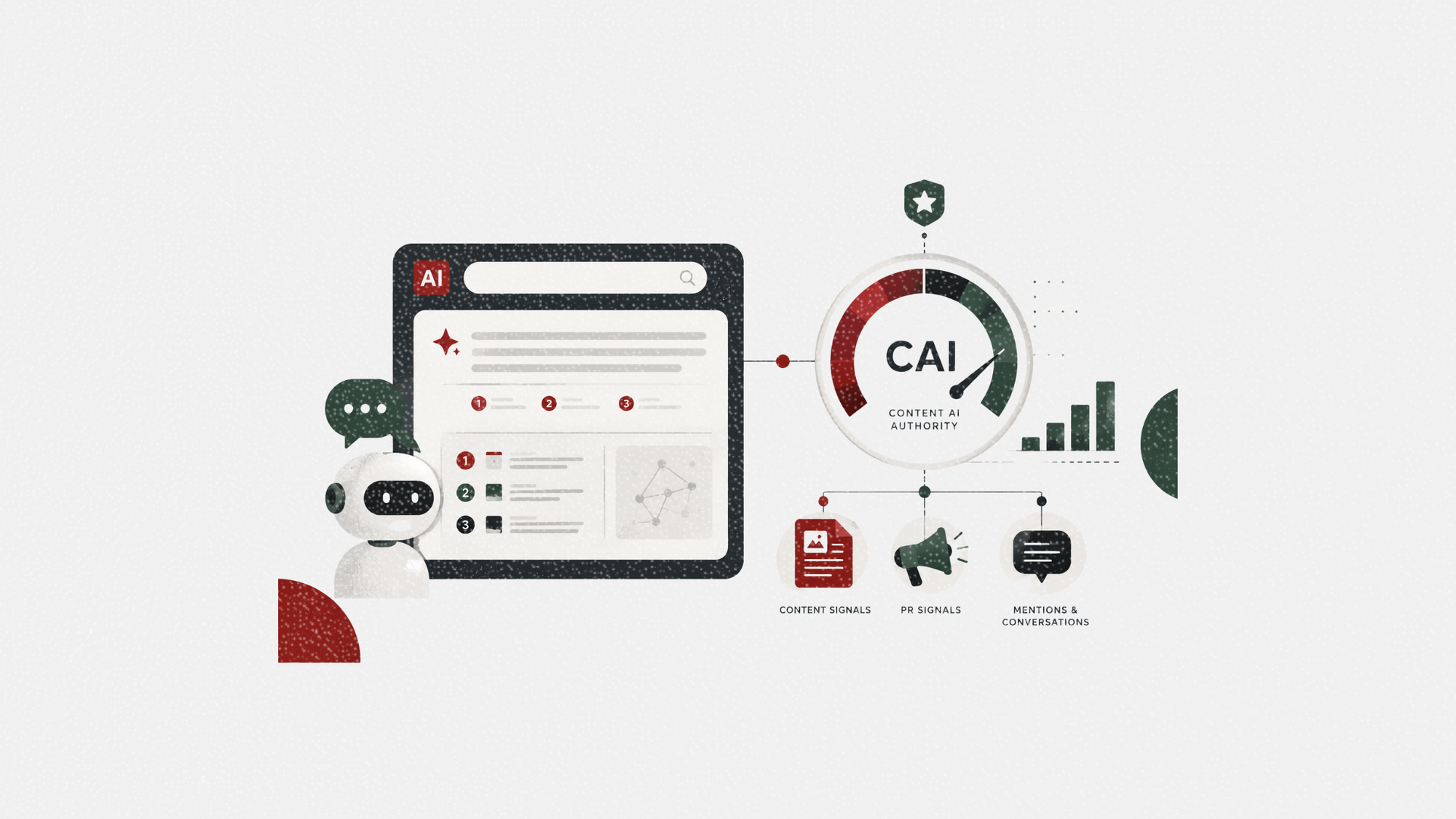
Skyword has launched Category Authority Index™ (CAI), a new metric inside its Accelerator360™ content marketing engine that helps enterprise marketers assess how their brands appear, get cited, and are positioned in AI-generated search responses.
The move lands as buyers increasingly rely on ChatGPT, Google AI Overviews, and other answer engines before visiting a brand website.
This article explores what CAI measures, why AI search visibility is becoming a board-level marketing issue, and how marketers should respond.
Table of contents
Jump to each section:
- What Skyword launched and why CAI matters
- How Category Authority Index measures AI search authority
- Why AI search visibility is not the same as authority
- What marketers should do before chasing AI citations
- What this means for content and PR teams
- The takeaway for marketers
 Patrecia Meliana
What Skyword launched and why CAI matters
Skyword’s Category Authority Index is designed to give cmos a single score for how much authority their brand holds in AI search conversations.
Instead of only tracking whether a brand appears in AI-generated answers, CAI looks at whether the brand is cited, associated with important category concepts, and described favorably or authoritatively.
“The reality is, traditional SEO metrics like rankings, traffic, and pageviews are no longer predictive of business outcomes,” said Andrew Wheeler, CEO of Skyword. “Buyers are forming opinions before they ever reach a brand’s website. As brands race to appear in AI search results, the real question isn’t just whether you show up, but whether you own shaping the answers driving those decisions. If marketers don’t define their brand’s unique perspective and build authority, they risk being left out of the conversation entirely.”
That distinction matters. A brand can show up in AI search without shaping the answer. Skyword is betting marketers will need to prove not just visibility, but influence.
How Category Authority Index measures AI search authority
CAI combines four signals:
- Presence and share of model: how often a brand appears in AI responses to high-intent, non-branded questions.
- Citation yield: how often AI systems cite the brand’s own content when mentioning it.
- Entity strength: how strongly the brand is connected to core category concepts.
- Narrative sentiment and favorability: how positively or authoritatively the brand is described.
The metric sits within Skyword’s Accelerator360™ platform, alongside its Category Authority Standard™ and Category Authority Ladder™ framework.
Why AI search visibility is not the same as authority
Traditional SEO taught marketers to chase rankings, traffic, and pageviews. AI search makes that playbook messier.
When buyers get answers directly from AI tools, the click may never happen. That makes old performance signals less reliable as proxies for trust, consideration, or purchase intent.
CAI reflects a bigger shift: marketers now need to understand how machines interpret their expertise. The new question is not “did we rank?” It is “did the answer engine trust us enough to use us?”
What marketers should do before chasing AI citations
Before teams obsess over AI visibility dashboards, they should tighten the content foundation.
- Define the category narrative: make it painfully clear what your brand believes, solves, and stands against.
- Build expert-led content clusters: AI systems are more likely to surface brands with consistent, specific, and well-structured authority.
- Audit citation-worthy assets: research pages, explainers, benchmarks, and original insights are more useful than thin blog posts.
- Track branded and non-branded prompts: buyers rarely search the way marketers write positioning decks.
- Align PR and content teams: earned media, owned content, and analyst-style thought leadership now all feed the same authority layer.
What this means for content and PR teams
For content teams, CAI points to a future where authority measurement becomes less about page performance and more about category influence.
For PR teams, it raises the stakes around narrative consistency. If AI systems summarize your market, they may also summarize your brand’s role in it. Weak positioning will not age well in that environment.
The practical move is to treat AI search as a reputation channel, not just another SEO surface.
The sharp marketers will not wait for traffic declines to prove the shift is real. They will start building content that AI systems can understand, cite, and trust.