If you’ve ever handed a writer a topic and a keyword and called it a brief, I get it. That’s how a lot of content teams start. But there’s a point where that approach stops scaling, and the first signal is usually a pile of articles that rank for nothing and connect to nothing.
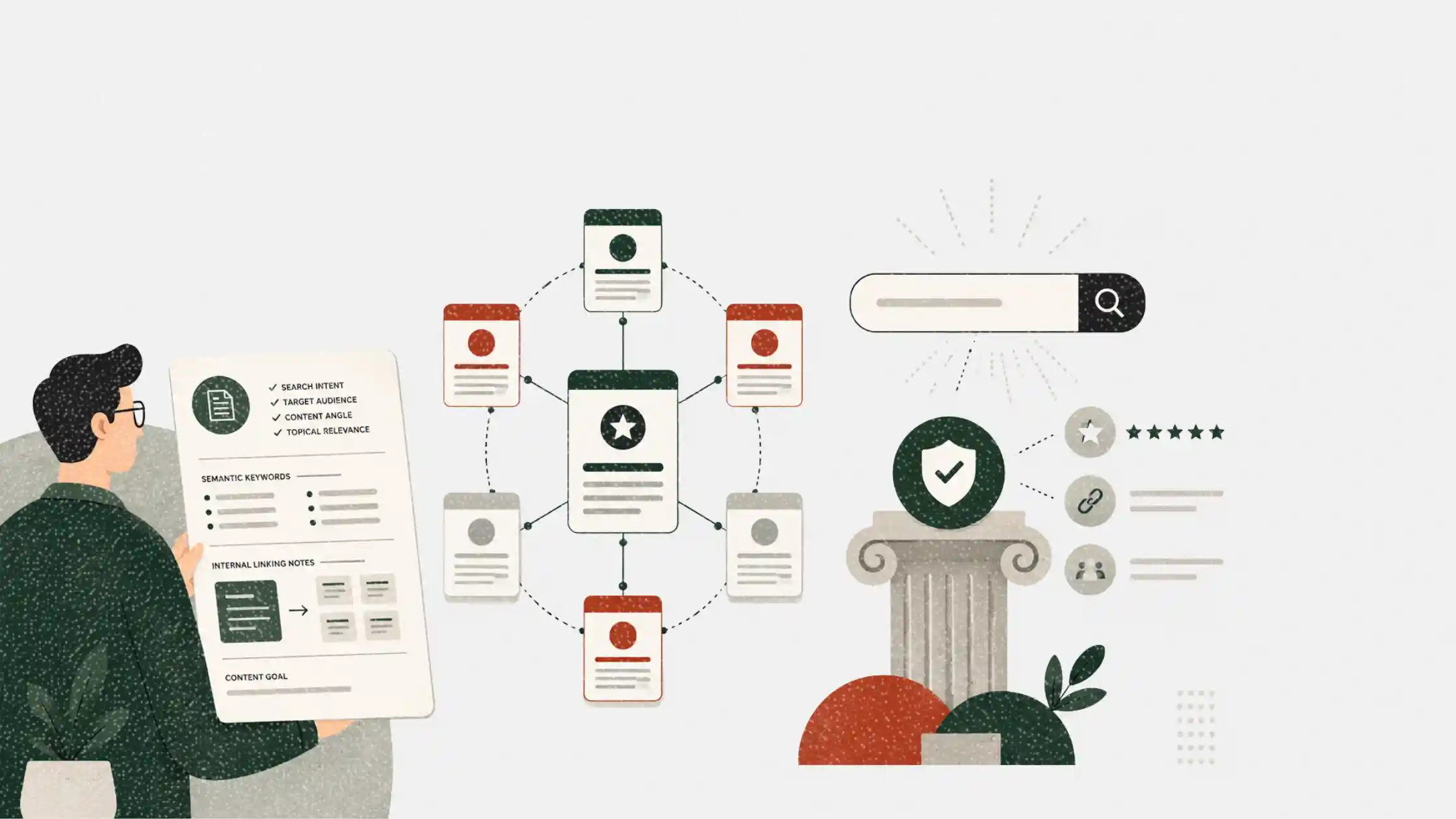
A proper SEO content brief does more than tell a writer what to cover. It anchors each piece of content inside a bigger system so that Google (and your readers) can see you as a credible source on a subject, not just a blog with a lot of posts.
This article walks through how to build that kind of brief, with the topical authority logic baked in from the start.
Table of contents
Jump to each section:
- Why topical authority changes how you write a brief
- The anatomy of a topical authority-oriented brief
- How to build briefs at scale without losing quality
- The briefing mistake that undermines topical authority
- A quick checklist before you ship the brief
Why topical authority changes how you write a brief
Most content briefs are built around a single keyword. The brief exists to help one page rank for one term. That worked well when Google was primarily a keyword-matching machine.
Search has moved past that. In 2025, keyword matching is no longer the only lever for organic success. While keywords still matter, they’re now part of a broader equation centered around topical authority. Search engines prioritize depth, consistency, and content relationships over isolated keywords.
What this means practically: a content brief today needs to serve the individual article AND the larger content ecosystem it belongs to. You’re not just briefing a post. You’re briefing a node in a network.
Long-form content is especially effective for building that network. Articles over 2,000 words generate 77% more backlinks than shorter ones and tend to rank for more long-tail keywords. Those long-tail queries drive around 70% of all search traffic, so covering topics in depth not only attracts links, it boosts overall visibility.
That’s the business case for building briefs with depth in mind.
The anatomy of a topical authority-oriented brief
Here’s what a well-built brief needs to include, and why each element matters.
1. Cluster position
Before anything else, the brief should define where this article sits in your content cluster. Is it a pillar page? A supporting article? A comparison piece? A definition page?
This single decision shapes everything from word count to how many internal links you’re targeting. A pillar page covering “influencer marketing strategy” will be structured very differently from a supporting article on “how to brief an influencer for a product launch.”
Label it clearly at the top of every brief. Writers who understand the piece’s structural role make better decisions throughout the draft.
2. Primary keyword and search intent
This part most teams already do. The gap is usually intent.
A keyword like “content brief template” could mean someone wants to download one, read about what goes in one, or understand why they need one at all. The intent signals how to frame the angle, what format works best, and where the article should lead the reader next.
Map the intent before writing the keyword target. Then write the keyword target.
3. Secondary keywords and semantic coverage
Sites demonstrating clear, in-depth knowledge across a topic are more likely to show up for both head terms and long-tail variations. The way you build that signal is through semantic coverage, not keyword stuffing.
Your brief should list 5 to 10 related terms and questions the article should address. These come from “People Also Ask” sections, competitor outlines, and keyword tools. The goal is not to force those terms into the copy. It’s to make sure the writer addresses the full scope of the topic so the article reads as genuinely thorough.
4. Suggested word count with reasoning
Don’t just drop in a number. Explain why. A 1,200-word brief for a definition article makes sense. A 2,500-word minimum for a pillar page also makes sense, but for different reasons. When writers understand the reasoning, they make better editorial decisions under pressure.
Use competitor analysis as a baseline, then adjust up if you want to go deeper on the topic.
5. Internal linking targets
This is the part most briefs skip, and it’s where topical authority gets built or broken.
Every brief should specify two to three existing articles to link out to, plus a note on what the anchor text context should look like. It should also flag whether this article is expected to receive links from future pieces.
A well-structured content cluster enhances topical authority, improves SEO performance, and provides a valuable resource for your audience. Ensure that supporting content links to the pillar page and to each other where relevant.
Think of internal links as the connective tissue that makes your content ecosystem legible to search engines. A brief that ignores this misses the point.
6. E-E-A-T signals to include
Google’s quality guidelines emphasize Experience, Expertise, Authoritativeness, and Trust. Your brief should push writers toward including signals that demonstrate this: first-hand observations, cited data, named sources, or quotes from subject matter experts.
This is especially relevant if you’re producing content under your brand’s name or under a specific author byline. Generic information assembled from other articles doesn’t build authority. Specific insight, original angles, and cited data do.
7. AI citation opportunity
This one is becoming increasingly important. 97% of AI Overviews cite at least one source from the top 20 organic results, underscoring how closely AI Overview visibility aligns with traditional SEO rankings.
If your brief targets an informational query, there’s a real chance the finished article could get cited in AI Overviews. That happens when the content is structured clearly, answers the question directly, and demonstrates authority on the subject.
Include a note in your brief on whether there’s an opportunity to structure the opening paragraphs as a direct, citable answer to the primary query.
How to build briefs at scale without losing quality
Here’s the tension most content teams hit: the brief process I just described sounds like a lot of work per article. It is, if you do it from scratch every time.
The fix is templates tied to content types. A pillar brief template. A supporting article template. A comparison page template. Each one has the same fields but different defaults, depth requirements, and internal linking logic.
Once those templates exist, building a brief becomes a research and strategy task rather than a formatting task. The writer gets consistent guidance. The strategist spends time on the actual thinking.
The briefing mistake that undermines topical authority
The most common mistake is treating each article as independent. A brief that only optimizes for one article’s performance, without thinking about how it connects to the rest of the site, produces a content library that looks unstructured to search engines.
The sites that rank best are those with structured, topic-driven ecosystems of content, not one-off blog posts.
A brief that doesn’t define cluster position, doesn’t specify internal linking targets, and doesn’t consider semantic coverage contributes to content sprawl rather than topical depth. Over time, that’s the difference between a site that earns consistent rankings on a subject and one that gets sporadic traffic from disconnected posts.
A quick checklist before you ship the brief
Before any brief goes to a writer, run through these:
- Cluster position defined (pillar, supporting, comparison, etc.)
- Primary keyword and intent mapped
- 5 to 10 secondary terms and related questions included
- Word count with rationale explained
- 2 to 3 internal link targets specified with anchor context
- E-E-A-T signals identified (data, quotes, first-hand angle)
- AI citation opportunity noted if applicable
That’s the foundation. Some teams add more (competitor URLs, tone guidance, CTA direction), but those eight points are where topical authority starts at the brief level.
A content brief is a planning document, but it’s also a strategic signal. It tells your writers what the content is for, where it fits, and what success looks like beyond word count and keyword inclusion.
Teams that invest in briefs built around topical authority don’t just rank individual articles better. They build sites that search engines learn to trust on specific subjects, and that kind of compound trust is what separates content programs that grow over time from ones that plateau.