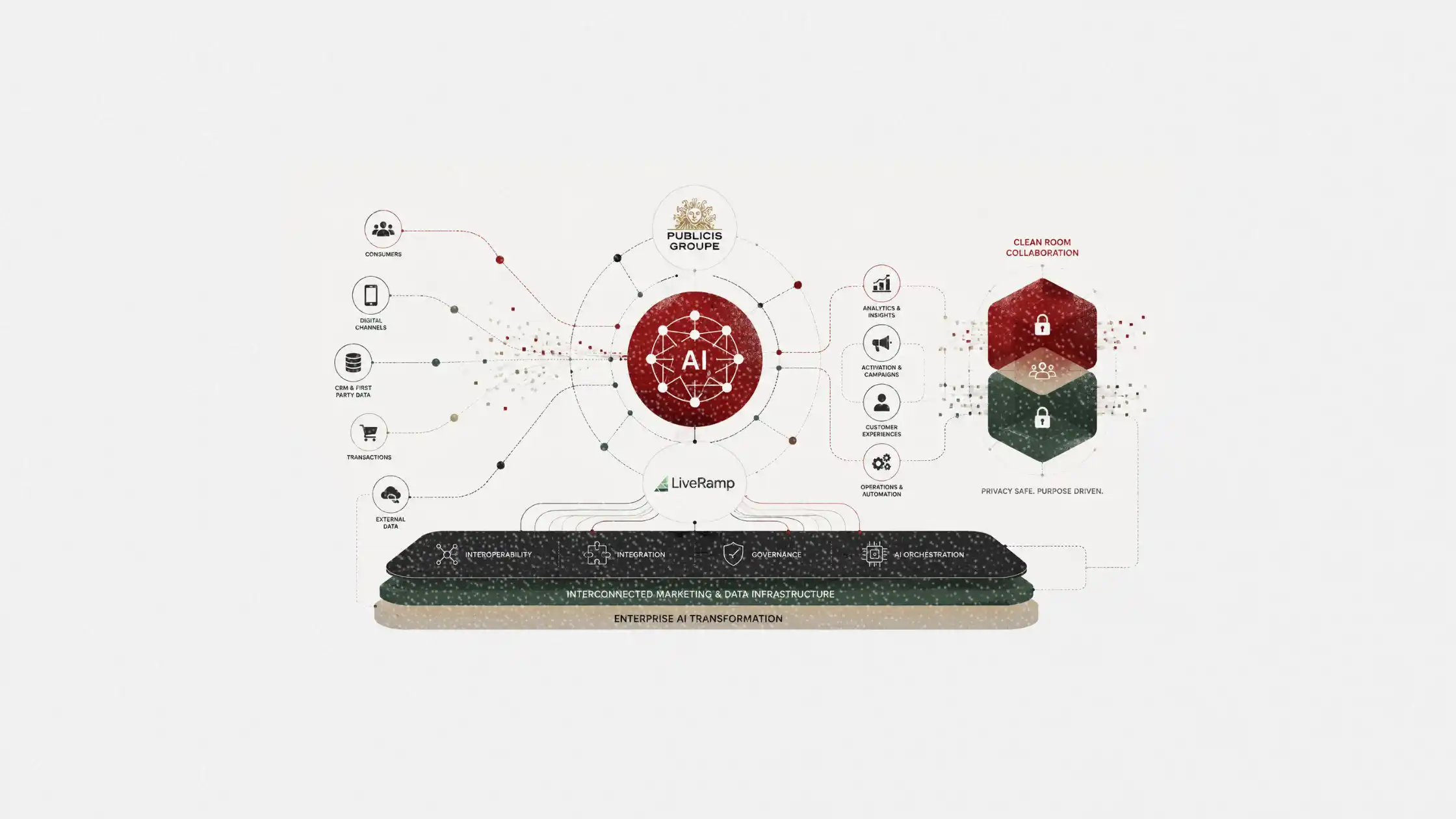
Publicis Groupe is making another major bet on the future of AI-driven marketing infrastructure. The company announced plans to acquire LiveRamp in an all-cash deal valued at approximately US$2.2 billion, positioning the move as a way to accelerate “data co-creation” and enterprise AI transformation.
The acquisition signals something bigger than another martech consolidation play. Publicis is effectively building an integrated stack that combines identity resolution, data collaboration, AI activation, and enterprise transformation under one ecosystem.
For marketers navigating fragmented customer data and rising AI expectations, this deal could reshape how enterprise marketing agents are trained, deployed, and optimized.
Table of contents
Jump to each section:
- Why Publicis is acquiring LiveRamp
- How data co-creation could reshape AI marketing infrastructure
- What marketers should know about Publicis’ AI strategy
- Why this matters for martech, privacy, and enterprise AI
- What happens next for LiveRamp and Publicis
Why Publicis is acquiring LiveRamp
Publicis Groupe announced that it has entered into an agreement to acquire LiveRamp for a total enterprise value of approximately US$2.167 billion in an all-cash transaction priced at US$38.50 per share. The deal represents a nearly 30% premium over LiveRamp’s closing share price on May 15, 2026.
The acquisition is designed to strengthen Publicis’ position in AI, identity, and data collaboration. According to the company, combining LiveRamp with Epsilon, Publicis Sapient, and Marcel creates a more comprehensive infrastructure for enterprise AI agents and “agentic business transformation.”
LiveRamp brings a significant footprint to the table:
- Connectivity across more than 25,000 publisher domains
- Over 500 technology and data partners
- Operations across 14 markets
- Thousands of participating brands, retailers, media platforms, and publishers
- A highly recurring revenue model with a reported five-year CAGR of 13%
Publicis also raised its long-term financial outlook as part of the announcement. The company now expects stronger net revenue growth and headline EPS growth for 2027 and 2028, largely tied to expanded AI and data capabilities.
How data co-creation could reshape AI marketing infrastructure
One of the most important ideas in this acquisition is “data co-creation.”
Publicis describes data co-creation as the process of securely connecting multiple high-value datasets across organizations to generate new proprietary data assets. Instead of relying solely on internal CRM or media data, companies can combine signals from partners, commerce ecosystems, payment networks, healthcare systems, or retailers without exposing raw sensitive data.
That matters because AI agents are only as effective as the data feeding them.
Publicis claims that 93% of companies still lack the right data foundation for successful AI deployment. LiveRamp’s clean room and interoperability infrastructure could help address that gap by enabling privacy-conscious collaboration between brands, platforms, and enterprise systems.
The company outlined several use cases:
- Financial institutions creating AI wealth management agents using secure banking and merchant data
- Retailers building retail journey agents across CRM, loyalty, and retail media ecosystems
- Pharmaceutical companies optimizing therapeutic marketing and field-force deployment using co-created healthcare signals
This is where the deal moves beyond traditional adtech.
Publicis is positioning AI agents not merely as campaign automation tools, but as enterprise operating layers fueled by shared, continuously updated intelligence. That could have major implications for personalization, attribution, forecasting, media optimization, and customer lifecycle management.
What marketers should know about Publicis’ AI strategy
For marketers, this acquisition highlights several broader shifts happening across martech and enterprise AI.
1. Identity is becoming foundational again
The industry’s shift away from third-party cookies never eliminated the need for identity resolution. It simply changed the architecture.
Publicis already strengthened its identity capabilities with the acquisition of Epsilon in 2019. Adding LiveRamp expands interoperability and collaboration across external ecosystems, making identity graphs more dynamic and useful for AI systems.
Marketers should expect future AI tools to rely heavily on unified identity layers tied to first-party and partner data.
2. AI agents are moving toward enterprise orchestration
Most marketers still think of AI in terms of assistants, chatbots, or content generation.
Publicis is betting on something much larger: AI agents that coordinate workflows, business functions, customer journeys, and decision-making across entire organizations.
That means marketers may soon need to evaluate:
- Whether their customer data infrastructure is AI-ready
- Which systems can securely participate in data collaboration
- How governance and privacy frameworks support AI activation
- Whether their martech stack can support interoperable AI agents
3. Clean rooms are becoming strategic infrastructure
Data clean rooms have often been treated as niche privacy tools for large advertisers. This acquisition suggests they are becoming central AI infrastructure.
As regulators tighten privacy requirements and platforms restrict data portability, clean-room collaboration may become one of the few scalable ways to train AI systems using shared commercial intelligence without violating compliance rules.
Why this matters for martech, privacy, and enterprise AI
The Publicis-LiveRamp deal reflects a larger trend: holding companies and enterprise consultancies are racing to become AI infrastructure providers, not just service vendors.
That changes competitive dynamics across:
- Advertising agencies
- Cloud providers
- CDPs
- Retail media networks
- Identity platforms
- AI workflow vendors
- Enterprise data providers
There’s also a privacy angle marketers cannot ignore.
Publicis repeatedly emphasized governance, anonymization, tokenization, and interoperability throughout the announcement. That messaging is intentional. AI-driven personalization is increasingly colliding with regulatory scrutiny, especially as brands seek richer behavioral data for autonomous systems.
The challenge for marketers moving forward will be balancing:
- AI performance
- Data accessibility
- Consumer trust
- Regulatory compliance
- Cross-platform interoperability
The winners may not necessarily be the companies with the biggest AI models, but the ones with the most usable and permissioned data ecosystems.
What happens next for LiveRamp and Publicis
Following the acquisition, LiveRamp will continue operating as a neutral and interoperable platform under ceo Scott Howe, who will report directly to Publicis ceo Arthur Sadoun.
Publicis stated that:
- Existing customers and partners will retain access to LiveRamp services
- Commercial practices and pricing structures will remain unchanged in the normal course of business
- LiveRamp’s neutrality and privacy commitments will continue post-acquisition
Whether the broader ecosystem fully embraces that neutrality remains to be seen.
Competitors, publishers, and enterprise brands may eventually question how independent a data collaboration platform can remain once owned by one of the world’s largest advertising groups. Still, Publicis clearly understands the risk and appears determined to reassure the market early.
For marketers, though, the bigger takeaway is clear: AI competition is rapidly shifting toward data ecosystems, interoperability, and enterprise orchestration. The companies that control secure collaboration layers may end up shaping the next phase of marketing AI.