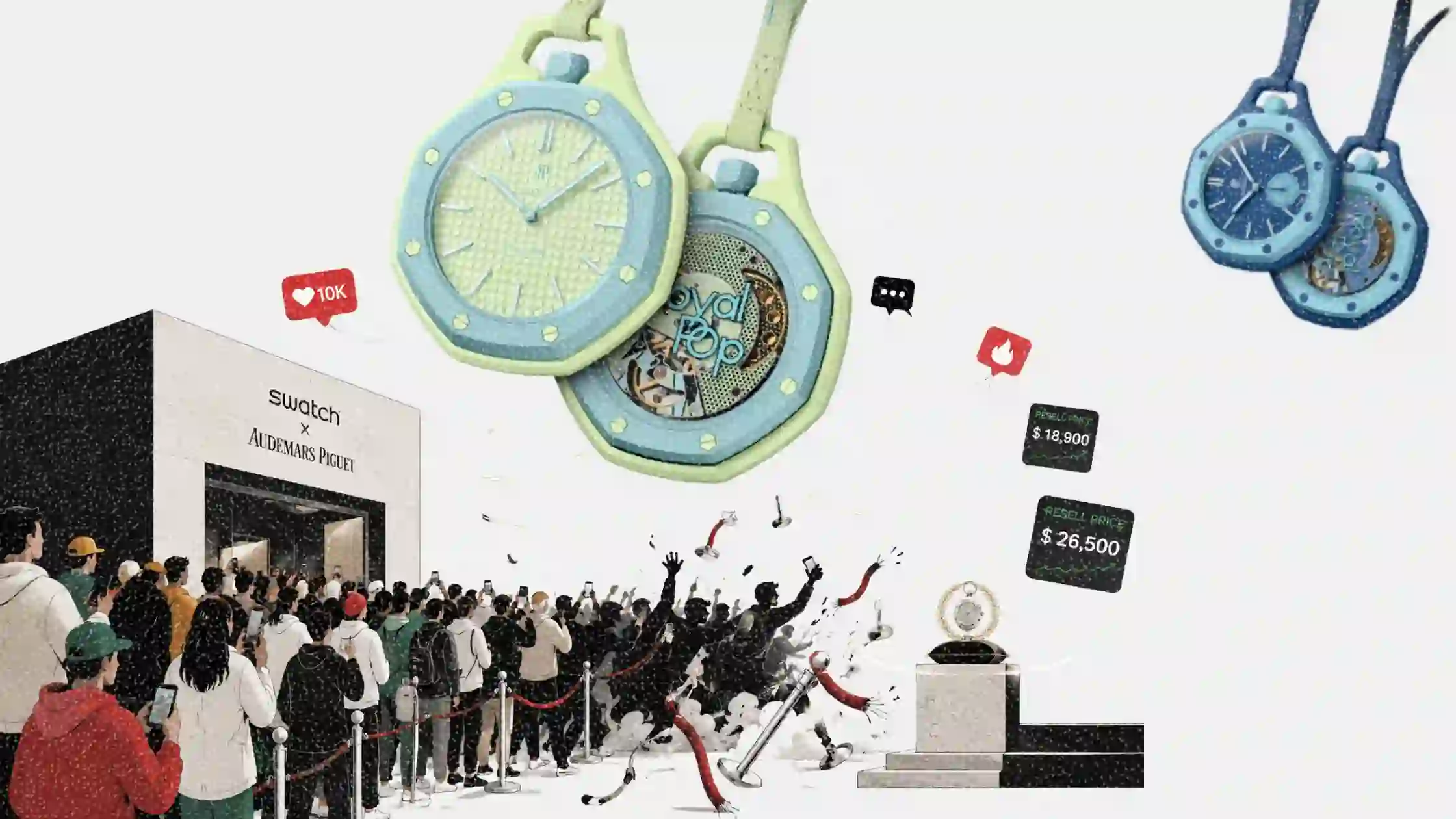
The Swatch x Audemars Piguet “Royal Pop” collection has triggered overnight queues, police interventions, store closures, and resale madness across major cities worldwide. From Singapore and Kuala Lumpur to London, Milan, and New York, the launch blurred the line between product release and cultural spectacle.
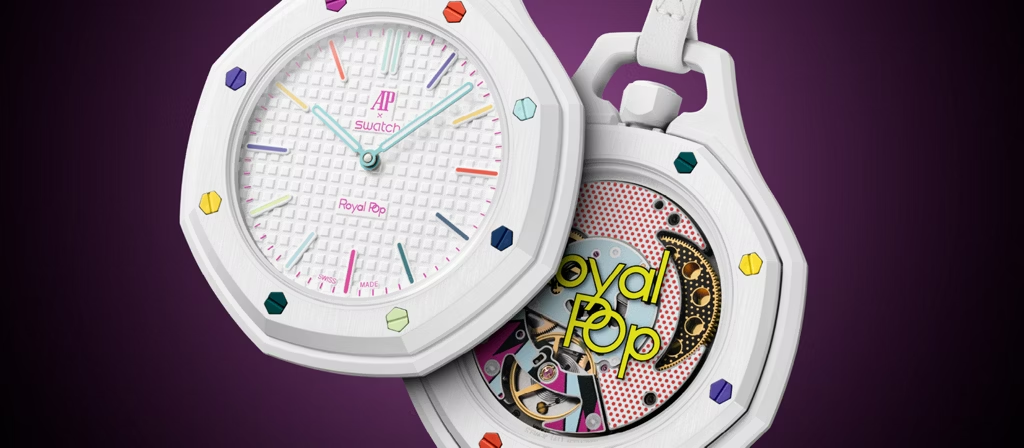
For marketers, the frenzy goes beyond watches. It highlights how modern collaborations are increasingly engineered around social participation, scarcity, and emotional access to luxury. Consumers were not simply buying a timepiece. They were buying proof that they were part of the moment.
This article explores why the Swatch x AP collaboration exploded globally, why it feels different from previous luxury crossovers, and what marketers should learn from the chaos.
Table of contents
Jump to each section:
- Why the Swatch x AP Royal Pop launch became a global frenzy
- Why the AP collaboration feels different from MoonSwatch
- How scarcity, resale culture, and social currency fueled demand
- What marketers should know about hype-driven collaborations
- Why operational failures can damage cultural marketing wins
- The bigger shift: luxury brands are becoming cultural platforms
 Patrecia Meliana
Why the Swatch x AP Royal Pop launch became a global frenzy
The launch of the Swatch x Audemars Piguet “Royal Pop” collection generated massive crowds across Europe, Asia, the Middle East, and the US. Consumers queued overnight, some for several days, hoping to secure one of the brightly colored pocket watches priced around US$400.
In several cities, the situation escalated into disorder. Reports emerged of fights, queue-jumping disputes, crowd surges, and police intervention. Swatch stores in parts of the UK temporarily closed over safety concerns, while authorities in France reportedly deployed tear gas to disperse crowds outside stores near Paris.
The intensity mirrors the viral Omega x Swatch MoonSwatch release from 2022, but many industry observers believe this collaboration crossed into an even bigger cultural moment.
Part of the reason comes down to how the partnership combines accessibility and aspiration. Consumers who could never realistically purchase an Audemars Piguet Royal Oak worth tens of thousands of dollars suddenly gained access to a symbolic version of that status.
For aspirational luxury buyers, the product became less about watchmaking and more about identity.
Several marketing and branding experts interviewed across regional media described the collaboration as a strategic move that allows Swatch to regain cultural coolness while giving AP broader visibility among younger audiences.
Why the AP collaboration feels different from MoonSwatch
Comparisons to the Omega MoonSwatch launch are inevitable, but marketers say the AP partnership carries a different emotional weight.
Unlike Omega, Audemars Piguet is not part of the Swatch Group. AP remains one of the world’s most exclusive independent luxury watchmakers. That independence makes the collaboration feel more unexpected, more controversial, and arguably more culturally powerful.
The MoonSwatch campaign was largely positioned around nostalgia and accessibility. Royal Pop feels closer to a controlled disruption of luxury hierarchy. That tension is exactly what made the launch so emotionally charged.
The collaboration effectively allowed consumers to buy into a luxury fantasy at a dramatically lower price point. For many buyers, the watch acted like a symbolic shortcut into a world that normally feels financially unreachable.
This also explains why reactions became more extreme than previous drops. The product itself mattered, but the emotional proximity to luxury mattered more.
The collaboration also reflects a broader shift happening in luxury marketing. Prestige brands are becoming more willing to participate in mass culture, especially when younger consumers increasingly value cultural relevance over traditional exclusivity.
How scarcity, resale culture, and social currency fueled demand
Scarcity remains one of the most powerful marketing tools in modern retail, and the Royal Pop launch amplified it perfectly.
Although the watches were reportedly not limited editions, availability constraints, selected store releases, and social hype created a perception of rarity almost instantly.
Within hours of launch, resale listings appeared online at prices reaching several multiples above retail. In some reported cases, watches originally sold for around US$400 were allegedly resold for up to US$4,000.
That resale dynamic transformed the launch from a retail event into a speculative cultural game.
But not everyone joined the queues to flip watches for profit. Many consumers simply wanted to participate in the cultural conversation. Owning the product became proof of relevance, timing, and social awareness.
This behavior reflects a larger consumer trend marketers should pay close attention to: increasingly, audiences want participation as much as ownership.
The queue itself became part of the product experience. Photos, TikTok videos, Instagram reels, and viral footage from crowded stores helped fuel additional demand. The chaos reinforced the perception that the launch mattered.
In other words, the spectacle became the marketing engine.
What marketers should know about hype-driven collaborations
The Swatch x AP launch offers several important lessons for marketers navigating collaborations, exclusivity strategies, and cultural branding.
1. Cultural relevance now matters as much as product quality
Consumers increasingly buy products because of the cultural conversations attached to them. The emotional and social value of participating in a moment can outweigh the functional value of the product itself.
This is especially true among younger audiences shaped by TikTok, resale culture, fandoms, and drop-based commerce.
2. Accessibility can strengthen luxury positioning when executed carefully
Traditional luxury strategy relied heavily on distance and exclusivity. But collaborations like Royal Pop show that carefully controlled accessibility can actually reinforce desirability.
The key is maintaining aspiration while lowering entry barriers temporarily.
3. Scarcity works best when audiences amplify it socially
Scarcity alone is no longer enough. Modern hype cycles depend on visible participation.
Consumers want to document the queue, show the packaging, post the experience, and signal involvement online. Brands that understand this dynamic can turn launches into self-sustaining media events.
4. Collaboration strategy is becoming a long-term growth engine
Luxury collaborations are no longer novelty campaigns. They are becoming structural growth strategies.
Brands increasingly use partnerships to:
- Reach younger demographics
- Expand cultural relevance
- Generate earned media
- Drive social conversation
- Build collectible ecosystems
- Extend brand storytelling into lifestyle culture
This mirrors broader trends already visible across fashion, entertainment, collectibles, and lifestyle branding.
Why operational failures can damage cultural marketing wins
While the collaboration succeeded in generating enormous visibility, the launch also exposed a major weakness: operational preparedness. Across multiple markets, reports described overwhelmed security teams, damaged barriers, pushing incidents, and unsafe crowd conditions.
That creates an important reminder for marketers. Virality without operational planning can quickly turn from brand win into reputational risk. The more successful a hype campaign becomes, the more brands must think like event operators, not just marketers.
Crowd management, purchase systems, anti-scalping measures, queue fairness, and security planning are no longer secondary logistics. They are now core parts of the customer experience.
When physical activations become cultural spectacles, execution matters just as much as storytelling.
The bigger shift: luxury brands are becoming cultural platforms
The Swatch x AP frenzy reflects something larger than a successful watch launch. Luxury brands are increasingly behaving like media platforms and cultural publishers. Their goal is no longer limited to selling products. They are creating moments designed for participation, documentation, discussion, and emotional identification.
The watch itself almost becomes secondary. What matters is the narrative around it.
This is why collaborations across fashion, music, collectibles, gaming, and entertainment continue accelerating. Modern consumers engage with brands the same way they engage with culture itself.
For marketers, the implication is clear: future brand value will depend less on ownership alone and more on a brand’s ability to generate cultural gravity.
The Swatch x AP launch proved that hype, scarcity, emotional aspiration, and social participation can combine into a global marketing engine. But it also showed the risks when operational readiness fails to match cultural momentum.
As brands continue chasing relevance through collaborations, the winners will be the ones that balance spectacle with execution.