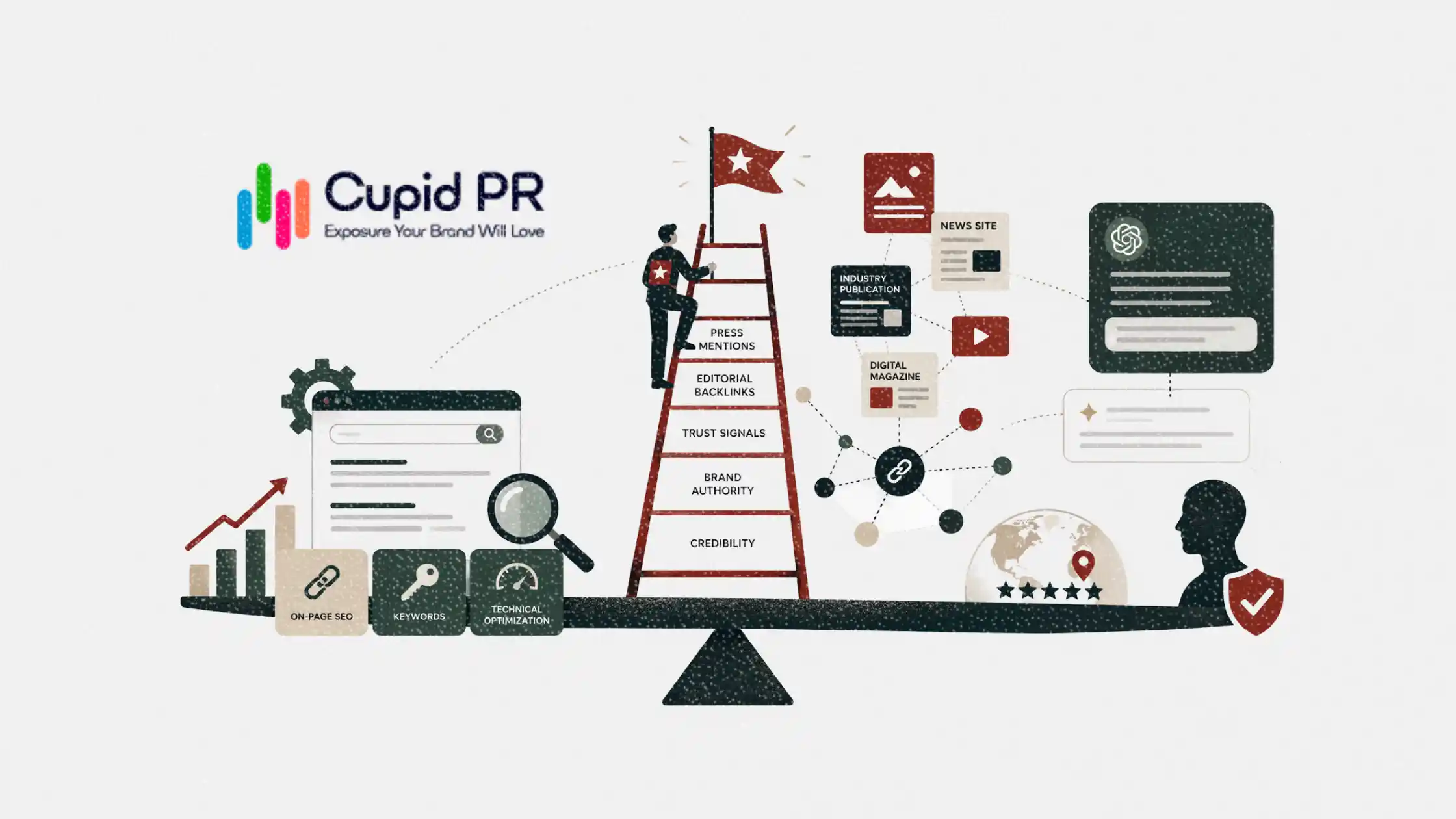
Search demand for Digital PR is climbing fast as brands look beyond traditional link building and focus more heavily on authority, credibility, and visibility across search engines, media platforms, and AI-powered discovery tools.
According to Glimpse search trend data analysed by Cupid PR, searches for “Digital PR” rose by 192% over the past year, reaching 383,000 searches in the past month. The spike reflects a broader shift in how brands are approaching SEO at a time when rankings are becoming harder to secure through on-site content alone.
For marketers, this matters because SEO is increasingly tied to external authority signals. Media mentions, expert commentary, editorial backlinks, and broader brand visibility are becoming more important as Google AI Overviews, ChatGPT Search, and other AI-driven discovery experiences reshape how information is surfaced online.
Table of contents
Jump to each section:
- Why Digital PR searches are rising so quickly
- Why brands are being warned about paid “media links”
- How Digital PR is changing SEO strategy for online brands
- What AI search and LLM visibility mean for marketers
- What marketers should know before investing in Digital PR
- Why authority is becoming the new SEO battleground
 Patrecia Meliana
Why Digital PR searches are rising so quickly
Cupid PR says the rise in Digital PR search demand reflects growing concern among brands about how to build authority online as organic visibility becomes more competitive. The consultancy argues that brands are increasingly aware that publishing blog content alone is no longer enough to build a strong search footprint.
The firm distinguishes Digital PR from traditional link building by focusing on earned media coverage rather than transactional backlink acquisition.
According to Sophie Rhone, founder of Cupid PR, Digital PR should start with relevance, expertise, and stories journalists genuinely want to cover, rather than simply chasing backlinks.
This distinction matters because many marketers still treat all backlinks as strategically equal, even though Google’s ranking systems increasingly reward context, topical authority, and editorial trust.
The growing interest also reflects how SEO teams are becoming more integrated with PR, content marketing, and brand strategy.
Instead of operating as isolated disciplines, brands are now trying to build coordinated visibility across:
- Search engines
- Industry publications
- Expert commentary opportunities
- AI-generated search experiences
- Social discovery channels
- Thought leadership platforms
Why brands are being warned about paid “media links”
Cupid PR also used the trend data announcement to warn brands about agencies selling paid placements disguised as earned media coverage. According to the consultancy, many businesses still struggle to distinguish between genuine editorial coverage and paid link placements packaged as “Digital PR links.”
The warning is particularly relevant as SEO budgets increase and pressure grows to show faster ranking improvements. Google’s spam policies explicitly state that buying or selling links for ranking purposes can violate search quality guidelines unless those placements are properly disclosed using sponsored or no-follow attributes.
Cupid PR argues that marketers should ask direct questions before purchasing any link-focused service, including:
- Whether coverage is earned or paid
- Whether the publication independently chooses to feature the brand
- Whether links are editorially placed
- Whether the agency controls the publication
- Whether links are marked sponsored or nofollow where appropriate
- Whether the publication is genuinely relevant to the brand’s niche
This is becoming a major issue because many brands still equate media logos with authority, even when those placements are effectively sponsored content.
For B2B marketers and ecommerce teams, that distinction matters more than ever. Low-quality paid placements may create temporary visibility spikes but often fail to build long-term authority or trust.
How Digital PR is changing SEO strategy for online brands
Cupid PR says Digital PR is becoming especially important for ecommerce, SaaS, finance, legal, travel, beauty, wellness, and professional services brands competing in crowded search environments.
In these industries, SEO success increasingly depends on broader reputation signals beyond website optimization. That includes:
- Editorial mentions
- Brand references
- Expert citations
- High-quality backlinks
- Third-party trust signals
- Industry authority
This reflects a larger change happening inside modern SEO. Brands are no longer just competing for keywords. They are competing for credibility.
A SaaS company quoted regularly in industry publications sends stronger trust signals than one relying only on blog output. Similarly, an ecommerce brand referenced by reputable publishers builds more topical authority than a competitor publishing isolated product content without external validation.
Cupid PR says effective Digital PR campaigns increasingly combine:
- Search trend analysis
- Data-led campaigns
- Reactive PR
- Expert commentary
- Newsjacking
- Original research
- Journalist resources
- Commercial SEO priorities
The most effective strategies now connect PR activity directly to business outcomes, including organic growth, commercial page visibility, and conversion performance.
What AI search and LLM visibility mean for marketers
The rise in Digital PR interest also comes as marketers try to understand how AI-powered search experiences influence discoverability. Google AI Overviews, ChatGPT Search, and other AI-driven systems increasingly summarize and reference information from across the web rather than relying solely on traditional ranking pages.
Cupid PR says brands should avoid chasing speculative “LLM optimization hacks” and instead focus on building a credible footprint across trusted websites and media sources.
That advice aligns with broader industry sentiment.
AI-powered discovery systems still rely heavily on external signals to understand which brands, experts, and publishers are associated with particular topics.
For marketers, that means visibility beyond owned channels is becoming more strategically important. A brand mentioned across respected industry sites, cited by journalists, and associated with specific expertise areas is more likely to build durable authority signals than a brand operating entirely inside its own content ecosystem.
This is particularly important in sectors where trust directly affects conversion rates, including:
- Financial services
- Healthcare
- Legal services
- B2B SaaS
- Enterprise technology
- Ecommerce
As AI-generated search experiences expand, marketers may need to think less about “ranking pages” and more about “building recognizable authority footprints.”
Patrecia Meliana
What marketers should know before investing in Digital PR
For marketers evaluating Digital PR providers, the current environment requires more scrutiny than ever.
Here are several practical considerations:
1. Prioritize relevance over link volume
A small number of highly relevant editorial mentions often delivers more strategic value than large numbers of low-quality backlinks.
Context matters. Publication quality matters. Audience alignment matters.
2. Treat Digital PR as a brand strategy, not just an SEO tactic
The strongest campaigns support multiple objectives simultaneously:
- SEO visibility
- Brand authority
- Referral traffic
- Thought leadership
- Media awareness
- AI search discoverability
That makes Digital PR more valuable when integrated with broader marketing goals.
3. Focus on commercial impact
Coverage alone is not enough. Marketers should measure:
- Organic traffic growth
- Rankings for priority keywords
- Referral traffic quality
- Assisted conversions
- Visibility for commercial landing pages
- Brand search demand
- Share of voice within industry conversations
4. Build expert visibility inside your organization
AI-driven discovery systems increasingly surface people alongside brands. That means companies should invest in:
- Executive thought leadership
- Expert commentary programs
- Data-backed insights
- Research reports
- Opinion-driven content
Brands that consistently contribute useful expertise are more likely to earn authoritative references over time.
Why authority is becoming the new SEO battleground
The biggest takeaway from the Digital PR search trend surge is that marketers are beginning to recognize how much SEO has changed.
Search visibility is no longer driven solely by publishing frequency or technical optimization. Authority, trust, and external validation are becoming central ranking and discovery signals across both traditional search engines and AI-powered platforms.
That does not mean Digital PR replaces SEO. Instead, it suggests modern SEO is evolving into a broader authority-building discipline that combines content, PR, expertise, media visibility, and search strategy.
For marketers, the challenge now is separating credible long-term authority building from short-term link acquisition tactics dressed up as PR. Brands that understand that difference will likely be better positioned as AI search, media fragmentation, and trust-based discovery continue reshaping digital visibility.