Most marketers know they need topical authority. Far fewer know how to measure whether they actually have it.
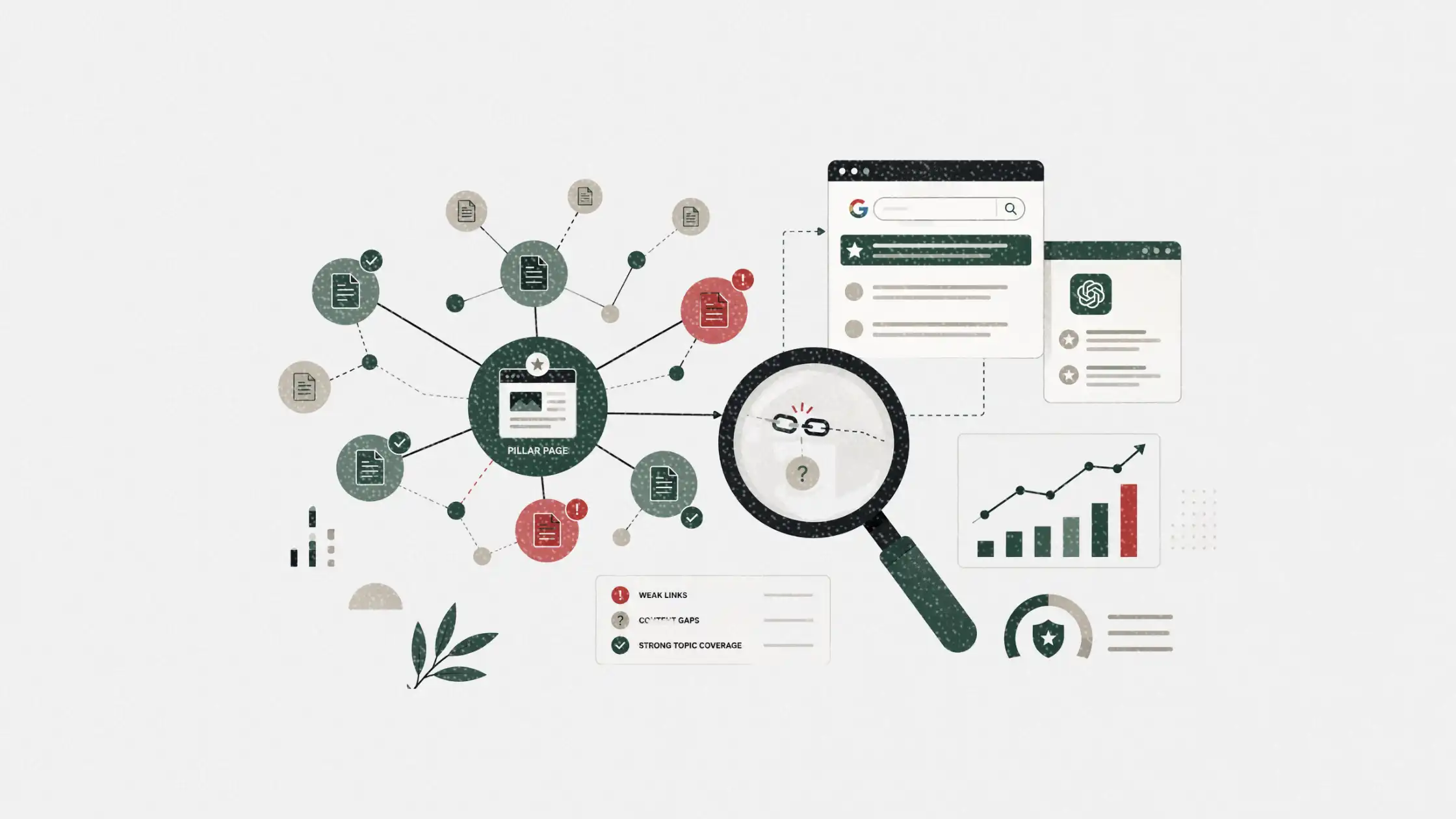
A topical authority audit is not the same as a standard content audit. You are not just checking word counts, bounce rates, or whether a page has a meta description. You are mapping how well your website covers a subject area — finding the gaps, overlaps, and weak links that tell search engines you do not own a topic yet.
This guide walks you through how to run that audit, what signals to look for, and what to do with what you find.
Table of contents
Jump to each section:
- Why topical authority now matters more than it did two years ago
- Step 1: Define your topical universe
- Step 2: Inventory what you have
- Step 3: Score each cluster for coverage depth
- Step 4: Check for cannibalization
- Step 5: Audit internal link architecture
- Step 6: Compare coverage against competitors
- Step 7: Build your action list
- How often to run this audit
 Patrecia Meliana
Why topical authority now matters more than it did two years ago
Search engines have shifted how they evaluate content. Keyword relevance still matters, but it has become a baseline expectation rather than a competitive edge. What separates strong-ranking sites from average ones today is depth of coverage on a defined subject area.
This shift has real consequences. According to a BrightEdge study tracking citation behavior across nine industries from May 2024 through September 2025, nearly half of Google’s AI Overview citations go to content that does not appear in organic search results at all. The common thread among cited content: strong topical authority signals, regardless of ranking position.
That means your topical coverage now affects both your traditional search rankings and your chances of appearing in AI-generated answers. Running a topical authority audit is no longer optional if you care about sustainable organic visibility.
Step 1: Define your topical universe
Before you can audit coverage, you need to be explicit about the topic you are trying to own.
Start with a single anchor topic. For a B2B SaaS company, that might be “marketing automation.” For a fintech startup, it might be “personal finance for freelancers.” Be specific. Trying to own too broad a topic area is one of the most common reasons sites fail to build authority.
From that anchor, map out three layers:
- Core topic: The primary subject your site exists to serve. Every piece of content you publish should connect back to this in some way.
- Subtopics: The main branches of your core topic. For “marketing automation,” subtopics might include email marketing, lead nurturing, CRM integration, marketing analytics, and workflow automation.
- Micro-topics: The specific questions, comparisons, how-tos, and use cases that live under each subtopic. These are often the long-tail terms your audience searches for.
This three-layer map becomes your benchmark. Everything else in the audit measures how well your current content covers it.
Step 2: Inventory what you have
Pull a full crawl of your site using a tool like Screaming Frog, Sitebulb, or Ahrefs Site Audit. Export every indexed URL with its title, meta description, and primary keyword target (if tracked).
Now group those URLs by subtopic. A spreadsheet with a “Topic Bucket” column works fine. The goal is to see, at a glance, how your content is distributed across your topical map.
What you are looking for at this stage:
- Cluster density: Do you have enough content per subtopic, or are some areas covered by a single page while others have ten?
- Pillar page gaps: Does every major subtopic have a comprehensive pillar page that links out to supporting content?
- Orphan pages: Are there pages with no internal links pointing to them? These are invisible to search engines even if they are technically indexed.
Research from 2024 SEO data found that sites publishing at least 25 authoritative articles within a single tightly connected content cluster typically see a 40 to 70% increase in keyword rankings for that topic within three to six months. That threshold gives you a useful benchmark for cluster density.
Step 3: Score each cluster for coverage depth
Once your content is sorted into clusters, score each one. You are not trying to build a complex system here. A simple 1-to-5 scale works:
- No presence: No content exists on this subtopic or micro-topic.
- Surface coverage: One or two pages exist but they skim the topic. No dedicated pillar, thin content, no internal linking structure.
- Partial coverage: A pillar page exists but supporting content is thin. Major subtopics are covered but many micro-topics are missing.
- Strong coverage: Pillar page plus several supporting articles. Most common questions answered. Internal linking is consistent.
- Dominant coverage: Comprehensive pillar, deep supporting content, multiple content formats (listicles, how-tos, comparisons, case studies), strong internal link architecture, and external backlinks pointing into the cluster.
Be honest. Most sites are at a 2 or 3 across most of their clusters. That gap is your opportunity.
Step 4: Check for cannibalization
Coverage gaps hurt you. But so does coverage overlap.
Cannibalization happens when two or more pages target the same keyword or answer the same question. Search engines struggle to determine which page to rank, and the result is both pages performing below their potential.
To find cannibalizing content:
- Use Google Search Console. Filter by query, then look for queries where multiple URLs appear in the impressions data.
- Use Ahrefs or Semrush’s cannibalization reports.
- Manually review any clusters where you have high page counts. Five pages all covering “how to set up email automation” is a red flag.
When you find cannibalization, you have three options: consolidate the pages into a single stronger piece, redirect weaker variants to the canonical page, or differentiate them clearly enough that each one serves a distinct search intent.
Step 5: Audit internal link architecture
Topical authority is not just about having the right content. It is about how that content connects.
Search engines use internal links to understand which pages are most important on a site and how topics relate to each other. A poorly linked cluster sends weak topical signals even if the individual pages are well-written.
For each cluster, check:
- Does every supporting article link back to its pillar page?
- Does the pillar page link out to all supporting content?
- Are anchor texts descriptive and consistent with the topic language?
- Are there pages within the cluster that have zero internal links pointing to them?
Sites that sustain well-linked cluster publishing for 12 or more months see 40% higher organic traffic than comparable single-page strategies, according to data from Digital Applied’s 2026 content cluster analysis. Internal linking is what makes those compounding gains happen.
Step 6: Compare coverage against competitors
Your topical authority is always relative. A site covering 60% of a topic cluster may be the authority in a niche market, but the same coverage could leave you on page two in a competitive vertical.
Run a keyword gap analysis using Ahrefs, Semrush, or a similar tool. Input your top two or three direct competitors and identify:
- Subtopics they rank for that you do not cover at all
- Micro-topics where they have dedicated pages but you are relying on a passing mention within a longer article
- High-traffic queries where they are ranking in the top three but you have no presence
Prioritize gaps where competitors are winning and where you have existing cluster content that you can extend from. These are your fastest paths to closing the authority gap.
Step 7: Build your action list
By this point you have:
- A topical map with coverage scores per cluster
- A list of cannibalization issues
- An internal link audit
- A competitor gap report
Turn this into a prioritized action list:
- Priority 1: Fix structural issues first. Cannibalization and broken internal links actively suppress existing rankings. These are quick wins.
- Priority 2: Strengthen pillar pages. If your core pillar pages are weak, every supporting piece suffers. Update these before creating new content.
- Priority 3: Fill the highest-value gaps. Focus on subtopics where you have some existing presence but missing depth, rather than building brand-new clusters from scratch.
- Priority 4: Build out new clusters strategically. Pick one new subtopic at a time. Go deep before going wide.
How often to run this audit
Topical authority is not static. New competitors enter your space, search intent evolves, and your own publishing creates new gaps or overlaps over time.
A full topical authority audit is worth running every six months. A lighter check — looking at Search Console for ranking shifts, scanning for new cannibalizing content, and reviewing internal link health — should happen quarterly.
The sites that build durable organic traffic are not the ones that publish the most. They are the ones that audit consistently, fill gaps deliberately, and maintain cluster coherence over time. That discipline is what the audit process is designed to support.