
A new Cloaked study reveals a growing contradiction in AI adoption: Americans continue using AI-powered platforms while simultaneously taking active steps to limit the personal data those platforms can access. The survey of 1,009 U.S. adults found that only 18% trust AI companies to keep their personal data secure, yet most respondents remain active users of digital services powered by AI.
For marketers, the findings highlight a challenge that goes far beyond privacy compliance. As AI becomes embedded across search, customer service, personalization, and advertising, consumer trust is emerging as a competitive differentiator.
The brands and platforms that can clearly explain how data is collected, processed, and protected may have a significant advantage in the years ahead.
Table of contents
Jump to each section:
- What did the Cloaked study find about AI trust and privacy?
- Why are Americans pushing back against AI data collection?
- What makes Meta AI stand out among AI platforms?
- What marketers should know about AI trust and consumer behavior
- Why this matters for the future of AI marketing
 Patrecia Meliana
What did the Cloaked study find about AI trust and privacy?
The headline finding is simple: Americans are increasingly skeptical of how AI platforms handle personal information.
According to the survey:
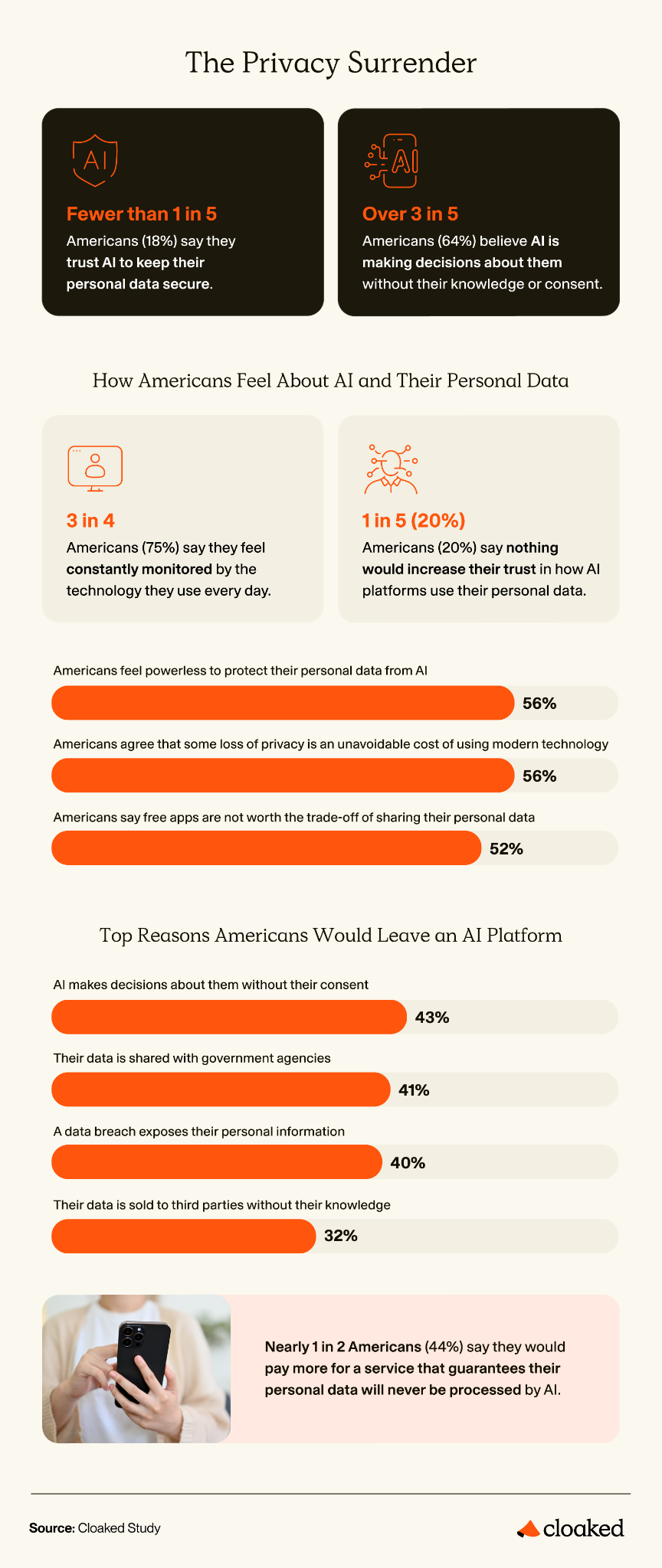
- Only 18% of Americans trust AI companies to keep their personal data secure.
- 64% believe AI is making decisions about them without their knowledge or consent.
- 75% say they feel constantly monitored by the technology they use every day.
- 44% would pay more for a service that guarantees their personal data would never be processed by AI.
- 31% admit to providing fake personal information such as a false name or birthday when prompted by an AI-powered service.
The study also found that more than half of Americans actively opt out of data collection, tracking, or targeted advertising whenever possible.
When it comes to sensitive information, respondents expressed the greatest discomfort sharing:
- Social Security numbers (88%)
- Financial information (87%)
- Biometric data such as fingerprints, facial scans, or voiceprints (74%)
- Private messages or texts (71%)
- Home addresses (70%)
These findings suggest that consumer concerns extend well beyond targeted advertising and increasingly focus on how AI systems process highly personal information.
 Patrecia Meliana
Why are Americans pushing back against AI data collection?
The research paints a picture of consumers who feel they have lost control over their digital identities.
More than half of respondents said they have accepted that companies know more about them than they are comfortable with. Nearly two-thirds believe they have less control over their personal data today than they did five years ago.
Instead of abandoning technology entirely, consumers appear to be adopting defensive behaviors:
- Opting out of tracking and data collection
- Refusing to sign up for services due to privacy concerns
- Providing inaccurate personal information
- Covering or disabling device cameras
- Deleting apps or accounts over privacy concerns
One particularly notable finding is that 43% of Americans would leave an AI platform if they learned it was making decisions about them regarding credit, hiring, or insurance without their consent.
For marketers, this highlights a growing sensitivity around algorithmic decision-making and transparency.
What makes Meta AI stand out among AI platforms?
Despite widespread skepticism toward AI, the study found meaningful differences between user communities.
Among surveyed AI users:
- Meta AI users were the most comfortable with AI handling their personal data (67%).
- Claude users ranked second (63%).
- Grok users ranked third (62%).
When asked specifically about trust in AI platforms to keep personal data secure:
- Meta AI ranked first at 36%.
- Perplexity ranked second at 31%.
- Grok ranked third at 27%.
Perhaps the most surprising finding is that Meta AI users reported trust levels nearly double those of ChatGPT users, where only 20% expressed confidence in AI platforms’ ability to protect their personal data.
The study does not identify exactly why Meta AI users express greater trust, but the results suggest that platform familiarity, ecosystem integration, or perceptions of transparency may influence consumer confidence.
What marketers should know about AI trust and consumer behavior
The findings offer several practical lessons for marketing teams.
1. Trust is becoming a competitive advantage
Consumers increasingly evaluate brands based on how responsibly they use data. AI-powered personalization can improve customer experiences, but only when users understand what data is being collected and why.
2. Transparency matters more than ever
The strongest negative reactions came from scenarios where AI was perceived as operating without consent or visibility. Marketers should clearly explain how AI supports customer experiences and what safeguards are in place.
3. Privacy can become a premium feature
Nearly half of respondents said they would pay more for services that guarantee their data will not be processed by AI. That suggests privacy-focused positioning could become a differentiator in crowded markets.
4. Younger consumers are not automatically more trusting
The study found Gen Z users were among the most likely to feel powerless about protecting their personal data and among the most likely to report declining trust in AI over the past year.
Marketers should avoid assuming younger audiences are comfortable with unrestricted AI-driven data collection.
5. AI governance is becoming a brand issue
Privacy concerns are no longer limited to legal or compliance teams. Consumer perceptions of AI usage increasingly affect brand reputation, loyalty, and retention.
 Patrecia Meliana
Why this matters for the future of AI marketing
The Cloaked study reveals a consumer base that is neither embracing AI unconditionally nor rejecting it outright.
Instead, Americans appear to be making a pragmatic compromise. They continue using AI-powered tools because they see value in them, but they are increasingly looking for ways to limit how much personal information those systems can access.
For marketers, that shift matters. The next phase of AI adoption may not be determined by who has the most advanced models or features. It may be determined by who earns the most trust.
Brands that can balance personalization with transparency, convenience with consent, and innovation with privacy may be best positioned to win in an AI-driven marketplace.