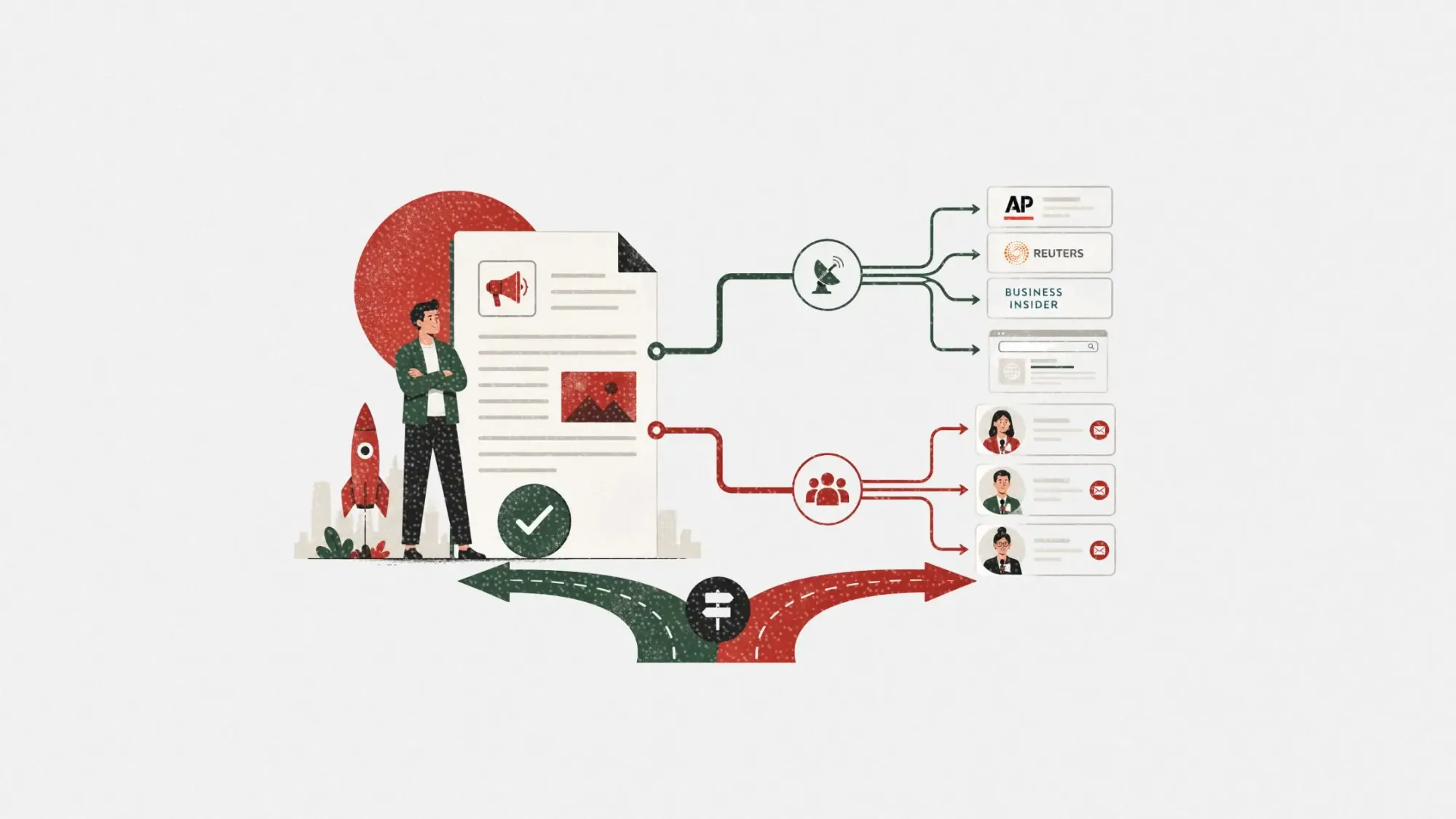
Getting your company covered does not have to cost anything upfront. Free press release distribution services give founders and solo marketers a way to build online visibility, earn backlinks, and test their messaging without committing budget to paid wire services that start at US$110 per release.
But free distribution comes with real limits. The platforms in this guide will not send your release to a journalist’s inbox. They will not guarantee placement on major news sites. And stacking your release across all of them at once is more likely to create duplicate content problems than amplify your reach.
This guide explains what free PR distribution actually does, compares six platforms with honest detail, includes a quick-reference table, and shows you when to stop relying on free tools and start building direct media relationships instead.
Table of contents
Jump to each section:
- What free press release distribution can and cannot do
- Best free press release distribution services compared
- How to choose the right free PR platform
- Free PR distribution vs direct journalist outreach
- How to measure results from free PR distribution
- FAQs about free press release distribution
What free press release distribution can and cannot do
Free press release platforms are publishing tools, not pitching tools. That distinction matters more than any feature comparison on their websites.
When you submit a release to PRLog or OpenPR, your news gets indexed by search engines, hosted on the platform’s domain, and sometimes syndicated to a network of aggregator sites. That creates a searchable online record of your announcement and can produce backlinks with real SEO value.
What it does not do: land your story in a journalist’s inbox. According to Cision’s 2025 State of the Media report, 72% of journalists find press releases the most useful resource PR teams can offer – but the operative word is “offer,” as in, sent directly to them by a PR professional. No free newswire delivers your release to a journalist’s email. Journalists are not browsing free distribution platforms for their next story idea.
Free distribution is genuinely useful for:
- Creating a permanent, indexed record of a product launch, funding round, or company update
- Generating backlinks from syndication partners that build domain authority over time
- Practicing press release formatting and messaging before paying for a wire service
- Supplementing a direct-outreach strategy, so journalists who search for you find something credible
It is not a substitute for building real media relationships or sending tailored pitches. Those efforts belong in a separate workflow.
Best free press release distribution services compared
Here is a side-by-side view of six platforms across the features that matter most for lean teams.
| Platform | Free releases | Multimedia | Google News | Frequency limit | Best for |
|---|---|---|---|---|---|
| PRLog | Unlimited | Yes (images + video) | Via RSS | None | Frequent announcements, multimedia, SEO |
| OpenPR | 1 per month | Images only | Yes | 1/month | SEO-focused distribution, European markets |
| News By Wire | Unlimited (currently free) | No | No | None | Regional reach across US, UK, Europe, Gulf, Asia |
| IssueWire | First release only | Yes (images + video) | No | 1 free, then paid | First-time use with media assets |
| PR.com | Unlimited (basic) | No | No | None | Industry-targeted distribution with business directory |
| EIN Presswire | 1 (1 channel, approval-based) | No | No | 1 free total | High-authority network, single use |
PRLog
PRLog is the most flexible free option for teams that publish news regularly. You can submit as many releases as you want at no cost, include images and video, and get indexed by Google quickly via RSS. Releases are hosted permanently on prlog.org with a shareable URL, which makes it practical for adding a credible reference link to your social posts or email pitches.
The caveat is clear: PRLog is a publishing platform, not a distribution network. It will not contact journalists on your behalf or guarantee syndication beyond its own domain and RSS feeds. According to SimilarWeb estimates, the site draws approximately 215,000 monthly pageviews – an active audience that its dated interface does not suggest.
OpenPR
OpenPR’s free tier allows one press release per month and focuses on search visibility. Releases are indexed in Google News and distributed via RSS feeds, giving them more indexed authority than generic newswire aggregators.
Based in Germany, OpenPR has stronger reach into European media ecosystems than most US-centric alternatives. Word limits on free submissions run around 800 to 1,000 words, and multimedia on the free plan is restricted to images only.
SimilarWeb estimates put the site at approximately 471,000 monthly pageviews – the second-highest audience of any platform on this list, making its one-release-per-month free limit a genuine constraint worth planning around.
News By Wire
News By Wire operates on a different model from every other platform on this list. Rather than primarily hosting releases for visitors to browse, they actively distribute to a list of 5,500+ opted-in journalists and publication editors via email, matching releases to the most relevant contacts.
The site claims that its journalist network spans 3,500+ US and UK outlets – including the New York Times, Guardian, BBC, Financial Times, Wall Street Journal, and Washington Post – plus 1,500+ European publications and contacts across the Gulf, Asia, and Australasia. They also run 50+ specialist RSS feeds and share releases with over 6,500 social media followers.
The practical implication: News By Wire is the closest thing to a paid journalist-outreach service that this list offers, but for free (for now). Their site draws an estimated 36,000 monthly pageviews, but that number is largely irrelevant to how they create value – their distribution is outbound, not audience-driven. Releases are checked before publication, and their website states that current free distribution may not stay free indefinitely as paid tiers are coming.
IssueWire
IssueWire’s free plan is a one-time offer. Your first press release is distributed at no cost, with multimedia support (images and video) and indexing across approximately 150 partner sites. After that, paid plans start at US$21 per release and go up to US$65.
For a startup using press release distribution for the first time and wanting to attach a product image or explainer video, IssueWire is a reasonable entry point. Use the free release for a meaningful announcement. SimilarWeb estimates the site at approximately 212,000 monthly pageviews, comparable to PRLog.
PR.com
PR.com combines a press release distribution platform with a business directory, which gives free-tier users something most pure newswires do not: a company profile page that gets indexed alongside your releases.
The free account allows unlimited press release submissions at a basic level and lets you tag releases to specific industries for category-targeted distribution. Paid plans (starting around US$60) add syndication to major news outlets and expanded reach.
For startups that want a free hosted presence beyond just a release URL, PR.com adds a small but useful layer. SimilarWeb estimates the site at approximately 118,000 monthly pageviews.
EIN Presswire
EIN Presswire’s free option works differently from every other platform on this list. Rather than a self-serve upload, you submit a request via their contact form, their team reviews it, and if approved, sends you upload instructions.
Your release then goes out on one EIN Presswire distribution channel of your choice from their network – which includes industry-specific and country-specific newswires via einnews.com. You also receive a distribution report. No images, no video, no RSS syndication, and no scheduling are included on the free tier; those require a paid plan starting at US$149 per release.
The reason to go through the process anyway is domain and network authority. EIN Presswire distributes to AP News, Google News, and over 1,000 outlets on paid plans, and its own domain carries the indexing weight of being associated with that network.
SimilarWeb estimates the site at approximately 493,000 monthly pageviews – the highest of any platform on this list. A release in one of their industry channels – even the free tier – is more likely to surface in branded searches and AI-generated company summaries than the same release on a lower-authority platform.
Reserve the single free submission for your most meaningful announcement, and be prepared that approval is not guaranteed.
 Enricko Lukman
How to choose the right free PR platform
The six platforms here fall into two distinct models. Five of them – PRLog, OpenPR, IssueWire, PR.com, and EIN Presswire – create value primarily through their own site’s audience and search indexing: your release lives on their domain, gets indexed, and earns backlinks from there. News By Wire works differently: their value is outbound distribution to journalist inboxes, not site traffic. Keep that split in mind when choosing.
For regular publishing, PRLog is the default starting point. Unlimited free submissions, multimedia support, and RSS distribution make it the most friction-free option for teams that publish monthly or more.
For maximum indexed reach on a single release, OpenPR and EIN Presswire have the largest site audiences of the group. OpenPR is the more accessible choice – one free submission per month, no approval needed, Google News indexed. EIN Presswire has the highest traffic of all six platforms and the strongest domain authority, but requires contacting their team for approval and is limited to one free submission total. Use it once, for your most significant announcement.
If journalist visibility is the actual goal, News By Wire is the only platform here whose model supports it – they claim to distribute to 5,500+ opted-in journalist contacts by email. Set realistic expectations: even outbound journalist distribution rarely results in pickup. But if you are going to use a free platform with that ambition, this is the one. Note that their free tier may not stay free permanently.
For a first press release with images or video attached, IssueWire’s one-time free offer includes multimedia support that the others at this tier do not. PR.com is worth adding to your rotation if a bundled business directory profile – an indexed company presence beyond just the release – is useful to you.
One note on multi-platform submissions: Google does not penalize syndicated press releases. What happens instead is deduplication – Google picks the most authoritative version to show in search and filters the rest.
Submitting to all six platforms does not give you six indexed results; it mostly gives you one result on the highest-authority domain. If you also publish the release on your own company blog, Google may surface a higher-authority newswire version in search instead of your own page.
Free PR distribution vs direct journalist outreach
Free newswires and journalist pitching serve fundamentally different outcomes. Treating them as interchangeable is the most expensive mistake lean startup PR teams make.
A free distribution platform creates a searchable, indexed record of your news. A journalist pitch is a personalized ask for editorial coverage from a human being making judgment calls about what their readers care about. The first requires a well-formatted press release. The second requires knowing the journalist’s beat, reading their recent work, and explaining in two or three sentences why your story belongs in their next piece.
Tommy Prayoga, Head of Agency at content-led PR agency Content Collision, puts it directly: “Startups often assume that getting a release onto a newswire means a journalist will find it. The releases that actually generate coverage are almost always the ones sent directly to a reporter who covers that specific topic, with a subject line that signals relevance in five seconds.”
The data supports that framing. According to Propel PRM’s Q2 2024 Media Barometer, which analyzed over 405,000 pitches sent to journalists, the average journalist response rate to PR pitches is 3.43%. And that figure applies to personalized email pitches, not wire submissions. No wire service, free or paid, can claim a comparable engagement rate because journalists are not reading newswire feeds as a discovery mechanism.
It is worth being direct here: even paid wire services with guaranteed distribution to thousands of outlets rarely generate organic journalist interest from the wire alone. A journalist finding a story by browsing a newswire and deciding to write about it unprompted is not a realistic scenario in most verticals. Free newswires reduce that chance further, to near zero. What wire services of any tier reliably do is index your announcement, create a timestamped public record, and build syndication backlinks.
The recommended approach for startups with limited PR budget: use one free platform to create a hosted, indexed version of each announcement, then spend the majority of your actual PR time building a targeted media list and sending personalized pitches. A well-structured press release is still the foundation of that outreach.
 Enricko Lukman
How to measure results from free PR distribution
Be honest with yourself about what free newswire submissions can realistically deliver before you build a measurement framework around them.
Even paid wire services with wide distribution networks rarely generate organic journalist discovery. Free newswires offer a fraction of that reach, so media pickup from a free submission is effectively zero. Referral traffic from the distribution platform is unlikely to be meaningful – an occasional session from prlog.org or openpr.com is possible, but it is background noise rather than a conversion channel.
The most defensible outcome from free press release distribution in 2026 is third-party site indexing. Every aggregator or syndication partner that picks up and hosts your release adds another indexed web reference to your company name and announcement. That indexing matters increasingly as a signal for large language models like ChatGPT and Perplexity, which draw from third-party domains when generating summaries about companies and products. A press release hosted on five different indexed domains gives an LLM more corroborating sources than one that only exists on your own website.
To make that indexing work harder, pair each press release submission with two additional actions: publish an announcement post on your company blog (to create a canonical owned-media reference), and share it across your social channels (to extend reach to your existing network). Free newswire submissions are not a standalone activity. They only compound when used alongside owned and social distribution. Submitting to three platforms and doing nothing else is not a PR strategy.
If you do want to track what free submissions contribute over time, focus on two signals: whether your company name returns more third-party domain results in Google over several months of consistent publishing, and whether your release URLs appear in any AI-generated company summaries. Both are slow-moving metrics, but they reflect the actual value these tools provide.
 Ramya Priya
FAQs about free press release distribution
1. Do free press release services actually work?
It depends on what you mean by “work.” They reliably create indexed, permanent records of your announcements and can build incremental SEO backlink value over time. They do not reliably produce journalist coverage, meaningful referral traffic, or significant lead generation. Think of them as one tool in a broader PR and content strategy, not a standalone solution.
2. How many free platforms should I use per announcement?
One to two is a reasonable working number, but not because of duplicate content penalties — Google does not penalize syndicated press releases. What actually happens is deduplication: Google picks the most authoritative version to show in search and filters the rest out. Submitting to six platforms does not give you six indexed results; it mostly gives you one visible result on the highest-authority domain. Choose platforms based on which channels genuinely reach your audience, and prioritize quality of distribution over volume of submissions.
3. Can I use free PR distribution for a product launch or funding announcement?
Yes, for creating an indexed public record and a shareable hosted reference. For a major announcement where earned media coverage is the primary goal, combine one free platform with direct personalized journalist pitching, and consider whether EIN Presswire’s approval-based free submission — which distributes to one channel of your choice from their network — is worth using for that specific release.
4. Is there a word limit for free press release submissions?
It varies. PRLog supports roughly 800 words on the free plan. OpenPR runs closer to 1,000 words. In practice, aim for 300 to 500 words per release. Prowly’s research on press release length finds that length range delivers the highest engagement from journalists and editors.
5. What is the difference between a newswire and a journalist database?
A newswire publishes your release to its own website and a network of partner RSS and aggregator feeds. A journalist database (such as Muck Rack, Cision, or Prezly) gives you direct contact information and beat data for reporters so you can pitch them personally. The free services in this guide are all newswires. Journalist databases are almost always paid, and the two serve entirely different functions.