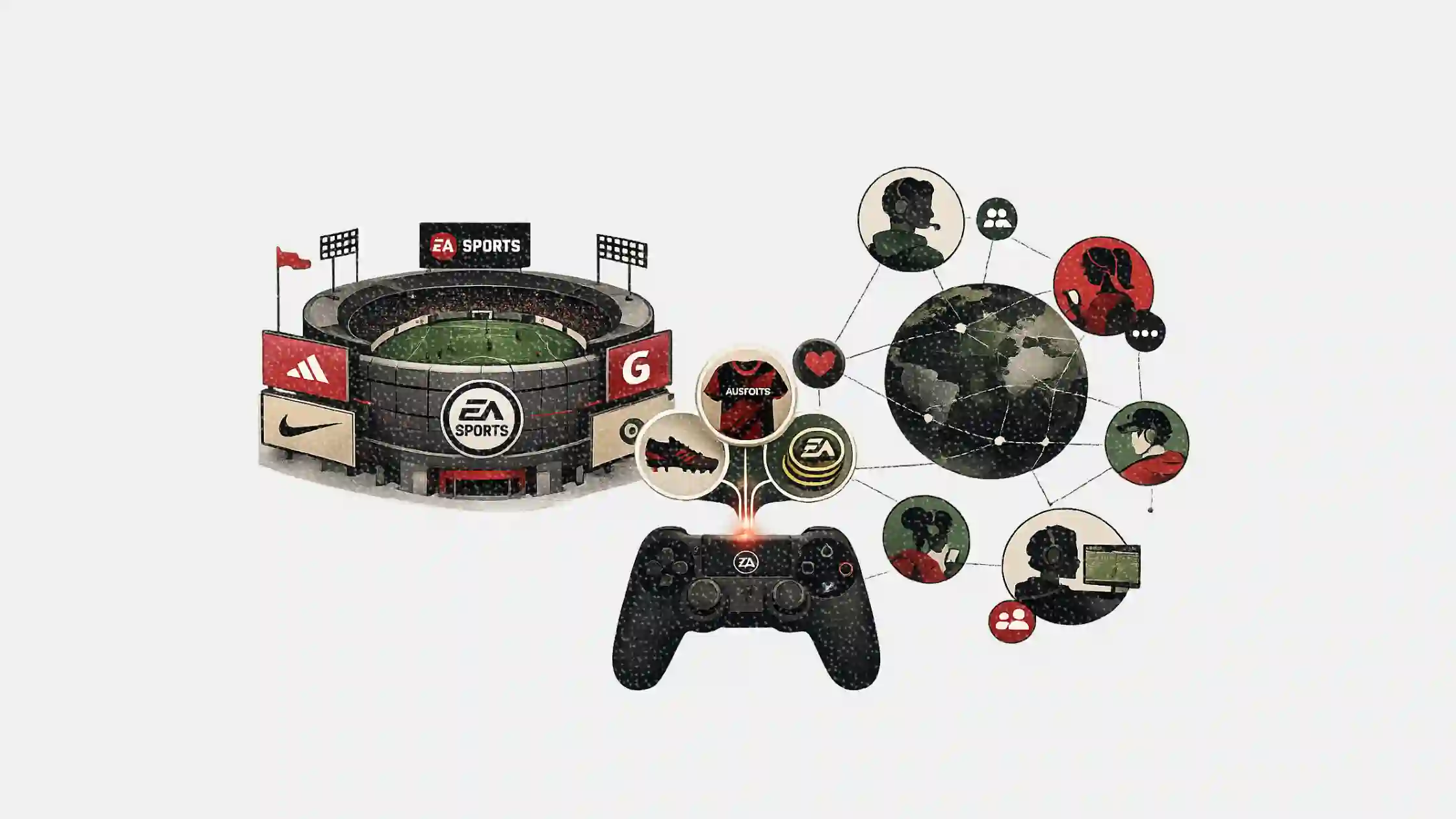
EA has launched EA Advertising, a new platform designed to help brands appear inside gameplay, live experiences, and fan communities across its global gaming portfolio.
The move matters because gaming is no longer a side channel for experimental brand activations. EA says its games and services reached more than 120 million monthly players during fiscal year 2026, giving advertisers a scaled environment where audiences are playing, watching, competing, and connecting.
Table of contents
Jump to each section:
- What EA Advertising brings to in-game brand integrations
- Why EA’s sports ecosystem matters for advertisers
- What marketers should know about gameplay-native advertising
- The brand safety question EA still needs to manage
- What comes next for brands inside gaming worlds
 Patrecia Meliana
What EA Advertising brings to in-game brand integrations
EA Advertising gives brands access to dynamic in-game placements, custom content, sports sponsorship programs, and live fan activations across EA’s portfolio.
That includes stadium signage, digital ad boards, scoreboards, broadcast-style overlays, in-game challenges, branded rewards, vanity items, and playable branded experiences.
EA says the ads are designed to feel native to gameplay rather than disruptive. The company is also introducing measurement aligned with IAB standards, plus targeting powered by its proprietary ad server and SDK built for the Frostbite game engine.
 Patrecia Meliana
Why EA’s sports ecosystem matters for advertisers
The real prize is EA SPORTS.
EA says fans play the equivalent of 23,000 NFL seasons daily in Madden NFL and complete more than 1 billion matches each month in EA SPORTS FC. That gives brands a rare combination of attention, fandom, and repeat engagement.
The new EA SPORTS Partner Program formalizes this opportunity. Brands can participate in live events, creator tools, social play experiences, Ratings Reveals, Madden Bowl activations, and athlete-driven programs like GEN / EA SPORTS.
Early partners include Visa, Lowe’s, Red Bull, Xfinity, Peacock, and Mountain Dew.
 Patrecia Meliana
What marketers should know about gameplay-native advertising
For marketers, the lesson is simple: gaming ads need to earn their place. Strong in-game campaigns should:
- Add utility, rewards, or cultural relevance
- Match the logic of the game world
- Avoid interrupting competitive or emotional moments
- Measure engagement beyond impressions
- Treat players as participants, not passive viewers
EA’s examples show where this is heading. Lowe’s used Ultimate Team challenges and branded player content. Red Bull leaned into objectives, kits, and athlete collaborations. Mountain Dew created “DEW University” as a playable team experience inside EA SPORTS College Football 26.
This is not banner advertising with shinier graphics. It is brand experience design.
 ContentGrip Staff
The brand safety question EA still needs to manage
The opportunity is obvious, but so is the risk.
Players are quick to reject ads that feel forced, excessive, or out of place. EA’s promise to “enhance, not disrupt” the player experience will need to hold up as the platform scales.
Privacy also matters. EA says advertisers can collaborate in a privacy-safe way and use aggregated engagement insights. That framing is important, especially as gaming environments become more measurable and more commercially active.
For brands, the smart move is to test carefully. Start with integrations that fit naturally into fan behavior before chasing broad reach.
What comes next for brands inside gaming worlds
EA Advertising shows where premium gaming media is going: less interruption, more integration, and tighter links between digital play, live events, creators, and sports culture.
For marketers, this is a signal to treat gaming as a serious media and experience channel. Not every brand needs a custom team, kit, or stadium takeover. But every brand targeting younger, sports-driven, or entertainment-heavy audiences should understand how gaming communities respond to value.