Pinterest has released a limited-access experimental app called Ask Pinterest to test a more conversational approach to shopping and product discovery that could later inform features in its main app. The company framed the product as a way to extend Pinterest’s visual discovery strengths into a chatbot-like experience that can handle more complex, multi-step queries.
The update was shared in the company’s newsroom post outlining a broader set of AI tools for advertisers, including Business Assistant in Ads Manager, Pinterest Model Context Protocol (MCP), and new Performance+ creative capabilities. The details were outlined in the company’s newsroom announcement.
Pinterest also positioned Ask Pinterest as an experiment that can run outside the core Pinterest experience, allowing rapid iteration without disrupting how most users browse and search today.
Table of contents
Jump to each section:
- Ask Pinterest and what Pinterest is testing
- How personalization may work: Taste Graph, Boards, and context
- Pinterest’s advertiser AI updates: Business Assistant, MCP, Performance+
- What this means for marketers
Ask Pinterest and what Pinterest is testing
Ask Pinterest is designed as a conversational, AI-powered shopping and discovery interface where people can use natural language to get more personalized recommendations and inspiration. Pinterest described it as a way to support queries that do not fit neatly into traditional keyword search, such as planning a dinner party or furnishing a room over time.
The experience is currently limited access and available via the web on both mobile and desktop.

Positioning it as a stand-alone app is an important product choice. It gives Pinterest room to test interaction design, response formats, and multi-session behavior without forcing an immediate change to its flagship app’s search and browse patterns.
 ContentGrip
How personalization may work: Taste Graph, Boards, and context
Pinterest tied Ask Pinterest to its “Taste Graph,” which it describes as internal mapping that connects people to interests and aesthetics. In practical terms, this suggests the system is meant to answer with outputs anchored in Pinterest-native signals, not only generic web knowledge.
Pinterest also said Ask Pinterest can use a signed-in user’s saved Pins and Boards to personalize responses. That matters because it turns conversational shopping into an experience grounded in declared and observed preferences, rather than starting from scratch each session.

The company also emphasized context retention across sessions. If Pinterest can reliably keep the “thread” of a multi-step shopping or planning journey, it could shift how users progress from inspiration to action inside Pinterest’s ecosystem, especially for longer consideration categories where intent evolves over days or weeks.
Pinterest’s advertiser AI updates: Business Assistant, MCP, Performance+
Alongside Ask Pinterest, Pinterest outlined several AI updates aimed at advertisers and agencies.
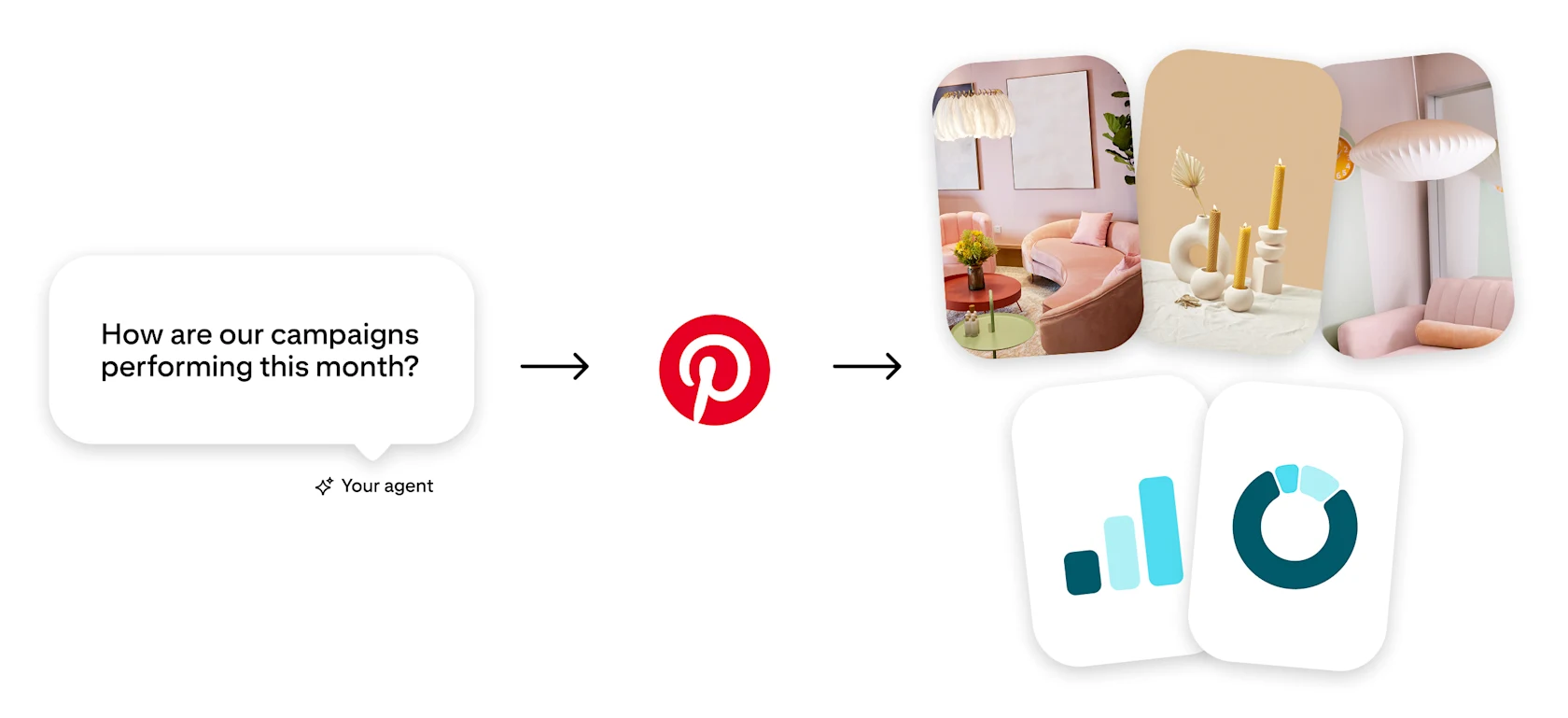
Business Assistant is an AI collaborator in Ads Manager and mobile, described as being in closed beta in the U.S. Pinterest said it is designed to provide guidance using platform insights, and to present information visually, including trend graphs and examples of top Pins to promote. The company also described proactive notifications on mobile related to trends, performance status, and optimization opportunities.
Pinterest Model Context Protocol (MCP) is positioned as an AI-native infrastructure layer that connects Pinterest to partner copilots and agentic tools that advertisers use. Pinterest said MCP provides secure access to campaign, analytics, and keyword insights, and it is being developed with alpha partners including PMG, Pacvue, Dentsu, Havas, Innovid by Mediaocean, and Omnicom’s Jump450.
Performance+ creative also received an update through a new AI model intended to select among creative variations and pick the variant most likely to perform for each ad impression. Pinterest said that in testing, the new model increased click volume by 7.5% compared to the previous “singular variant model,” and it also mentioned new ad review tools and enhanced creative reporting breakouts.
Taken together, these changes point to two parallel bets: conversational discovery experiences for shoppers, and more automated, AI-assisted workflows for advertisers operating on Pinterest.
What this means for marketers
Pinterest’s announcement bundles consumer-facing experimentation with infrastructure and workflow changes for advertisers. For marketing teams, the practical question is not whether conversational interfaces will exist, but where they will shape discovery behavior and how platforms will expose (or restrict) the signals and controls brands rely on.
- Treat conversational discovery as a new “query shape,” not a new channel
Ask Pinterest is built for multi-step, contextual requests that do not fit keyword search. Marketers should consider how product content, creative, and landing experiences support exploratory journeys rather than single-intent searches. - Plan for personalization that is anchored in platform-native signals
Pinterest is explicitly leaning on its Taste Graph plus user Boards and saved Pins. That implies that Pinterest outcomes may depend heavily on how well a brand’s assets perform within Pinterest’s own interest and intent system, not only on generalized SEO-style optimization. - Expect optimization to shift from ad-level decisions to asset-level selection
With the updated Performance+ creative model selecting variants at impression time, creative strategy becomes more about producing robust variation and ensuring each asset communicates clearly. The upside is better matching; the tradeoff is less direct control over which exact variant appears when. - Prepare for AI copilots to become “interfaces” to campaign management
Pinterest MCP is designed to let third-party agentic tools manage and monitor campaigns in a standardized way. If this direction continues, marketing operations may increasingly happen through copilots that abstract away native UI workflows, raising new requirements for governance, permissions, and reporting consistency. - Use platform AI assistants as insight surfaces, not truth engines
Business Assistant is described as visual and trend-oriented, with graphs and examples of Pins. Teams can treat this as an opportunity to speed up exploration and planning, while still validating conclusions through first-party measurement and established reporting processes.
If Ask Pinterest remains limited access, its immediate impact will be modest. But the underlying product direction matters: Pinterest is testing conversational discovery while also building advertiser-facing AI infrastructure that could reduce friction between planning, execution, and optimization.
Over time, the brands that benefit most are likely to be those that treat Pinterest creative as a living library of variations and signals, and that can adapt faster when the interface to “search” becomes less about keywords and more about context, taste, and session continuity.