A new study from crypto payments platform Oobit suggests that younger consumers are becoming increasingly skeptical of traditional banking institutions while showing growing interest in stablecoins, self-custody, and crypto payments. The findings point to a broader shift in financial attitudes that marketers, fintech brands, and financial services companies should pay close attention to.
The study combines survey data from 1,004 Americans aged 18 to 34 with an analysis of more than 22,000 Reddit posts. Together, the findings paint a picture of a generation that is not necessarily abandoning banks, but is actively exploring alternatives and diversifying where and how they manage money.
Table of contents
Jump to each section:
- What did Oobit’s study find about banking trust and crypto adoption?
- Why are young consumers rethinking traditional banks?
- How crypto spending is moving from investing to everyday use
- What marketers should know about shifting financial behavior
- What happens next for banks, fintechs, and crypto brands?
What did Oobit’s study find about banking trust and crypto adoption?
According to Oobit’s research, 50% of Americans aged 18 to 34 said they would not choose a traditional bank if they were opening their first financial account today. The study also found that 62% had already taken at least one step to move money away from traditional banks over the past year.
Several findings stand out:
- 42% believe traditional banks are becoming less relevant to their generation.
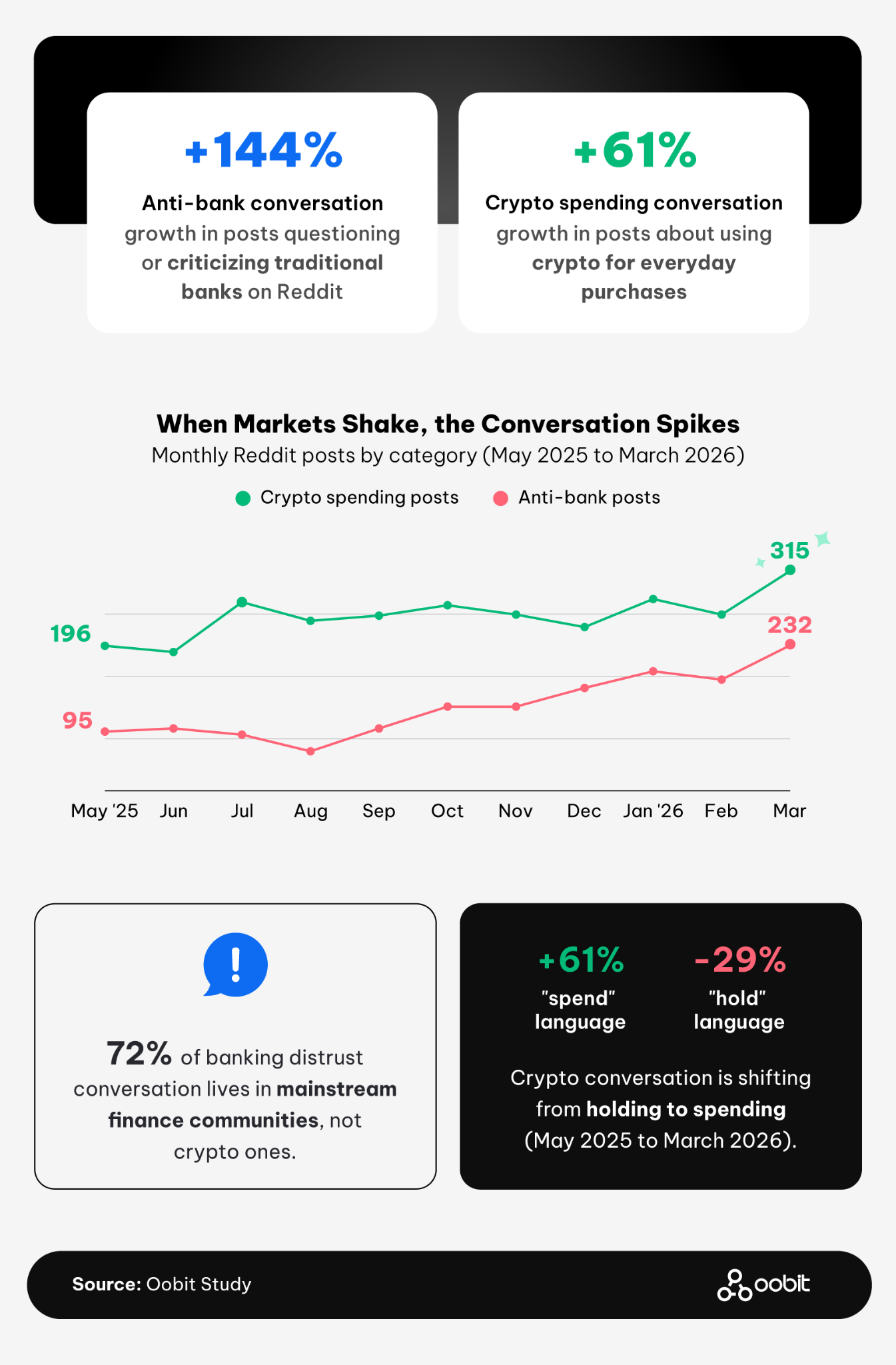
- 49% say a stablecoin wallet feels as safe as a bank for receiving a paycheck.
- 55% want at least some level of self-custody over their money.
- 1 in 4 young adults would consider paying with crypto anywhere Visa is accepted.
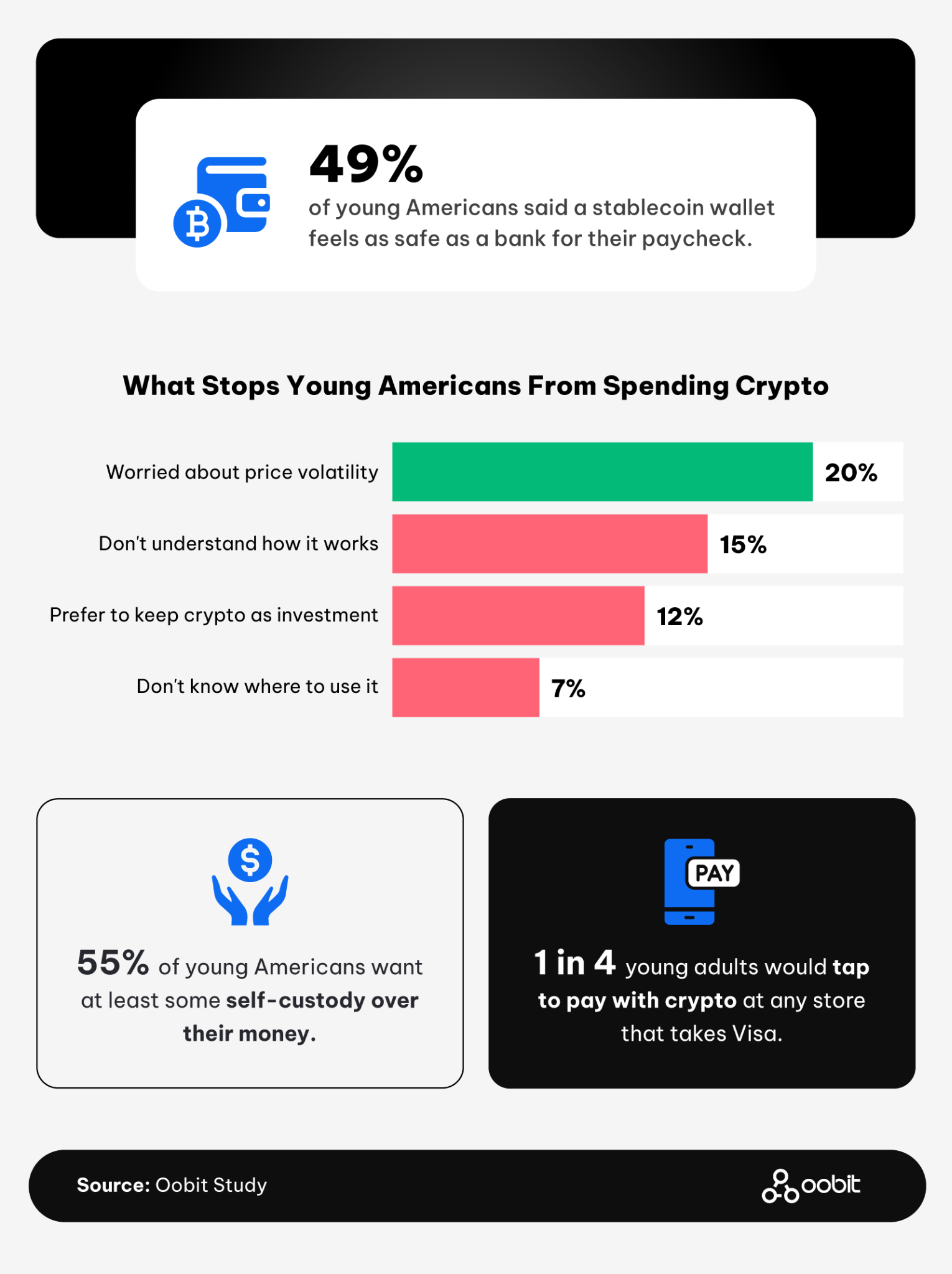
The study also revealed significant growth in online discussions related to banking distrust and crypto spending. Anti-bank conversations on Reddit increased by 144% between May 2025 and March 2026, while crypto spending discussions rose by 61% over the same period.
Why are young consumers rethinking traditional banks?
Economic uncertainty appears to be a major driver. Among respondents, inflation and recession concerns ranked as the top reason for rethinking traditional banking relationships, followed by geopolitical uncertainty and rising interest rate concerns.
Interestingly, Oobit found that younger consumers are not necessarily closing bank accounts outright. Instead, many are gradually changing behaviors by moving portions of savings, experimenting with alternative financial platforms, or seeking greater control over how money is stored and transferred.
The findings also highlight the growing appeal of credit unions and fintech platforms. While banks remain the most trusted option for savings and paychecks, alternative providers are increasingly viewed as viable complements rather than niche alternatives.
How crypto spending is moving from investing to everyday use
One of the more notable findings is the shift in crypto conversations from holding assets to actually spending them.
Oobit’s Reddit analysis found that spending-related language increased by 61%, while hold-focused language declined by 29% during the study period. The data suggests that crypto users are increasingly discussing practical usage rather than purely investment-driven narratives.
That does not mean adoption barriers have disappeared.
Among crypto owners who have tried spending digital assets, 83% still report challenges using crypto for everyday purchases. The most common barriers include:
- Concerns about price volatility
- Lack of understanding
- Preference for treating crypto as an investment
- Uncertainty about where crypto can actually be used
This gap between interest and usability may represent one of the biggest opportunities for crypto payment providers, wallet companies, and fintech brands over the next few years.
What marketers should know about shifting financial behavior
For marketers working in fintech, banking, payments, and financial technology, the findings suggest several important shifts.
1. Trust is becoming a competitive differentiator
Nearly half of respondents said stablecoin wallets feel as safe as traditional banks. Whether or not consumers ultimately move funds, perceptions of trust are clearly evolving. Brands that communicate transparency, security, and user control may gain an advantage.
2. Education remains a growth opportunity
Many respondents cited confusion around crypto usage as a barrier. Educational content, onboarding experiences, and simplified messaging could play a larger role in driving adoption than feature launches alone.
3. Reddit is becoming a valuable financial insight channel
Oobit’s analysis found that 72% of anti-bank discussions occurred in mainstream finance communities rather than crypto-specific forums. This reinforces a broader trend where Reddit is increasingly functioning as a consumer research platform and trust signal for emerging financial products.
Marketers interested in community-led discovery may also want to examine why Reddit continues gaining influence in digital decision-making.
4. Consumer behavior is changing before account ownership changes
Many consumers continue using traditional banks while simultaneously experimenting with fintech apps, digital wallets, and alternative financial products. The customer journey is becoming more fragmented, creating new opportunities for partnerships, integrations, and ecosystem-based marketing strategies.
What happens next for banks, fintechs, and crypto brands?
The study does not suggest that traditional banks are disappearing anytime soon. Most respondents still trust banks for core financial activities such as receiving paychecks and storing savings.
What appears to be changing is the exclusivity of that relationship.
As stablecoins, fintech platforms, and crypto payment tools become easier to use, younger consumers are increasingly comfortable spreading financial activity across multiple platforms. The brands that succeed may not be those replacing banks entirely, but those that make financial experiences more flexible, transparent, and user-controlled.
For marketers, this is ultimately a story about shifting consumer trust. And trust, once it starts moving, tends to reshape entire categories.