Most brands running gifting programs are shipping skincare sets and activewear to lifestyle creators. B2B marketers have largely stayed on the sidelines, assuming the tactic belongs to consumer brands. That assumption is costing them.
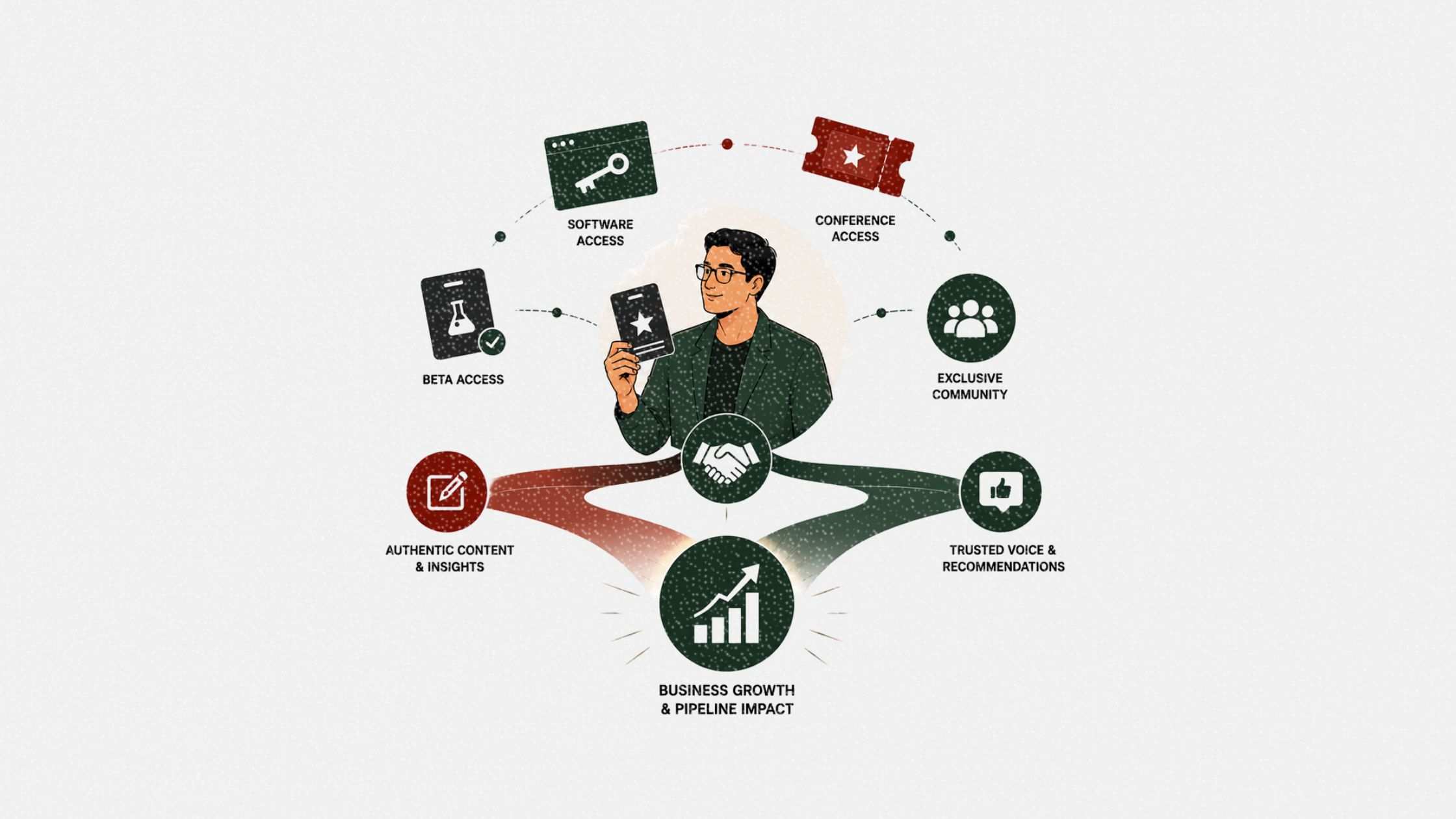
Gifting, adapted for the B2B context, is one of the most cost-efficient ways to seed genuine creator relationships before a dollar changes hands. The “product” is extended platform access, a conference pass, a beta invite, or early entry into a community program.
The logic is the same: give a creator something valuable, build a real relationship, and let honest advocacy follow. Done correctly, it produces the kind of credible, organic creator content that no paid brief can replicate.
This guide covers how B2B brands adapt the gifting model for software, SaaS, and professional services, which gift formats build the strongest creator relationships, and the FTC compliance obligations that most B2B teams miss entirely.
Table of contents
Jump to each section:
- Why B2B brands are turning to gifting programs
- What B2B gifting actually looks like
- The B2B gift formats that build lasting creator relationships
- How to select and vet creators for a gifting program
- FTC compliance: the rules most B2B brands misunderstand
- Measuring return from a B2B gifting program
Why B2B brands are turning to gifting programs
The B2B influencer market has grown to the point where paid partnerships are becoming competitive and expensive. LinkedIn operator-creators with audiences of genuine decision-makers are in demand. The brands that got there first are compounding the relationship advantage while latecomers negotiate for the same shrinking pool of credible voices.
Gifting programs create an alternative entry point. Rather than opening with a fee negotiation, a brand offers something genuinely useful: early access to a new product feature, a seat at an exclusive event, or an extended enterprise trial. The creator evaluates the product on their own terms. If they find value, they write about it or talk about it. The content that results is authentic in a way that a commissioned post rarely is.
According to the TopRank Marketing 2025 B2B Influencer Marketing Report, in-person events rank as the second most effective type of influencer content for B2B marketers at 39%, trailing only social media posts. Zapier, for example, hosted a glamping retreat in Zion National Park for 20 of its creator partners, generating US$136,000 in earned media value from the relationship investment alone. That is the gifting model applied at scale: an investment in the relationship rather than a placement.
The economics are also compelling for early-stage programs. A gifted enterprise trial or conference pass costs a fraction of a paid LinkedIn post from a creator in the same category, and it builds a relationship asset that a one-off brief does not. Analysis from GRIN found that 25 micro-creators outperformed two macro creators by 4.5x in revenue at the same total budget, a ratio that holds in B2B when audience density is prioritized over follower count.
For B2B brands not yet running structured influencer programs, gifting is a lower-risk starting point: it builds a pool of informed creator advocates before any formal partnership structure is needed.
What B2B gifting actually looks like
In consumer marketing, gifting means physical product. In B2B, the equivalent assets are intangible, but no less valuable to the right recipient.
The most common B2B gift formats fall into four categories:
Extended software access. A free seat on your platform for three to six months, at a tier above what the creator could access independently. A practitioner who builds real workflows in your tool will have more credible things to say about it than one who had a one-hour demo call.
Beta access to unreleased features. Early access to a feature under development gives the creator a genuine scoop. It also turns them into a feedback source, which has separate product value.
Event and conference access. A full conference pass at a relevant industry event is a meaningful gift for a practitioner-creator who would otherwise pay out of pocket or not attend. Zapier’s Zion retreat is a high-end version; a SaaStr summit pass is a more accessible one.
Exclusive community access. Entry into a private Slack group, a quarterly roundtable with your executive team, or first access to proprietary research holds significant value for creators whose audience cares about early intelligence.
Dinda Anandita, Account Director at Content Collision, a content-led PR agency, puts it plainly: “The B2B gifting conversation gets stuck on what to send. But the more useful question is what the creator actually needs to do their best work. For most operator-creators, that’s access: to your product’s real capabilities, to the people building it, and to data they can’t find anywhere else. That’s what produces honest, credible content.”
The DTC framing of gifting, centered on unboxing and product aesthetics, does not translate to B2B. What replaces it is access and credibility: giving a creator something that makes their professional work more informed.
The B2B gift formats that build lasting creator relationships
Not every gift format generates content. Some generate access but no follow-through. The difference comes down to relevance and effort required on the creator’s part to experience the value.
Extended platform access works best when the creator is already working in your product category and has a genuine use case for the tool. Giving a revenue operations practitioner a six-month seat on your pipeline analytics platform produces useful content because they have real workflows to test. Giving the same seat to a general marketing commentator produces nothing, because the tool is irrelevant to their daily work.
Beta access works best for creators with a technical or practitioner audience that values early intelligence. A well-targeted beta invite positions the creator as the first authoritative voice on a new capability, which has direct audience value for them.
Conference and event access works when the event is directly relevant to the creator’s niche. The relevance test is simple: would the creator have considered buying their own ticket? If not, the gift is unlikely to motivate content.
Exclusive community and research access produces slower-burn content. A creator in a quarterly executive roundtable will not post about it immediately, but that access shapes how they talk about your brand over the following months. It is the format best suited to long-term ambassador relationships.
The through-line across all formats: the gift should help the creator do their professional work better. It is an investment in a relationship where credible content is the natural by-product.
How to select and vet creators for a gifting program
Gifting the wrong creator is an operational cost with no return. The selection logic for a B2B gifting program is tighter than for a paid campaign, because the relationship stakes are higher.
The primary filter is audience density: the proportion of the creator’s followers who match your ICP. A LinkedIn creator with 6,000 followers, 60% of whom are procurement managers at mid-market SaaS companies, is more valuable than a creator with 60,000 followers across a broad professional mix. No platform dashboard reports this figure natively, which means you need to assess it manually or through a vetting tool.
The second filter is content authenticity. Read the creator’s last 20 posts and look for specific, opinionated professional commentary. Creators who produce genuine analysis of their own work are the ones who will produce genuine content about your product. Creators who post engagement-bait content or heavily sponsored material without their own point of view are less likely to produce the credible organic advocacy that makes gifting worthwhile.
The third filter is platform fit. For most B2B gifting programs, LinkedIn is the primary channel. YouTube and Substack newsletters are secondary. A creator who posts primarily on Instagram or TikTok without a meaningful LinkedIn or newsletter presence is unlikely to reach the professional audience that makes B2B gifting valuable.
The gifting outreach should be direct and specific. Name the gift, explain why you chose this creator, and be explicit that there is no obligation to post. That absence of obligation is part of what makes content credible when it does appear. Requiring a post as a condition of receiving the gift turns a gifting program into an underpaid campaign.
FTC compliance: the rules most B2B brands misunderstand
B2B marketing teams often operate under the assumption that FTC disclosure rules are a consumer marketing issue. They are not. The FTC’s 2023 Endorsement Guides make this explicit: when a brand sends a creator any gift, including free SaaS access, a conference pass, or beta product, the creator must disclose that material connection if they choose to post about the brand. The FTC draws no distinction between a physical product and a digital one.
The disclosure obligation does not disappear simply because no formal agreement to post exists. Per the FTC’s published guidance, brands that send unsolicited gifts should ask creators to clearly and conspicuously disclose the gift in any resulting posts, specify what disclosure language to use, and ask creators to tag the brand. Brands should also monitor the resulting tagged posts for compliance.
The joint liability framework matters here. According to analysis from Honigman LLP, when violations occur, the FTC’s focus is typically on the brand before the individual creator. Civil penalties under current guidelines run between US$51,744 and US$53,088 per violation as of 2025. A campaign with ten non-compliant posts from gifted creators can generate seven-figure exposure.
The practical workflow for B2B gifting compliance has three steps.
First, include disclosure guidance in every gifting outreach message. Specify the exact language: “#gifted,” “received free access from [brand],” or “paid partnership with [brand]” are compliant. Vague language like “thanks to [brand]” or “#partner” is not.
Second, monitor live content within 48 hours of any creator posting. Check that the disclosure is visible before any caption truncation point and, for video, within the first few seconds.
Third, document your outreach. A record of what was gifted, when, to whom, and what disclosure guidance was provided is the most defensible evidence if an enforcement inquiry arises.
Measuring return from a B2B gifting program
A gifting program does not produce clean last-click attribution. The content it generates may appear weeks after a creator receives access, and the pipeline influence it produces can span months. Setting the right measurement expectations from the start is what separates a gifting program that earns continued investment from one that gets defunded because nobody could prove its value.
The most actionable measurement framework for B2B gifting has three layers.
The relationship layer tracks program health: how many creators received gifts, how many posted within 90 days, average post quality, and content volume generated per gift type. This layer tells you whether the program is producing the raw material for influence.
The content layer tracks organic reach and engagement from gifted-creator posts: impressions, comment quality, and share rate. Compare this to the equivalent paid distribution cost for the same reach. Most B2B gifting programs produce a cost-per-impression well below what paid content would cost.
The pipeline layer is the hardest to close but the most persuasive. Set up UTM-tagged landing pages for any creators who do include links. Track branded search volume in the weeks following gifting-related content. Use intent data platforms to monitor whether target account profiles show activity spikes that correlate with creator post dates.
The common error is demanding the same attribution standards from a gifting program that you would apply to paid search or email. Gifting programs build the top of the trust funnel. The right comparison is not “did this generate a demo?” but “did this produce credible third-party proof that changed how our category buyers think about this brand?”
The brands getting the most from B2B gifting in 2026 treat it as a relationship investment with a 6-to-12-month return horizon, not a campaign with a 30-day attribution window.