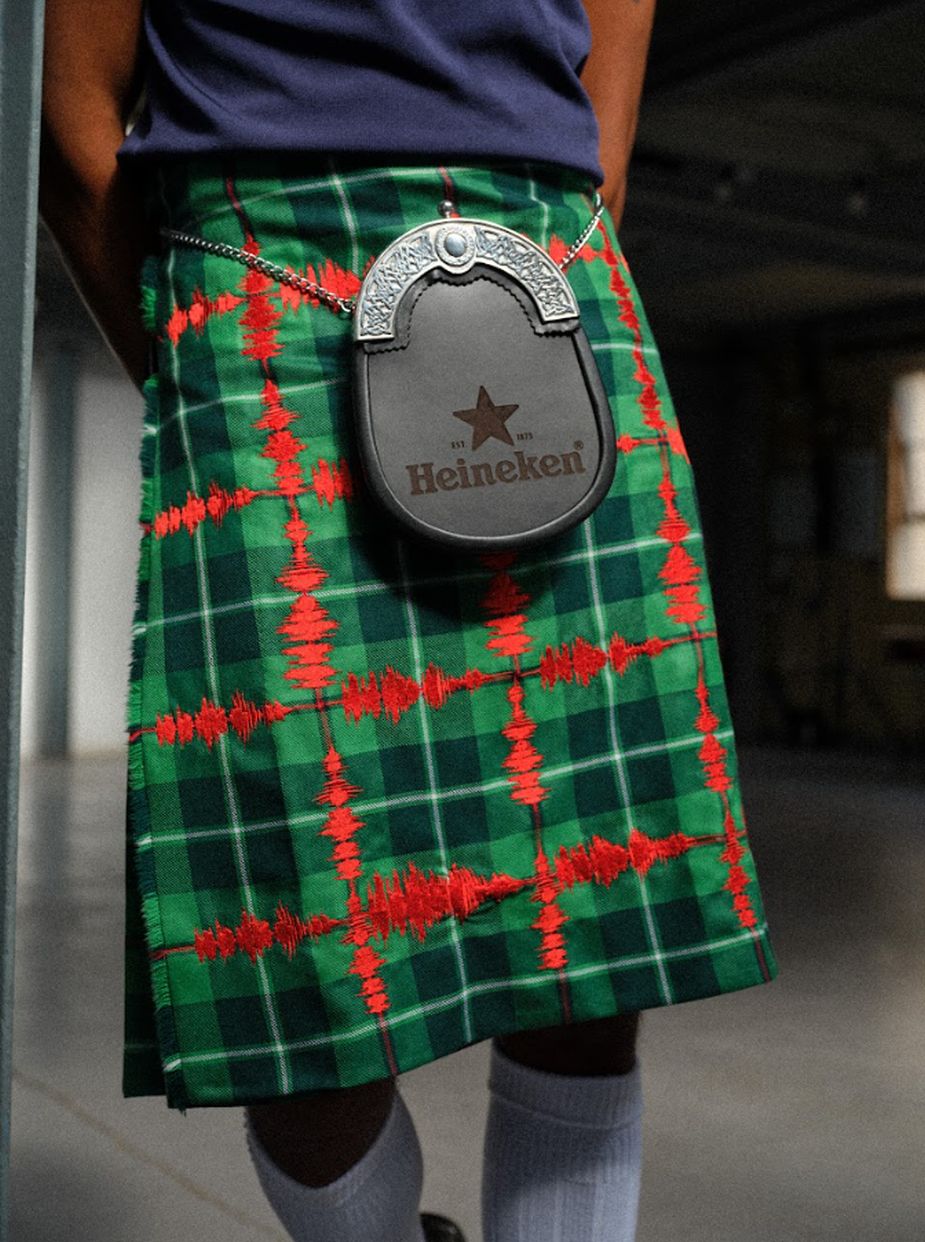
Heineken UK worked with creative PR agency The Romans and Scottish designer Siobhan Mackenzie to create a “soundwave kilt” tied to Scotland supporters and their chant “We’ll Be Coming.”
The kilt is framed as a tribute to the Tartan Army and Scotland’s return to the global stage after a 28-year wait, with the details outlined in the company’s official announcement.
Table of contents
Jump to each section:
- What the “soundwave kilt” is, and how it was made
- How this fits into culture-led brand expression
- What this means for marketers
What the “soundwave kilt” is, and how it was made
The “soundwave kilt” is a bespoke tartan design intended to capture the rhythm, volume, and energy of the Tartan Army chant “We’ll Be Coming.” It was designed by Siobhan Mackenzie and created in collaboration with Heineken UK, whose head office is in Edinburgh.
The concept leans on the identity of Scotland supporters as especially loud and passionate. The announcement notes that the Hampden Roar has even been associated with earthquake-level seismic activity, which helps set the context for why “sound” is the core material of the creative idea.
How this fits into culture-led brand expression
Rather than producing a standard matchday ad, the activation turns supporter culture into a tangible artifact. The kilt format does a few things at once:
- Signals locality through a distinctly Scottish garment and tartan tradition.
- Centers the fan, using a chant as the source material rather than using the team or tournament as the hero.
- Makes the “social” idea physical, so it can travel through PR, events, and community storytelling.
The announcement also positions the work around sociability and shared passions, reflecting a strategy where the brand’s role is to facilitate connection around rituals (chants, traditions, group viewing) that already exist.
What this means for marketers
Culture-led activations work best when they are specific enough to feel earned, and structured enough to travel beyond a single moment.
- Choose a fan truth that is unmistakably local.
A chant is not generic sports language. It is a community asset. Anchoring the idea in “We’ll Be Coming” makes it harder to replicate without feeling derivative. - Turn an intangible behavior into a usable creative asset.
“Sound” is experiential, but the tartan translates it into a design object that can be photographed, worn, and shared across channels. - Use collaborators to borrow credibility, not just style.
Naming a Scottish designer and building the piece around Scottish heritage helps the activation read as craft, not just branding. - Let PR be the distribution layer for a designed object.
A one-of-one item is inherently news-shaped: it can move via interviews, features, and appearances even without heavy media spend.
The broader implication is that fan marketing does not always need bigger media to feel bigger. When the creative unit is an object with cultural specificity, distribution can come from the community’s appetite to share symbols that represent them.
It also creates a cleaner narrative for brand positioning: the brand is aligning with the way fans express belonging, rather than asking fans to adopt a new ritual.
Over time, these artifacts can become repeatable frameworks: future drops can translate different chants, moments, or communities into new designs, without needing to reset the strategy each tournament cycle.