Ask Peter Duris what content actually converts on Kickresume, and the answer is almost anticlimactic. Not the AI resume builder. Not the blog. A page of real resumes, submitted by real people, who got hired at Google, McKinsey, and Spotify. No advice. No instructions. Just proof.
That should be a strange thing for the CEO of an AI-based career platform to admit. Peter co-founded Kickresume in 2013 with Tomas Ondrejka, initially as a simple tool to help themselves and friends write resumes for internships. It has since grown into a platform that helps candidates build resumes and cover letters, check them against applicant tracking systems, and tailor them to specific job ads, working with more than 8 million job seekers worldwide. Outside work, Peter keeps returning to surfing and snowboarding, less for the exercise than for the excuse to be fully offline with his friends and kids.
Speaking with ContentGrip, Peter walks through why the pages built from real examples outperform the pages built from good advice, why that gap is widening rather than closing as AI writing improves, and the one growth channel that quietly punished him for chasing volume instead of fit.
Table of contents
- The gap that shouldn’t exist anymore
- Why examples survive what advice can’t
- Depth is the only thing scale can’t fake
- When volume finds the wrong audience
The gap that shouldn’t exist anymore
In theory, AI should have closed the gap between generic content and standout content. Anyone can now produce a competent draft in seconds, resume, blog post, cold email, it barely matters. If quality writing were the scarce resource, AI should have flattened the competition.
It hasn’t. If anything, Peter has watched the opposite happen inside his own product. Kickresume partnered with PARWCC, the Professional Association of Resume Writers and Career Coaches, to survey 152 resume professionals on what AI-assisted resumes actually look like once they land on a recruiter’s desk. The top complaint, cited by 63% of respondents, wasn’t inaccuracy or bad formatting. It was generic, boilerplate content.
Peter’s explanation is simple. People generate a draft, feel relieved to have something on the page, and stop there. “The irony is that AI gets you to ‘done’ so fast you skip the part that actually makes you stand out,” he says.
That is the paradox worth sitting with. AI didn’t just fail to close the differentiation gap. It made the gap easier to fall into, because the effort that used to force differentiation, the blank page itself, no longer exists.
Nothing forces a writer to reach for something specific if a generic version is already sitting on the screen. “Those are self-knowledge problems, not writing problems,” Peter says, and the same line applies just as well to a brand struggling to say something only it could say.
Why examples survive what advice can’t
This is where Kickresume’s own content strategy starts to look less like an anticlimax and more like the correct read of the room. Peter says the honest answer behind most of the company’s best-performing pages is a single realization: “job seekers don’t want advice, they want examples.”
Advice is exactly the kind of content AI now produces at zero marginal cost. A guide on how to write a resume is a genre any language model can imitate convincingly, which means its differentiating value collapses the moment everyone can generate one.
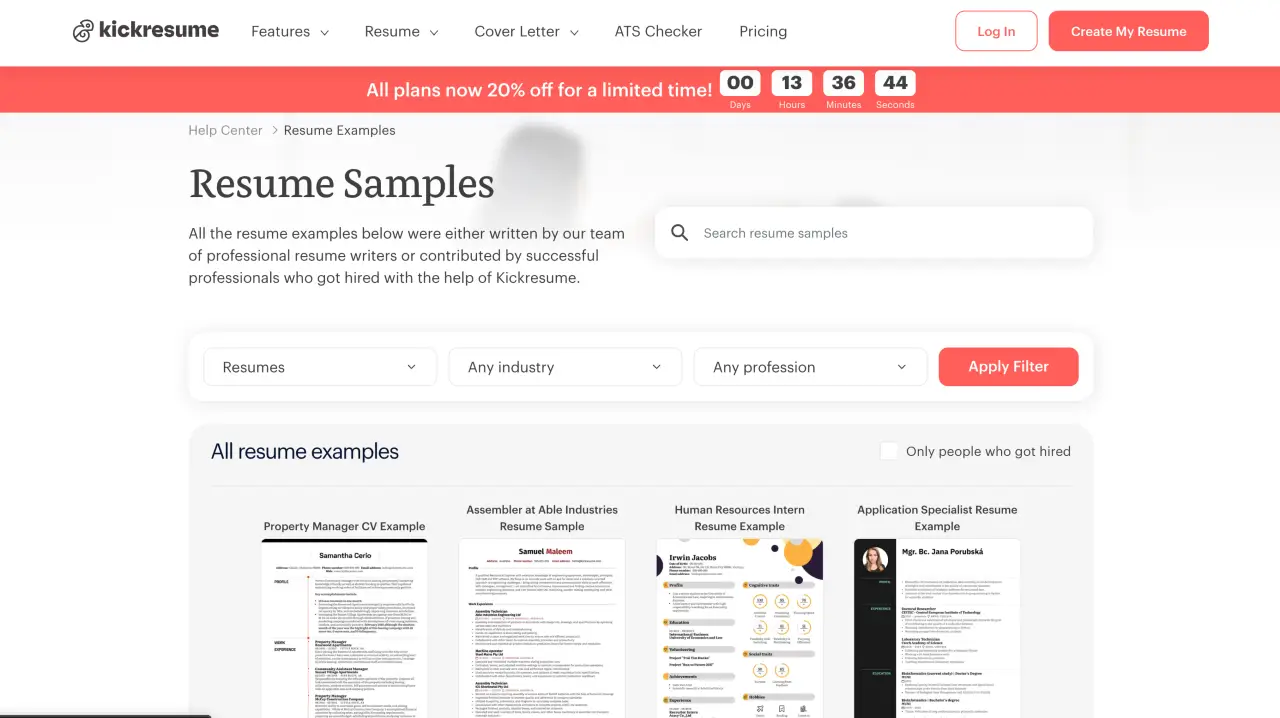
Unlike generic resume advice, real resume examples are rooted in actual hiring outcomes. That makes them inherently more difficult to reproduce through AI alone, which helps explain why they continue to outperform purely instructional content.
That is the quiet reason the shift from instructional content to example-based content drove a large share of Kickresume’s early organic growth, and why Peter says it still holds today. Real examples were never competing on writing quality in the first place. They were competing on a kind of evidence AI cannot manufacture.
Depth is the only thing scale can’t fake
The next problem Kickresume ran into was subtler. Traffic alone didn’t prove the strategy was working. Peter found that intent mattered more than volume.
A visitor searching for “software engineer resume example” was close to signing up. Someone arriving through a general career-tips article was much harder to move, even if that article pulled in more total readers.
So the team narrowed rather than broadened, building content that sat close to the product itself, resume samples, cover letter templates, ATS checkers, instead of top-of-funnel editorial that performed well in analytics but rarely translated into product use.
What made the narrowing compound, rather than just hold steady, was what Peter calls the library effect. “One example page is useful,” he says. “Ten thousand of them, organized by job title, industry, and experience level, become a destination. SEO compounds when you build genuine depth in a category.”
When volume finds the wrong audience
If proof and depth are the two pillars behind Kickresume’s growth, the third lesson is a warning about what happens when volume shows up without either one. Peter points to an experiment in influencer and affiliate marketing that, on paper, worked. Signups went up.
The problem only became visible afterward, in retention. As Peter puts it, “a lot of career-focused creators will say anything to share a promo code.” Kickresume started acquiring users who had signed up based on expectations the product was never going to meet.
Acquisition climbed. Retention fell. It took the team a long stretch to trace the drop back to where it started.
The lesson Peter draws from it cuts against a habit most growth teams default to under pressure. “The channel you use for acquisition shapes who shows up,” he says, and that shift carries downstream effects that rarely announce themselves early. “Volume without fit is expensive in ways that don’t show up immediately.”
A product that depends on a specific behavior to deliver value, in Kickresume’s case, actually sitting down and building a considered resume, needs users who understood what they signed up for. By the time the cost is visible, the channel already looks like a success.
Put the three lessons together and a single thread runs through all of them. AI made generation free, which means whatever a marketer chooses not to automate, real examples, depth, audience fit, is the only part of the funnel still doing real work. Kickresume built its growth around protecting exactly those three things. Everything else, it turned out, was replaceable.