If you live in Singapore, a convenience store run is usually a low-stakes routine: grab a drink, settle a snack craving, tap-and-go, done. But the behaviour 7-Eleven is leaning into is slightly different: people still want speed, they just also want the tiny thrill of finding something new.
In that context, 7-Eleven Singapore has rolled out a new brand campaign, “Find the good stuff,” positioning its stores less like a pit stop and more like a place for discovery. The company shared the update in an official announcement.
Table of contents
Jump to each section:
- Why 7-Eleven is trying to make convenience feel like discovery
- What the campaign includes, from a hero film to app rewards
- Collectibles and challenges: how 7-Eleven is using “retail play”
- What this means for marketers
Why 7-Eleven is trying to make convenience feel like discovery
7-Eleven’s shift is rooted in a simple reality: “convenient” is no longer a differentiator when every player is competing on proximity, speed, and basic price-value cues. The brand’s framing is that the next reason to choose a store is emotional, not functional: the joy of stumbling on something unexpected.
The company says a 2026 DFI Retail Group brand experience survey of more than 900 convenience shoppers pointed to three trust drivers: being “an exciting store to shop,” “a store that supports the community,” and “an innovative brand.” The subtext is that trust is being built less by “we’re near you” and more by “we’re worth visiting again.”
What the campaign includes, from a hero film to app rewards
At the centre is a hero brand film showing two friends moving through everyday moments that map to typical convenience-store needs: coffee and ready-to-eat meals, then later-night snack runs. 7-Eleven Singapore says the video has surpassed three million views across Instagram and Facebook.
The film also brings the app into the story, highlighting voucher drops, saver stamps, and value packs. That matters because it turns “discovery” into a habit loop: see something, try something, get rewarded, come back to see what’s next.
Collectibles and challenges: how 7-Eleven is using “retail play”
A big part of making a store feel “new” is giving people something to do beyond buying the obvious. 7-Eleven is layering in two mechanics that are already familiar to social-first shoppers: creator-led proof and collector energy.
One is the “Don’t judge till you try” challenge, fronted by four creators and built around sampling ready-to-eat items. 7-Eleven says it gave away 10,000 ready-to-eat items across selected stores in July, with each giveaway fully redeemed within an hour. The company also added an app incentive: SG$2 off ready-to-eat items for new and existing yuu app users while stocks last.
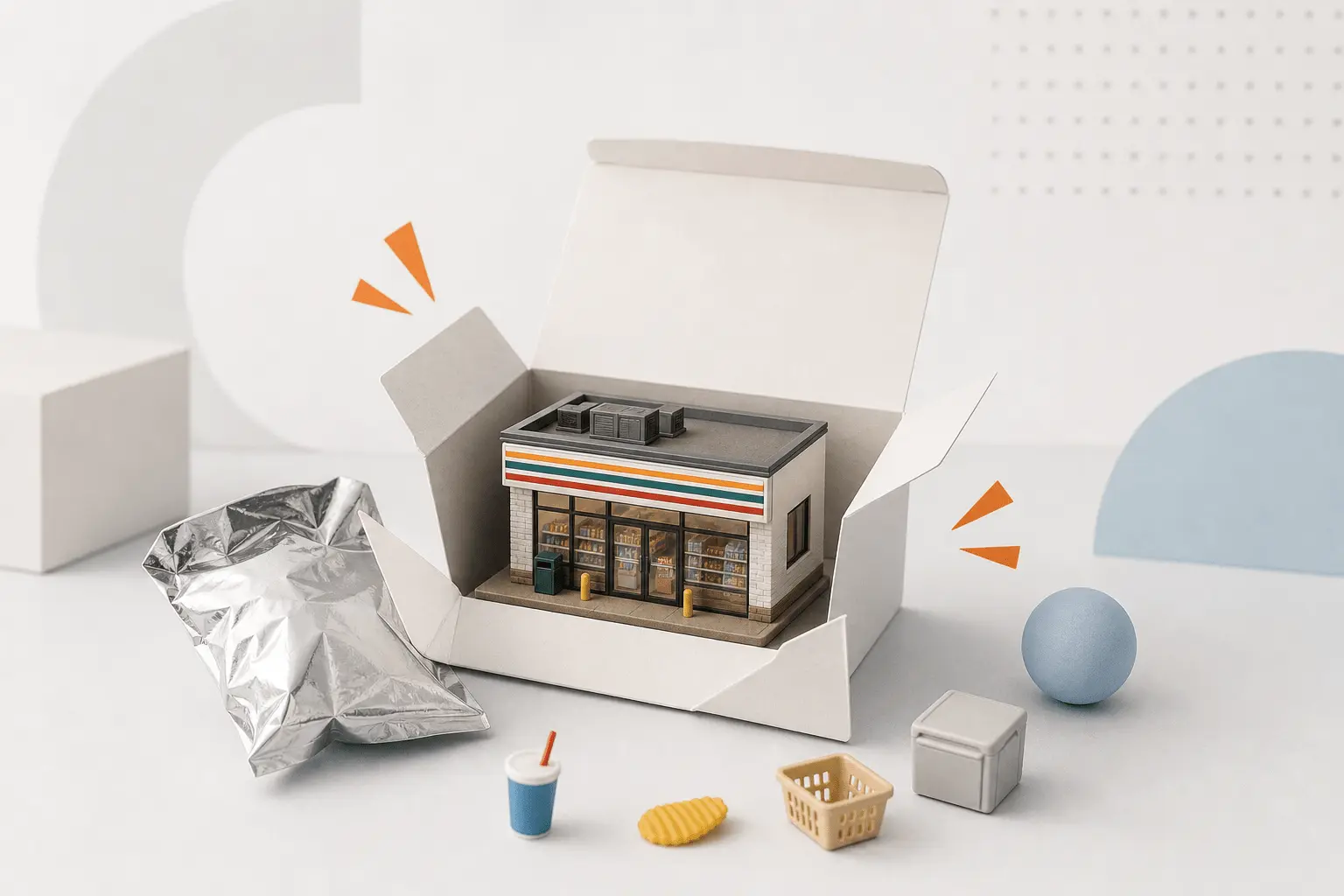
The other is a “build-your-own 7-Eleven store” blind box collection: five miniature store designs inspired by different shopping moments, plus one secret edition. The collectibles can be redeemed with a minimum spend of SG$28 (about $21) or purchased for SG$7.90 (about $6) each.

The campaign also has a physical footprint: point-of-sale materials across more than 450 stores, façade wraps at 11 flagship outlets, and campaign placements on selected MRT trains through July. That mix matters because it keeps the message consistent in the exact places where impulse decisions happen.
What this means for marketers
7-Eleven’s move is a reminder that “retail experience” is increasingly about micro-moments, not big flagship theatrics. The strategy is to make routine visits feel a bit more like browsing.
- Habit brands are competing on “freshness,” not just availability
When the product is convenience, the emotional hook becomes variety, exclusivity, and the feeling that there is always something new to notice. - Creators work best when they reduce judgement, not just drive hype
A “try it before you decide” framing is especially effective for food categories where perception lags behind reality, because it gives people social permission to change their mind. - Loyalty apps are shifting from points to moments
Voucher drops, stamps, and time-bound value packs turn the app into a reason to check in repeatedly, not just a place to store rewards. - Collectibles are a retail retention mechanic, not a side gimmick
Blind boxes and secret editions borrow from collector culture and make repeat visits feel purposeful, especially when tied to minimum spend thresholds. - Physical media still matters when it’s stitched into the commute
MRT placements and store-wide POS are not just reach plays; they reinforce the idea of 7-Eleven as a destination at the exact time people are deciding where to stop.
What’s most interesting here is how the brand is redefining “convenience” as a feeling rather than a distance metric. The store is still nearby, but the pitch is that it can also be fun.
For marketers, the signal is that retention is increasingly built through small, repeatable experiences that people can recognise and talk about, even if the “talk” is simply texting a friend about a weirdly good snack find. When routine becomes boring, novelty becomes strategy.