
Spider-Man fans do not just show up for the movie. They show up for the feeling of being part of a massive, shared obsession, where tiny personal details (favourite scenes, eras, characters, vibes) matter as much as the blockbuster moment itself.
Sony Pictures Canada and Spotify are leaning into that behaviour with an in-app experience for Spider-Man: Brand New Day that turns a fan’s own listening history into something that feels like a personalised “chapter” in the franchise. Instead of asking people to learn a new mechanic, it uses the data Spotify already has and wraps it in Spider-Man-style interaction.
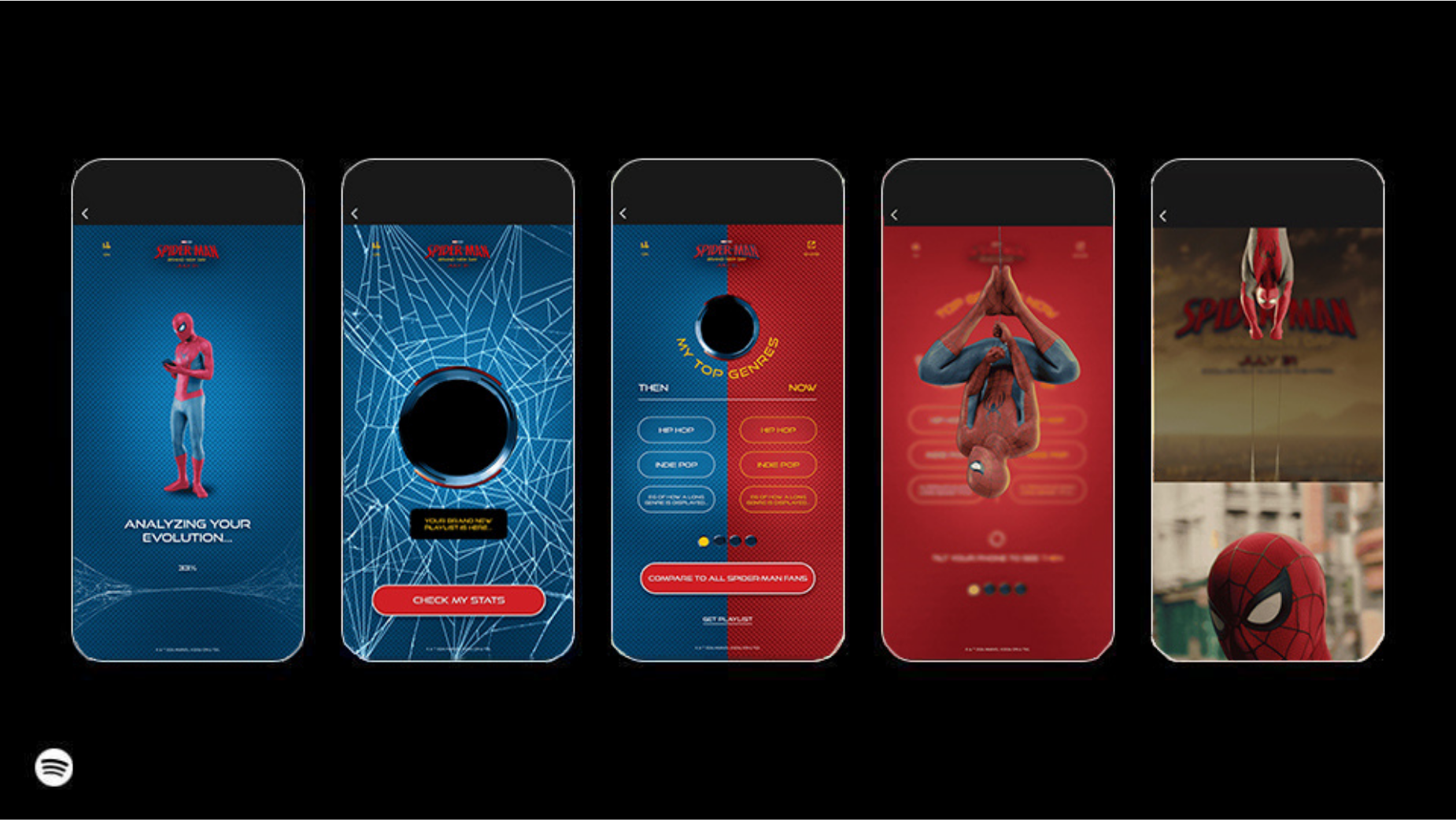
Table of contents
Jump to each section:
- What the Spotify experience actually does
- Why Spider-Man fandom makes personalisation feel worth it
- How the campaign uses “native” Spotify formats instead of ads-as-interruptions
- What this means for marketers
What the Spotify experience actually does
The campaign lives inside Spotify for users in the US and Canada, and it is built around a simple idea: your listening history can tell a story about change.
Fans see how their music taste has evolved over the past three years, tied to the film’s theme of “new beginnings.” They can also compare their listening patterns to the broader Spider-Man fan community and unlock a custom “Brand New Playlist” based on their listening evolution.
There is also a phone interaction mechanic designed to feel character-native: users flip their phone upside down, and Spider-Man flips into his iconic hanging pose while the data toggles between “then” and “now.” Alongside the in-app experience, the media mix includes custom audio spots with film dialogue and score, plus paid audio and video placements and podcast ads rolled out in phases across the release window.
Why Spider-Man fandom makes personalisation feel worth it
A lot of “personalised experiences” fail because they feel like a brand guessing. Fandom personalisation works better when it feels like recognition.
Spider-Man is a long-running franchise with multiple eras and interpretations, and fans tend to sort themselves into preferences, moods, and identity cues (the version they grew up with, the tone they love, the kind of hero story they relate to). That makes it unusually easy for fans to enjoy content that reflects them back, as long as it feels earned.
Spotify’s approach makes the personalisation about the fan first, not the movie first. The franchise becomes the wrapper, but the hook is, “This is what your last few years sounded like,” which is the kind of prompt people already engage with on Spotify. The “compare to the community” layer also matters because fandom is social. People want to know where they fit in the bigger crowd, not just what a brand thinks of them.
How the campaign uses “native” Spotify formats instead of ads-as-interruptions
The most interesting part is that the campaign is not just media placements. It is a product-like experience that uses Spotify’s strengths: behavioural data, familiar UI patterns, and audio as the primary canvas.
The audio spots with film dialogue and score, podcast ads, and paid placements still do the traditional awareness job. But the in-app journey does something ads struggle with: it creates a moment people can actively play with. The phone-flip mechanic is a small detail, but it is the kind of “I have to try it” interaction that makes an experience feel designed for a touchscreen culture, not ported from a billboard mindset.
Spotify also framed the work as coming from fan behaviour insights, which is a subtle but important creative signal. When the mechanic starts from how people already behave, the result tends to feel less like a sponsorship and more like an extension of the platform.
What this means for marketers
This kind of fandom-first personalisation works because it treats fans like participants, not impressions.
- Use personalisation to tell someone something about themselves
Spotify’s angle is not “here is Spider-Man.” It is “here is you, through a Spider-Man lens.” That is a stronger reason to explore, screenshot, or share. - Make the interaction match the character, not just the channel
The upside-down phone flip is a tiny piece of theatre, but it makes the experience feel specific to Spider-Man rather than generic “interactive ad tech.” - Community comparison can be more motivating than pure customisation
Letting fans compare themselves to the broader fan community taps into the social side of fandom, where belonging and identity matter as much as content. - Blend product experience with media, instead of relying on placements alone
Audio and podcast ads can build reach, but the in-app experience gives the campaign something to do inside the platform. That can deepen attention without demanding a separate landing page journey. - Behavioural data feels less creepy when it is framed as reflection
“Your listening evolved” reads like self-insight, not surveillance. The creative framing can determine whether data-driven work feels fun or invasive.
The broader signal here is that fandom marketing is increasingly moving toward platform-native experiences that feel like collectibles or mini rituals, not just trailers and takeover ads. When a campaign gives fans a personalised “proof” they belong in the moment, they are more likely to treat it like part of the culture, not just part of the media plan.