There is a familiar kind of TV-watching moment when a meal on screen becomes the thing you suddenly want for dinner. Instacart is building the launch campaign for its new AI shopping assistant around that impulse, using recognizable food scenes from Shrek, Scooby-Doo, The Office and A Charlie Brown Thanksgiving as prompts rather than decoration.
The idea is simple enough to understand without an AI explainer. A viewer sees food on screen, has a craving or dinner idea, then asks Clementine to turn that thought into something they can actually cook and buy. That makes the entertainment reference do two jobs at once: it grabs attention through recognition and demonstrates the product through behavior people already understand.
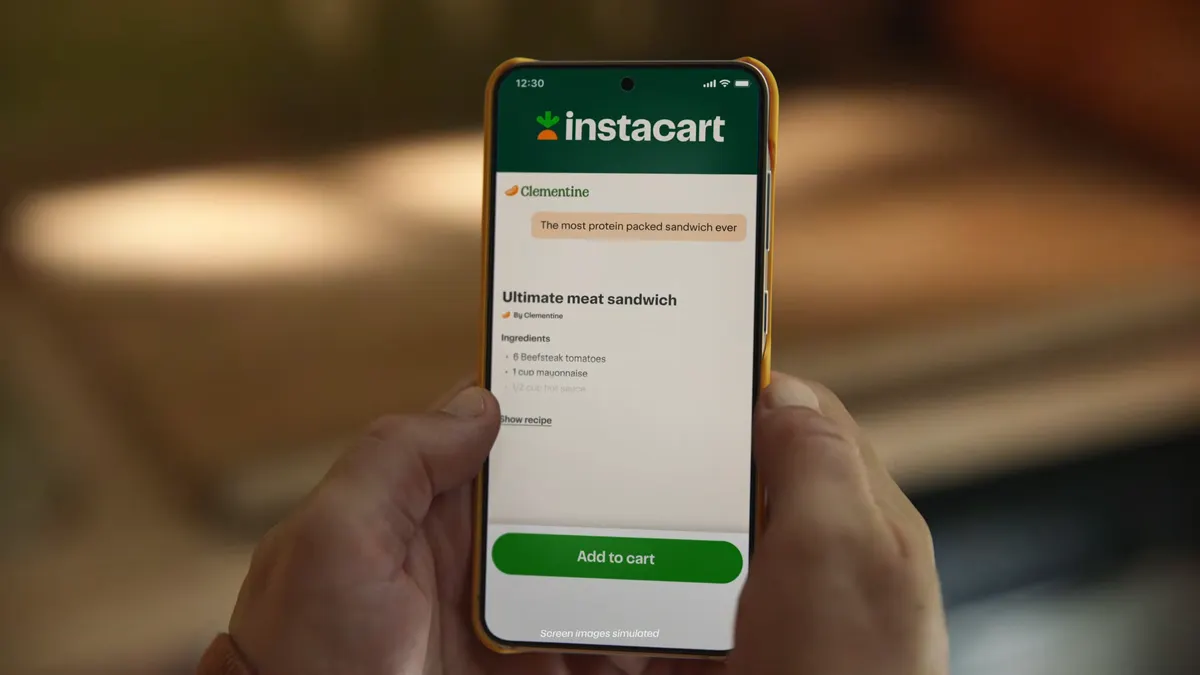
Table of contents
- How pop culture becomes a product demo
- Why nostalgia helps explain an AI assistant
- The bigger move inside Instacart’s shopping funnel
- What marketers can take from the campaign
How pop culture becomes a product demo
The campaign, called “Turn any idea into an order,” runs across linear TV, OTT, YouTube, audio, social and Instacart’s own app. Marketing Dive reports that the first spots include a woman watching Shrek and deciding she wants a one-pan dinner, which Clementine turns into a butternut squash risotto idea, and a Scooby-Doo reference built around the franchise’s famously oversized sandwiches.
More spots tied to The Office and A Charlie Brown Thanksgiving are set to follow later in the fall. Instacart’s in-house agency Local Produce developed the campaign, Prettybird handled production and Brian McGinn directed the spots.
The important creative choice is that Clementine is not introduced as a list of AI capabilities. Viewers see the problem first: “that food looks good,” “I want something like that,” or simply “what should I make?” The assistant appears only after the craving already makes sense.
That sequence gives the technology a role inside an existing habit instead of asking people to create a new one.
Why nostalgia helps explain an AI assistant
Nostalgia is useful here because the campaign is not really asking viewers to care about Shrek or Scooby-Doo as licensing news. It is borrowing the instant recognition of those worlds to make a new shopping behavior feel familiar.
A Scooby-Doo sandwich already communicates excess before anyone explains it. A meal scene in Shrek can trigger a reaction even if the actual food is deliberately unappealing. The reference does the emotional work quickly, then Clementine shows how that loose inspiration can become a practical meal.
That matters for an AI product because “AI shopping assistant” is still an abstract category for many consumers. A recognizable cultural cue gives people a concrete starting point.
Jasmine Taylor, Instacart’s vice president of brand marketing, said the team wanted Clementine to feel like “a warm and capable presence that helps you think ahead.” The campaign supports that positioning by making the assistant part of a domestic, everyday decision rather than a futuristic technology showcase.
The bigger move inside Instacart’s shopping funnel
Clementine itself launched earlier in September across the U.S. and Canada. In its product announcement, Instacart says the assistant is built on more than 1.6 billion lifetime orders, a catalog of more than 2 billion items and more than 10 million daily inventory signals from nearly 100,000 stores.
Users can ask for meal ideas, budget-friendly lunches, high-protein dinners or their usual grocery items. They can also turn recipes, screenshots or handwritten shopping lists into carts.
Instacart says orders placed through Clementine contain more items on average and exceed its $115 average basket size. That is company-reported early performance, not an independent measure of long-term adoption, but it explains why the marketing matters. Clementine is not just another feature inside search. It gives Instacart a chance to enter the decision before a shopper knows exactly what they want to buy.
The pop-culture campaign makes that shift visible. Inspiration can begin somewhere completely outside the grocery app, then Clementine tries to capture the next step.
What marketers can take from the campaign
The strongest part of the campaign is not the number of entertainment properties. It is how those properties are used to make a product behavior understandable.
For marketers introducing AI features, there is a useful pattern here. Start with a human moment people already recognize, then show the AI solving the next practical step. The product becomes easier to understand because the audience does not need to learn the technology before they understand the benefit.
Instacart is also continuing a broader creative habit. Its previous Super Bowl work brought together recognizable brand mascots and characters, showing that Local Produce already sees familiar cultural shorthand as a way to make grocery shopping feel bigger than a utility.
With Clementine, that approach is being asked to do more than generate attention. The references help teach a new path from entertainment to inspiration, from inspiration to a prompt, and from a prompt to a cart.
That is a more useful way to market an AI assistant than simply calling it intelligent. The campaign shows what the assistant is for.