OpenAI is pushing ChatGPT beyond the familiar prompt-and-response model with Dots, persistent AI agents designed to keep working after a user steps away. For marketing and content teams, the important change is the operating model: a Dot can maintain context, use its own cloud computer, work across connected applications, and return with completed work or decisions that need approval.
The company introduced Dots on September 29 as agents powered by GPT-6 Astra that can work toward goals 24/7 and connect to more than 4,000 apps through OpenAI’s plugin ecosystem. OpenAI is beginning the rollout across Pro, Business Premium, and Enterprise plans in eligible markets, with specialist Dots for organizations starting through focused enterprise pilots.
Table of contents
Jump to each section:
- Why Dots changes the unit of AI work
- What the launch means for marketing operations
- OpenAI is competing for the agent layer
- The control model matters as much as the autonomy
- What marketers should test first
Key Takeaways
- Dots are persistent agents that can keep working between conversations instead of waiting for a new prompt.
- OpenAI is tying the product to its plugin ecosystem, cloud-computer execution, and workplace channels such as Slack and Teams.
- For marketing teams, the near-term opportunity is recurring operational work, but governance and approval design will determine how much can safely run unattended.
Why Dots changes the unit of AI work
Most generative AI tools still organize work around a session. A user opens a chat, supplies instructions, receives an answer, and then starts another interaction when the next task arrives. Dots are designed around an ongoing goal instead.
A Dot gets its own cloud computer and browser, can connect to applications a user has authorized, and can continue working across projects without requiring every step to be manually orchestrated. Users can inspect the Dot’s computer, message it in ChatGPT, Slack, or Teams, and provide feedback as the work progresses.
That makes the product closer to a persistent work layer than a single assistant window. The distinction matters for marketers because many high-friction tasks are continuous rather than one-off: checking campaign feedback, updating launch materials, preparing recurring reports, monitoring incoming requests, and moving drafts through review.
4,000+ connected apps are available to Dots through OpenAI’s plugin ecosystem, according to OpenAI.
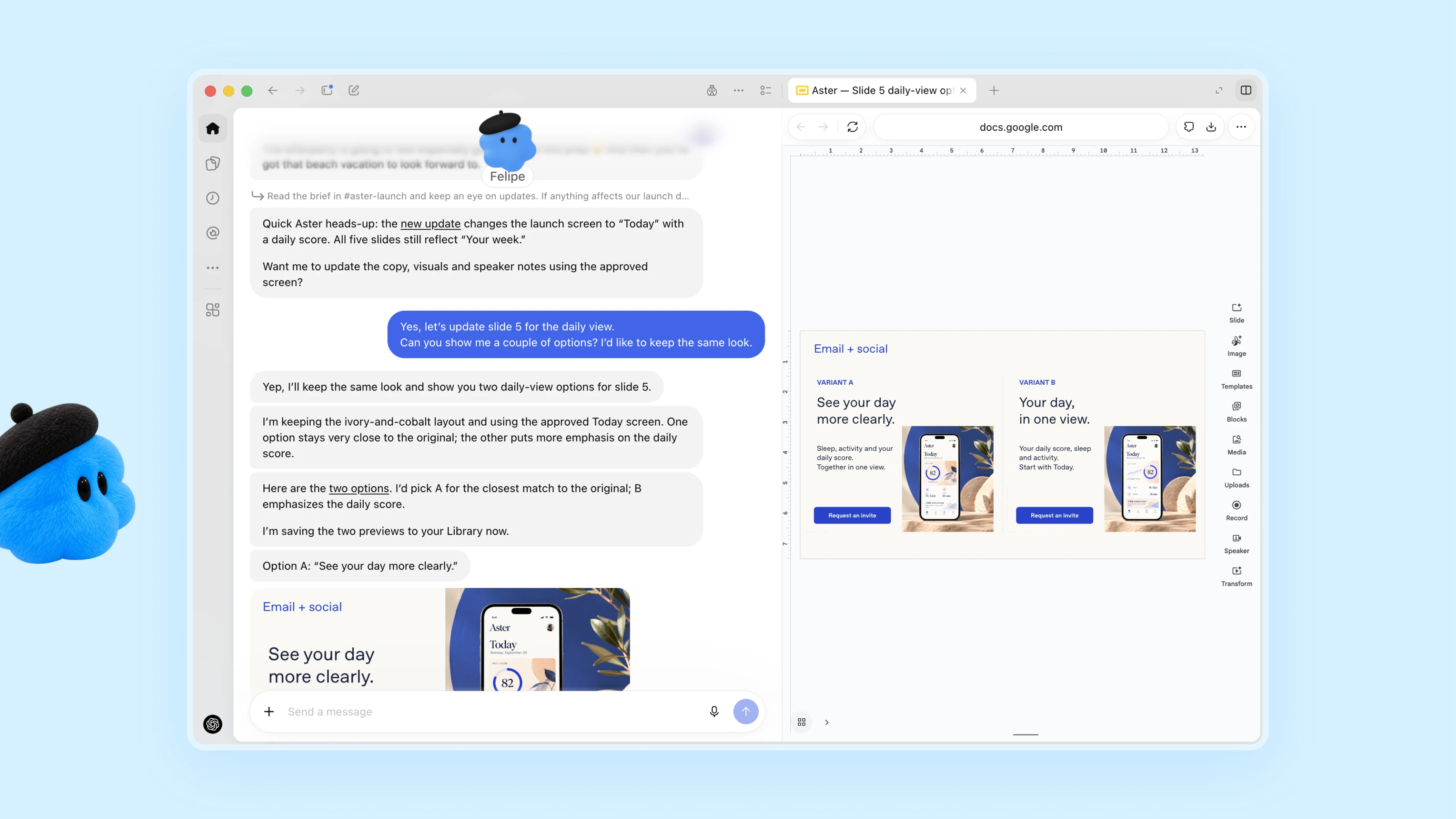
OpenAI’s own examples include a product-launch workflow where a Dot learns the audience, positioning, and creative standards, then revises launch materials when product scope changes. Another example focuses on content production, where an agent can process an interview transcript, identify clips, prepare show notes, and draft social posts for approval.
What the launch means for marketing operations
The practical opportunity is not simply faster copy generation. Persistent agents can potentially connect work that is currently split across separate tools, inboxes, documents, project boards, analytics systems, and approval queues.
A marketing team could assign an agent an ongoing launch objective rather than repeatedly prompting for individual deliverables. If product requirements change, the same agent could identify the downstream materials that need revision, update drafts, and surface the parts that require human judgment.
That changes where automation sits in the workflow. Traditional marketing automation usually depends on predefined triggers and rules. A persistent agent can interpret changing context, choose among tools, and decide which intermediate steps are needed to move toward a broader goal.
The trade-off is that teams need much clearer definitions of quality. An agent that works continuously will reproduce weak instructions continuously too. Brand voice, escalation rules, data access, approval thresholds, and the definition of a finished deliverable become operating inputs rather than documentation that sits beside the workflow.

OpenAI is competing for the agent layer
Dots arrive as the market for persistent personal agents becomes more crowded. Reuters reported that OpenAI is positioning the product against Meta’s Muse as companies race to make autonomous AI useful across everyday work.
OpenAI’s advantage is distribution across products that businesses may already be using. Dots can draw on ChatGPT Work and Codex, connect through the plugin ecosystem, and operate through workplace channels. OpenAI is also working with Microsoft to bring specialist Dots into Agent 365 governance controls.
That combination matters more than the character branding around the product. The competitive question is increasingly which agent can operate across enough of a company’s existing stack, preserve useful context, and pass enterprise security and governance requirements.
More than 35 million weekly users were using Codex and ChatGPT Work by September 29, 2026, according to Reuters citing OpenAI.
For marketers choosing AI tools, this makes ecosystem fit a more important buying criterion. A strong model is useful, but an agent that cannot access the systems where briefs, approvals, analytics, assets, and customer data live will still require substantial manual coordination.
The control model matters as much as the autonomy
Giving an agent more persistence also increases the cost of a bad action. OpenAI says Dots use built-in rules to decide when they can act independently and when they need approval. Users can create Custom Rules that allow, require approval for, or block specific actions.
The product also separates proactive research from higher-risk actions. When a user is not actively working with a Dot, OpenAI says proactive research uses connected apps through read-only tools. Sensitive tasks such as changing passwords remain user-controlled.
These controls are especially important for marketing teams because the systems an agent may touch can include customer data, ad accounts, content management systems, email platforms, and public publishing channels. The value of an always-on agent depends on whether teams can grant enough access to make it useful without turning broad access into broad authority.
For that reason, marketers should evaluate autonomy and permissions together. A pilot that only measures output speed will miss the more important operational question: how often does the agent need intervention, and are those intervention points placed before consequential actions?
What marketers should test first
The best initial workflows are recurring, bounded, and easy to review. Content repurposing, campaign feedback triage, launch-document maintenance, competitor monitoring, and recurring reporting are more suitable starting points than workflows that can directly publish, spend money, or change customer records.
Teams should also measure the handoff cost. If a Dot completes 80 percent of a workflow but leaves the remaining 20 percent scattered across unclear approvals, the automation may simply move coordination work rather than remove it.
A useful pilot should therefore track four things: time saved, error rate, number of human approvals, and how often the agent needs its instructions corrected. Those measures reveal whether persistence is producing reliable operational leverage or just more background activity.
OpenAI’s Dots make the direction of travel clearer. AI vendors are moving from tools that answer requests toward agents that hold context and keep projects moving. For marketers, the shift will be valuable when these agents can be trusted with repetitive operational work while leaving consequential decisions visible and reviewable.