Santa’s reindeer have a new look on Canadian streets this holiday season. They are red delivery trucks with familiar names, and the sleigh they are pulling is less important than what happens when the convoy reaches its destination.
For people who grew up writing a letter to Santa or posting a card to someone far away, the postal service already occupies an unusual place in Christmas folklore. Its vehicles are ordinary working objects, yet they carry some of the most personal things people send each December. That tension between everyday delivery and holiday imagination sits at the heart of Canada Post’s Holiday Fleet.
On November 23, Canada Post and creative agency T&P Canada brought nine reindeer-themed vehicles into Toronto for a journey ending with Santa arriving at a winter market. The live event is part of a wider seasonal campaign that turns the postal operator’s actual delivery network into a holiday character, without pretending that the logistics behind it disappear.
Table of contents
Jump to each section:
- How nine reindeer trucks crossed Toronto
- Why Santa letters give the idea a history
- The Holiday Fleet goes beyond one market
- What the trucks say about Canada Post
- What marketers can learn from the Holiday Fleet
How nine reindeer trucks crossed Toronto
The journey started at the Albert Jackson Processing Centre in Scarborough. From there, a formation of nine Canada Post vehicles traveled through Toronto to St. Lawrence Winter Market. Each truck stood in for one of Santa’s reindeer. Rudolph led the procession and carried the important passenger: Santa Claus.
At the market, Santa’s arrival opened the annual Free Santa Photos Program. That ending gave the fleet a destination that a family could understand without knowing anything about delivery networks, agency names or media plans. The trucks were no longer just advertising props. They had a job in the story, and that job ended in a recognizable holiday activity.
The November 23 campaign coverage identifies T&P Canada as the creative agency. A separate event-photo gallery shows vehicles on the road and Santa at the market. The imagery matters because the idea depends on real trucks entering public space, not only on a digital rendering of a festive vehicle.

The Holiday Fleet’s Santa delivery at the Toronto winter market. Image: T&P Canada / LBB.
The event made a promise in miniature: a national delivery company could bring a bit of Christmas to one specific street. That is a simpler and warmer proposition than explaining how many parcels fit into a sorting center. It also leaves the actual delivery operation visible rather than replacing workers and vehicles with an unrelated fantasy world.
Why Santa letters give the idea a history
The reindeer joke works because Canada Post already has a place in the story of Santa’s mail. The postal operator’s holiday program invites children to write a letter to Santa, a tradition that treats a familiar address and an ordinary envelope as a small act of imagination.
On its official Holiday Fleet campaign page, Canada Post connects the trucks to letter writing, seasonal stamps, a printable craft activity and a story about the fleet. One image shows a child writing to Santa in red crayon. Another shows Rudolph as a red delivery truck in a snowy landscape. These are different ways for the same idea to enter a household.

Rudolph appears as a Canada Post truck in the official Holiday Fleet materials. Image: Canada Post.
The important point is not that consumers are suddenly discovering Santa through an advertisement. It is that the creative idea attaches itself to a tradition the brand has a legitimate reason to participate in. A postal operator carries letters; families write letters at Christmas. Making the carrier part of the mythology is a natural extension of that relationship.
There is a practical side to this, too. The official campaign page links a make-your-own paper vehicle activity to the story, so the fleet can move from a street parade into something a child could print and color at home. It is a modest, tangible extension, not a claim that the campaign is viral or that every household is joining in.
The Holiday Fleet goes beyond one market
The Toronto journey was the live starting point rather than the whole campaign. Canada Post says the Holiday Fleet vehicles will also appear in Santa Claus parades in Montréal, Ottawa and Toronto. On screens and outdoor placements, individual reindeer trucks travel through different Canadian winter scenes.
WPP Media planned the broader TV, digital, social and out-of-home schedule, which the campaign announcement says will run through December 20. This arrangement gives the idea two forms: a physical convoy that can be photographed and a set of recognizable vehicles that can recur in other formats after the local event ends.
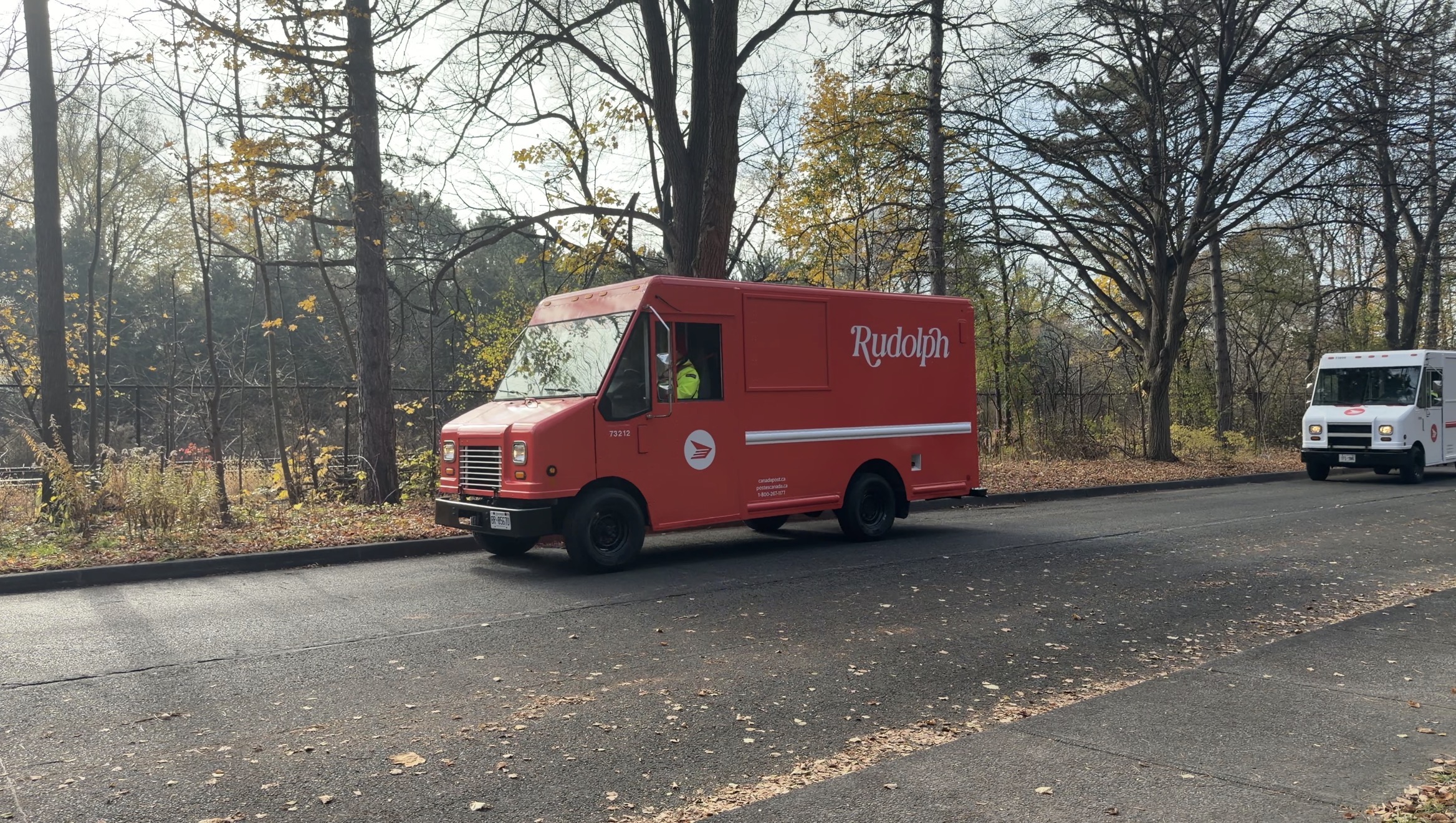
Canada Post’s reindeer-themed fleet on the road. Image: T&P Canada / LBB.
The appeal of naming the vehicles is straightforward. A red delivery truck can look almost identical to another red delivery truck, but Rudolph, Dasher, Dancer and Blitzen give viewers characters to recognize. That turns a uniform operational fleet into something that has the shape of a story, while leaving the real brand’s most visible assets intact.
The campaign does not provide independently verified reach, sentiment or sales figures. Its public components show the creative route and planned distribution, not proof that the work has changed preference for a delivery service. The distinction matters because an entertaining holiday moment and a measurable marketing result are different things.
What the trucks say about Canada Post
Behind the playful vehicles is a serious branding challenge: how does an organization known for essential operations make people feel something about those operations? In August, Canada Post introduced its broader Everywhere Canada Goes brand platform, intended to emphasize how the postal service connects people and businesses across the country.
The Holiday Fleet gives that platform a seasonal interpretation. Instead of relying only on service messages about locations, parcels and infrastructure, it gives those same assets a human purpose. People may forget an abstract claim about nationwide coverage, but they can follow a convoy that is trying to deliver Santa to a winter market.
Jennifer Justin, Canada Post’s director of brand strategy and advertising, describes the work behind the festivities as an “enormous logistical feat.” Her point is especially relevant to a company whose workers usually stay out of the holiday advertisements built around presents. This creative concept puts the vehicles and the front-line network back into the picture.
17.8 million Canadian addresses. That is the reach of Canada Post’s delivery network as described by T&P Group strategy executive Erika Maginn, not a campaign audience figure.
It also arrives during a period when Canada Post has publicly discussed reliability and customer confidence. In an October corporate update, the corporation said rebuilding trust and modernizing service remain priorities. A reindeer fleet will not solve delivery issues, but it can show why the company’s work matters to the people on the receiving end.
There is a useful distinction between a festive ad that borrows a holiday symbol and one that gives that symbol an operational role. Here, the postal trucks are still postal trucks. Their transformation depends on their existing purpose, which is precisely what gives the story credibility.
What marketers can learn from the Holiday Fleet
For marketers, the Holiday Fleet is a reminder that a familiar cultural ritual can make an everyday service more interesting without hiding what the service actually does. The important decisions are about which parts of the story can exist in the real world and which need only exist in an advertisement.
- Find the ritual the brand already belongs to. Canada Post did not have to invent the idea of writing to Santa. Its holiday letter program already connected the organization to that family activity. The campaign expanded an existing relationship rather than forcing the postal service into a random seasonal joke.
- Let the product or operation perform an action. The trucks are not merely parked next to a Christmas decoration. They move through a city and deliver Santa. Giving the familiar asset a job makes the central image easy to understand and easy to describe.
- Make the public event part of a larger creative system. A live Toronto arrival gives the campaign a real location and a set of photographs. The reindeer names and landscape imagery allow the same characters to continue across outdoor, social and video placements, without requiring the entire event to be repeated elsewhere.
- Keep brand affection separate from business results. The campaign can credibly be assessed for its concept, cultural relevance and execution. Measuring whether it improves trust or demand would require evidence that has not been disclosed publicly.
A useful comparison is the 2026 Bergdorf Goodman holiday windows in New York. The retailer created an invitation-themed seasonal experience that people could encounter in public before considering a purchase. Canada Post’s version is more mobile and built around service vehicles, but both treat a city as part of a holiday narrative rather than keeping the story entirely on a screen.
The wider lesson is less about decorating the outside of a business and more about recognizing what that business already contributes to a shared moment. A letter arriving, a gift being delivered or a child meeting Santa can carry emotional significance even when the machinery behind it looks routine.
For Canada Post, turning nine ordinary vehicles into reindeer makes that machinery visible in a playful way. The trucks still have to do the work. The campaign asks people to see a bit of the holiday story inside that work.