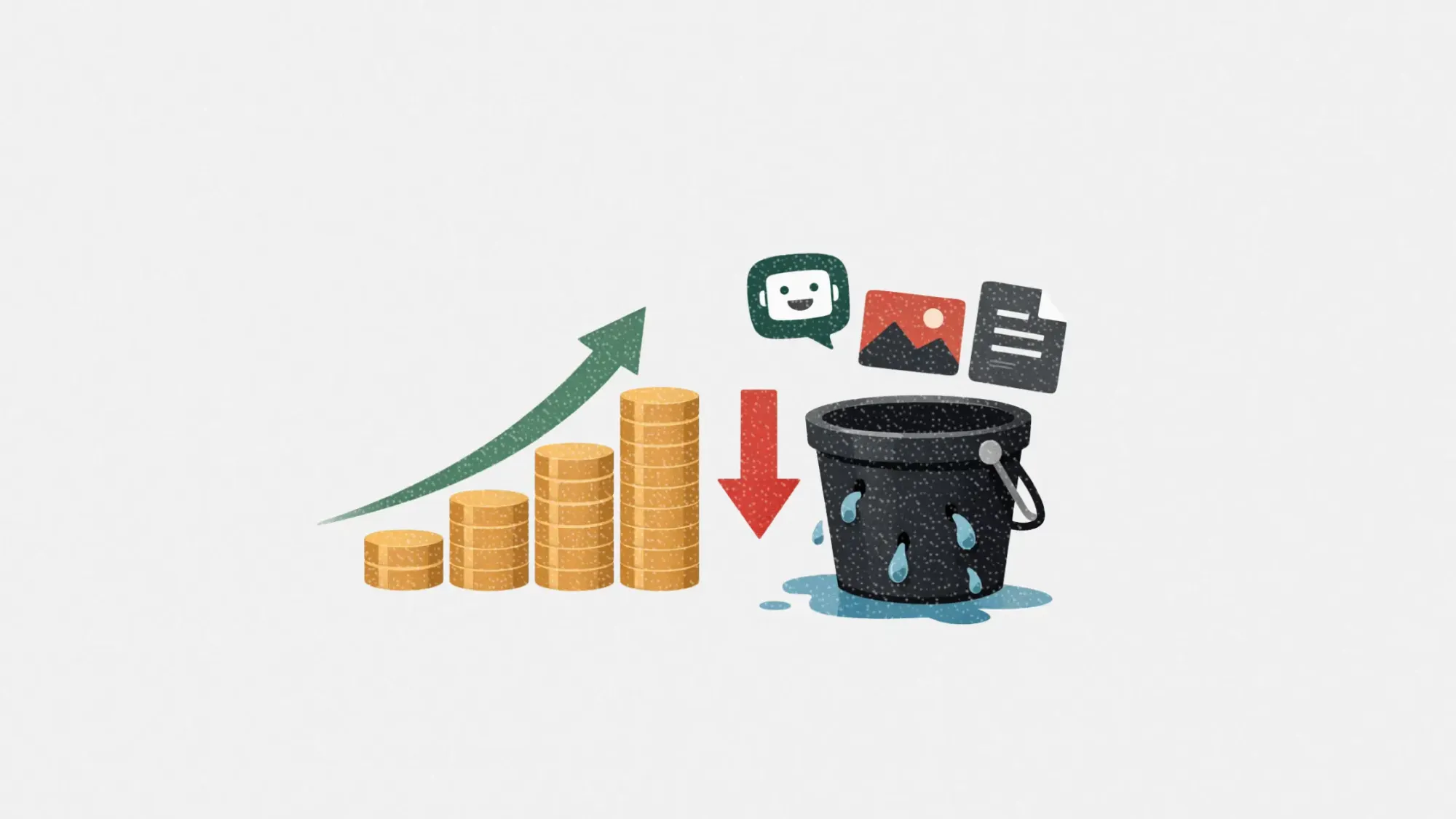
AI-powered apps are everywhere right now. From writing assistants to photo editors, they are among the fastest-growing products in the subscription economy.
But behind the revenue growth, there is a structural problem emerging.
This article explores what the State of Subscription Apps 2026 report reveals about AI apps, and why strong early monetization is not translating into long-term value.
Short on time?
Here’s a table of contents for quick access:
- Why AI apps monetize better than traditional apps
- Why retention is the real challenge for AI apps
- What’s driving the AI app churn problem
- What marketers should do differently
 Patrecia Meliana
Why AI apps monetize better than traditional apps
On the surface, AI apps look like a monetization success story. According to the report, AI-powered apps generate 41% more revenue per payer compared to non-AI apps . This reflects strong willingness to pay, especially for tools that promise productivity gains or creative output.
Several factors are driving this:
- Clear, immediate value proposition – Users often understand what the product does within seconds
- High perceived utility – AI tools are positioned as time-saving or income-generating
- Premium pricing acceptance – AI has reset expectations around subscription pricing, with users more willing to pay higher monthly fees
For marketers, this creates an attractive scenario: faster conversion, higher ARPU, and strong early traction.
But that is only half the story.
Why retention is the real challenge for AI apps
Despite strong monetization, AI apps face a significant retention gap.
The same report shows that AI apps experience 30% higher churn compared to non-AI apps . This creates a classic growth tension:
- High acquisition and conversion
- Weak long-term retention
In other words, AI apps are very good at getting users to pay, but not as good at keeping them subscribed. For subscription businesses, this is a critical issue. Retention, not acquisition, is what drives sustainable revenue and profitability.
What’s driving the AI app churn problem
There is no single reason behind this churn problem. Instead, it is a combination of structural factors tied to how AI products are used.
1. Novelty wears off quickly
Many AI apps deliver an impressive first experience. But once users satisfy their initial curiosity or complete a specific task, usage drops off. Unlike utility apps with recurring needs, some AI tools are episodic by nature.
2. Value is not always continuous
AI apps often solve specific problems:
- Generate content
- Edit images
- Summarize documents
Once that task is done, the user may not return frequently enough to justify a subscription. This creates a mismatch between subscription pricing models and actual usage patterns.
3. Competition is increasing rapidly
The same forces that make AI apps easy to build also make them easy to replicate. Users are constantly exposed to:
- New tools
- Free alternatives
- Features bundled into larger platforms
This reduces switching costs and increases churn.
4. Cost structure pressures pricing
Unlike traditional software, many AI apps have real marginal costs tied to usage. This pushes companies to:
- Limit free access
- Shorten trials
- Push users toward paid plans faster
While this improves early monetization, it can also increase churn if users do not perceive sustained value.
What marketers should do differently
For marketers and growth teams working on AI products, the playbook needs to evolve.
Here are the key shifts to consider:
- Focus on repeat use cases, not just initial value
Build messaging and onboarding around why users should come back, not just why they should try the product.
- Align pricing with usage patterns
Consider hybrid models, usage-based pricing, or tiered access instead of forcing pure subscriptions.
- Extend the “aha moment” beyond Day 0
AI apps excel at first impressions. The challenge is creating a second and third moment of value.
- Invest in retention loops early
Features like saved outputs, personalization, and workflows can increase stickiness.
- Differentiate beyond core AI functionality
The model is not the product. Experience, integration, and workflow design are where long-term value is built.
AI apps are proving that monetization is not the hardest part of building a subscription product anymore.
Retention is.
The current wave of AI products is optimized for acquisition and conversion, but not yet for sustained engagement. That gap represents both a risk and an opportunity. The teams that solve retention early will not just ride the AI wave. They will define the next phase of the subscription economy.


Leave a Reply