
Founder-led PR is quickly becoming the dominant playbook for B2B visibility.
As AI-generated content floods search results and feeds, audiences are shifting their trust away from faceless brands toward credible individuals with clear perspectives.
This article explores why founder-led PR is gaining momentum, what separates real thought leadership from noise, and how marketers can operationalize executive visibility into a strategic advantage.
Short on time?
Here’s a table of contents for quick access:
- Why founder-led PR matters in 2026
- What founder-led PR actually means
- What makes a founder a thought leader not just visible
- Common mistakes in founder-led PR
- What good founder-led PR looks like
 Falencia Naoenz
Why founder-led PR matters in 2026
PR is no longer just about company announcements. It is about who is speaking.
AI search is fundamentally changing how information is surfaced. Credible voices, cited experts, and consistent viewpoints are now more likely to be referenced than brand-owned content. In a landscape saturated with AI-generated outputs, human perspective becomes the differentiator.
This shift is already reflected in buyer behavior. 99% of executives say thought leadership is important when evaluating companies, while 75% say it has directly led them to research a product or service they were not previously considering. At the same time, 73% view thought leadership as a more trustworthy signal than traditional marketing materials.
Trust is the underlying driver. 81% of consumers say they need to trust a brand before buying, and founder-led brands can see up to 2.3x higher engagement. In some cases, high-quality CEO thought leadership has been linked to hundreds of millions in shareholder value.
The takeaway is clear. Executives are no longer just spokespeople. They are distribution channels, credibility signals, and strategic assets.
Patrecia Meliana
What founder-led PR actually means
Founder-led PR is often misunderstood. It is not influencer marketing. It is not personal branding for ego. And it is not about posting frequently without direction.
At its core, founder-led PR is strategic storytelling led by the founder or executive team. It connects personal insight with business relevance to build trust at scale.
Effective founder-led PR typically includes:
- Personal insights drawn from real operating experience
- Clear industry perspectives that challenge or reframe assumptions
- Behind-the-scenes thinking that audiences cannot get elsewhere
The goal is not visibility for its own sake. It is to create a consistent narrative that positions the executive as a credible authority in a specific domain.
Atikah Amalia
What makes a founder a thought leader not just visible
Visibility alone does not create influence. Thought leadership requires substance, consistency, and relevance.
1. Strong point of view
Opinion matters more than information. Generic summaries do not cut through. Executives who take a stance and articulate a clear perspective are far more likely to be remembered and cited.
2. Relevance to real problems
Thought leadership must connect directly to buyer pain points. Content that helps decision-makers understand challenges, risks, or opportunities performs significantly better than abstract commentary.
3. Credibility signals
Data, experience, and real-world examples are essential. High-performing thought leadership consistently references research, customer stories, and measurable outcomes.
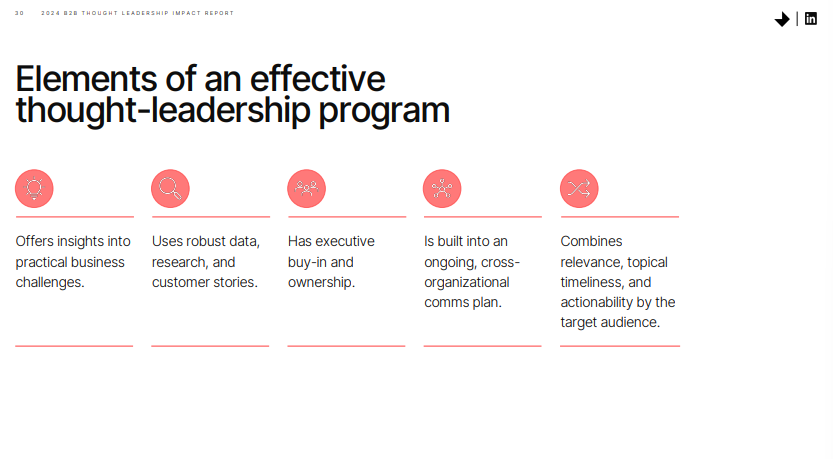
According to Edelman’s 2024 research, the most effective programs:
- Offer insights into practical business challenges
- Use robust data, research, and case studies
- Have executive ownership and buy-in
- Are embedded into ongoing cross-functional communications
- Balance relevance, timeliness, and actionability
4. Consistency
Authority is built over time. Repetition of ideas, frameworks, and perspectives reinforces positioning and increases recall. Inconsistent messaging weakens credibility, even if individual pieces perform well.
Common mistakes in founder-led PR
Many companies invest in executive visibility but fail to see results. The issue is rarely effort. It is usually execution.
Common pitfalls include:
- Being too promotional instead of insight-driven
- Publishing generic takes that add no new perspective
- Lacking a consistent voice or narrative
- Operating without clear positioning or audience focus
- Over-relying on trends rather than original thinking
These mistakes often stem from treating founder-led PR as a content exercise rather than a strategic function.
What good founder-led PR looks like
High-performing founder-led PR shares a few defining characteristics.
It is insight-driven, not announcement-led. It prioritizes ideas over updates. It is opinionated but grounded in real experience and data. And it maintains a consistent voice across channels.
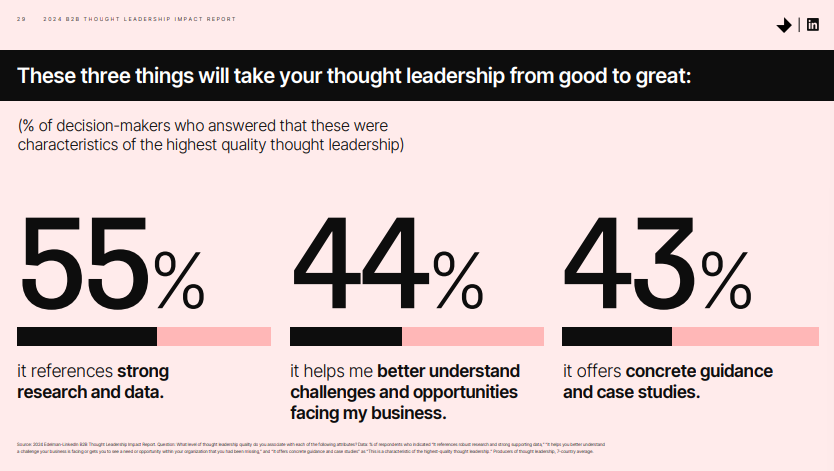
Edelman’s research highlights three elements that elevate thought leadership from good to great:
- 55% of decision-makers value strong research and data
- 44% prioritize content that helps them understand business challenges and opportunities
- 43% look for concrete guidance and case studies
In practice, this means founder-led PR should educate, challenge, and guide. Not just inform.
What marketers should know
For B2B marketers and PR professionals, founder-led PR is not a trend. It is a structural shift in how trust and authority are built.
To operationalize it effectively:
- Turn executives into content engines: Build systems around capturing insights, not just publishing posts
- Align PR with demand generation: Thought leadership should support pipeline, not operate in isolation
- Invest in narrative development: Define clear themes, positions, and messaging pillars
- Prioritize distribution: Even the best insights need amplification across channels
The opportunity is significant. But it requires treating executive visibility as a long-term strategic asset, not a short-term tactic.
Founder-led PR is becoming the default model for credibility in an AI-driven content landscape.
As trust shifts from brands to individuals, executives who can articulate clear, relevant, and consistent perspectives will have a disproportionate advantage. For marketers, the challenge is no longer just telling the company’s story. It is enabling leaders to tell it in a way that resonates, scales, and drives action.