Brands everywhere have made influencer marketing a standard line item in their budgets. Global spending on influencer campaigns reached an estimated $32.55 billion in 2025, and there are no signs of that slowing down. Yet one question continues to frustrate marketing teams at every budget level: what should this actually cost?
The honest answer is that pricing varies dramatically depending on the region you are targeting, the platform you are running on, and the size of creator you choose to work with. A sponsored Instagram post might cost under $100 with a nano-influencer in Indonesia, or tens of thousands of dollars with a macro-influencer in the United States.
Southeast Asia has emerged as one of the most active regions for influencer-driven commerce, with regional spending projected to surpass $2.1 billion in 2025. For brands considering the region, understanding local pricing benchmarks is as important as understanding global averages.
This article breaks down influencer marketing costs globally and across Asia, with specific pricing benchmarks for Singapore, so you can plan your budget with realistic expectations.
Table of contents
- How much does influencer marketing cost in 2026?
- Influencer marketing cost by platform
- Influencer marketing cost in the US vs Southeast Asia
- Influencer marketing cost in Singapore
- What affects influencer marketing cost?
- Agency fees vs direct influencer hiring
- What a regional expert says about influencer pricing in Southeast Asia
- Sample influencer marketing budget breakdown
- How to budget for influencer marketing campaigns
- Frequently asked questions
How much does influencer marketing cost in 2026?
Pricing is primarily structured around influencer tiers, which are defined by follower count. Here is how global benchmarks generally break down per post:
- Nano influencers (1K to 10K followers): $100 to $500
- Micro influencers (10K to 100K followers): $500 to $5,000
- Mid-tier influencers (100K to 500K followers): $5,000 to $25,000
- Macro influencers (500K to 1M followers): $25,000 to $100,000+
- Celebrity influencers (1M+ followers): $100,000 and above
These figures reflect single-post rates in the US market. Actual costs depend heavily on platform, content format, and the creator’s niche. The same tier will produce very different quotes in a Southeast Asian market compared to a Western one.
One notable shift in 2026: 62% of brands are increasing their influencer budgets, and over 30% plan to invest more than $5 million in creator collaborations this year. Demand for nano and micro creators is also growing fast. In 2025, 39% of brands chose nano-influencers as their most likely partners, a figure that continues to climb.
Influencer marketing cost by platform
The platform you choose has a significant impact on what you will pay. Each channel has different content formats, audience behaviors, and production requirements that shape creator pricing.
Instagram influencer pricing
Instagram remains a dominant channel for lifestyle, beauty, and fashion campaigns. Typical rates average around $364 per collaboration, though this varies by tier and format.
Reels command a 20 to 40% premium over standard feed posts because of their higher engagement potential. Stories are generally priced at 50 to 70% of feed post rates. Carousel posts tend to cost 20 to 30% more than single-image posts. A micro-influencer running an Instagram Reel for a fitness brand might charge between $1,500 and $3,000 for a single piece of content.
TikTok influencer pricing
TikTok has become the primary platform for product discovery in 2026. Influencer campaigns on the platform grew from 28.35% of total influencer activity in 2023 to 50.58% in 2025, and 51% of marketers now prefer it for influencer work.
Average TikTok rates per collaboration sit around $350, comparable to Instagram. Nano creators typically charge $200 to $800 per video, while macro-level TikTokers command $800 to $5,000 per post. Creators who integrate TikTok Shop and drive direct e-commerce conversions often charge a 30 to 50% premium on standard rates.
YouTube influencer pricing
YouTube consistently commands the highest rates of any platform, averaging $675 per collaboration. The higher cost reflects longer production timelines, scripting requirements, and content that stays discoverable for months or years after posting.
Mid-tier YouTube creators (100K to 500K subscribers) typically charge $5,000 to $20,000 per video. Macro creators (500K to 1M subscribers) often start at $10,000 and go up from there. Long-form videos of eight minutes or more command further premiums because they allow for multiple sponsorship placements within a single video.
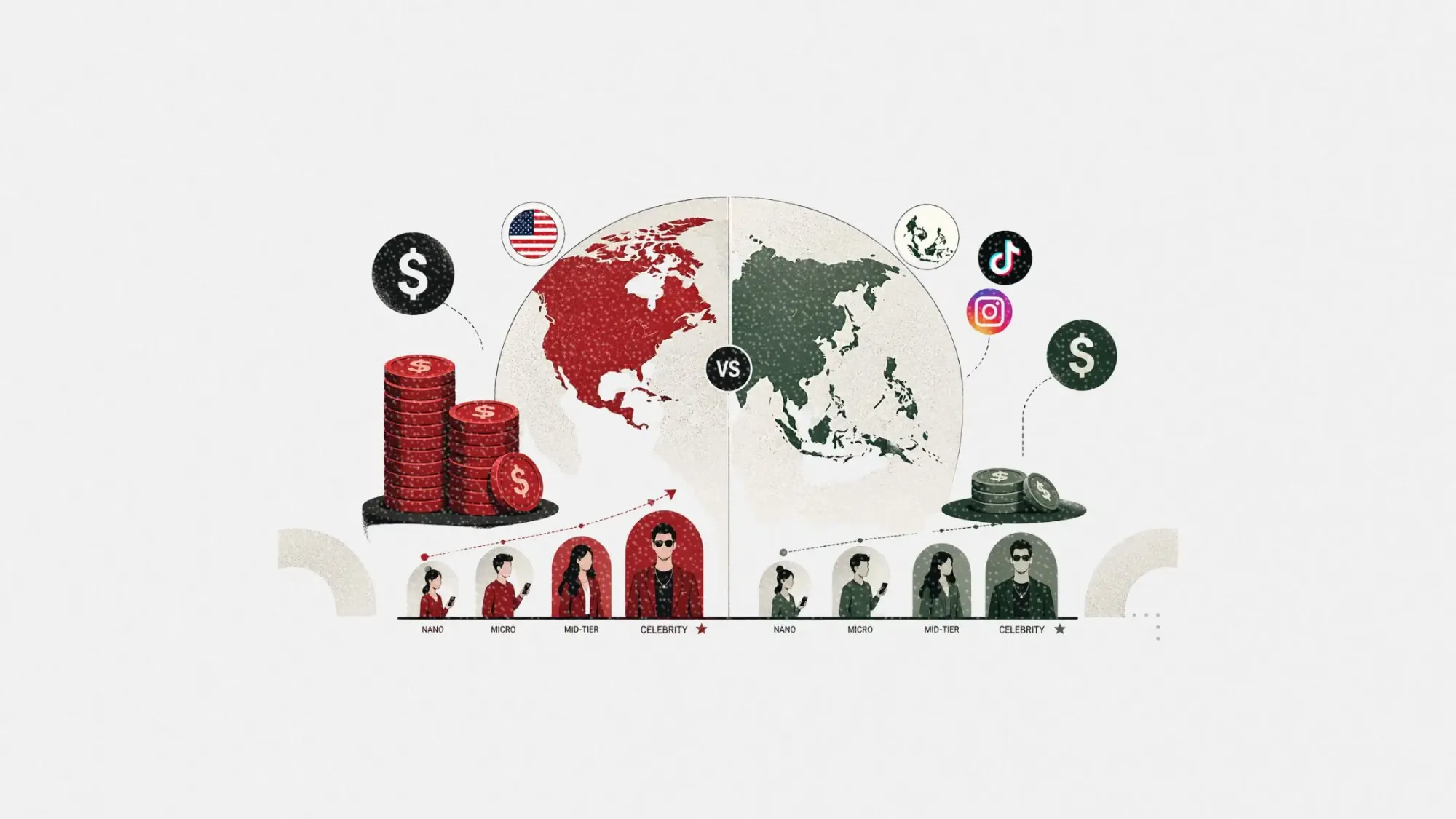
Influencer marketing cost in the US vs Southeast Asia
The pricing gap between Western markets and Southeast Asia is significant. Understanding that gap is key for brands deciding where to allocate budget.
US influencer pricing
The US is the most mature influencer marketing market globally. Creator rates reflect higher cost of living, stronger monetization infrastructure, and audiences that brands in North America and Europe are willing to pay a premium to reach.
A mid-tier US Instagram influencer might charge $5,000 to $10,000 per post. YouTube macro creators in the US regularly quote $15,000 to $40,000 per video. These rates have remained relatively stable in 2025, though there is growing pressure on celebrity-tier pricing as brands shift spend toward nano and micro creators who deliver better cost-per-engagement.
Southeast Asia influencer pricing
Southeast Asia operates at a fraction of Western pricing, while offering some of the highest engagement rates in the world. The region now drives between $38 and $46 billion in annual e-commerce sales, with $21 billion directly attributable to creator campaigns.
Across the region, nano and micro creators are the dominant tier. 46% of Southeast Asian consumers rely on nano-influencer recommendations for purchase decisions, compared to just 20% who trust celebrity endorsements. A nano-influencer in Indonesia or Vietnam will often produce a sponsored TikTok video for under $200. Micro-influencers across the region typically fall in the $300 to $1,500 range depending on platform.
Key differences
The practical differences for brands come down to three areas.
Cost efficiency. Southeast Asian creators deliver significantly lower cost per post and cost per engagement than their US counterparts. Brands running regional campaigns can activate more creators, across more markets, for the same budget.
Audience behavior. Southeast Asian audiences are highly responsive to influencer recommendations. 82% of consumers in the region say they make purchasing decisions based on influencer and creator content. The purchase intent is strong, especially on TikTok and Instagram.
Platform trends. TikTok commerce dominates in markets like Thailand, Indonesia, and Vietnam. Xiaohongshu is gaining ground in Singapore and Malaysia among Mandarin-speaking communities. The platform mix looks different from Western markets, and successful campaigns are built around those local preferences.
Influencer marketing cost in Singapore
Singapore operates in a category of its own within Southeast Asia. The market is smaller by population, but its creator economy is mature and its consumer base is affluent, digitally active, and brand-aware.
Singapore’s influencer marketing industry was estimated at SGD 285 million in 2025, growing at approximately 24% year-on-year. The market is projected to grow at a 12.4% CAGR through 2030.
Typical pricing by tier in Singapore, across platforms:
|
Tier |
Followers |
Rate per post |
|
Nano |
1K to 10K |
SGD $50 to $300 |
|
Micro |
10K to 50K |
SGD $300 to $1,000 |
|
Mid-tier |
50K to 200K |
SGD $1,000 to $5,000 |
|
Macro |
200K to 500K |
SGD $5,000 to $10,000 |
|
Celebrity / KOL |
500K+ |
SGD $10,000+ |
Platform rates vary on top of these tier benchmarks. TikTok videos generally run 10 to 30% higher than equivalent Instagram static posts due to production effort. YouTube integrations command the highest rates given scripting and editing requirements, with mid-tier Singapore creators (50K to 250K subscribers) typically charging SGD $500 to $2,000 per video.
A practical pricing benchmark used by agencies in the market: approximately 1% of the influencer’s follower count in SGD. So an influencer with 100,000 followers would typically charge around SGD $1,000 per feed post.
Singapore is more expensive than other SEA markets for several reasons. The creator talent pool here is smaller, which drives up individual rates. Brand expectations for production quality and compliance are also higher, particularly in regulated industries like finance and health where disclosure requirements add process overhead. And because Singapore serves as a regional headquarters for many global brands, local campaigns are often built to a higher standard with downstream activation in Malaysia, Indonesia, and Thailand.
For brands entering Southeast Asia, Singapore is frequently the test market, before scaling to larger volume markets elsewhere in the region.
What affects influencer marketing cost?
Beyond tier and platform, a range of campaign-level factors push rates up or down.
Follower count is the baseline. But engagement rate increasingly determines where a creator’s quote lands within their tier range. Nano-influencers average engagement rates of 3.69%, more than double what macro-influencers typically produce.
Platform matters because production complexity varies. A TikTok video is faster to produce than a YouTube integration with scripting, b-roll, and editing.
Content type shifts the cost. A static Instagram post costs less than a Reel, which costs less than a dedicated long-form review video.
Usage rights are a frequent source of hidden cost. If a brand wants to repurpose creator content in paid ads or owned channels, expect to pay a 20 to 50% premium above the base content fee.
Campaign duration and exclusivity affect pricing. A 30-day exclusivity window, preventing the creator from working with competitors, can double a quote. Long-term ambassador arrangements often carry volume discounts.
Industry and niche also play a role. Finance, health, and legal content often carries a premium because of the compliance work required on both sides.
Agency fees vs direct influencer hiring
Brands have two main options for activating influencer campaigns: working directly with creators or going through an agency.
Direct hiring keeps costs lower per creator, since there is no management markup. But it requires internal resources to handle outreach, contract negotiation, briefing, approvals, and performance tracking. For brands running a handful of campaigns per year, this can work. For multi-market campaigns across several countries, the operational overhead adds up quickly.
Agency partnerships add a management fee, typically 10 to 20% of campaign spend, but bring creator relationships, platform data, compliance workflows, and reporting infrastructure that in-house teams usually cannot replicate at scale.
Brands expanding across Southeast Asia often work with regional partners to manage campaigns across multiple markets. The coordination complexity of running creators in Singapore, Indonesia, and Thailand simultaneously, each with different languages, platforms, and cultural contexts, is significant. Agencies that specialize in this region bring localization capability that pure cost comparisons do not capture.
For brands evaluating agency options in Singapore, this guide on top influencer marketing agencies in Singapore covers the key players and what differentiates them.
What a regional expert says about influencer pricing in Southeast Asia
Brands entering Southeast Asia for the first time often anchor their budget expectations to Western benchmarks, which leads to miscalculations in both directions.
Dinda Anandita, Account Director at content-led comms agency Content Collision, puts it directly:
“The mistake we see most often is brands treating Southeast Asia as one market with one budget. Indonesia and Singapore might sit on the same map, but the creator ecosystems, platform behaviors, and audience expectations are completely different. A micro-influencer rate that feels expensive in Jakarta can be a strong deal in Singapore, and vice versa. Brands that win in this region are the ones who localize their influencer strategy by market, not just by tier.”
This is especially relevant for brands evaluating cost efficiency. The raw rate per post rarely tells the full story. A lower-cost creator in a volume market like Indonesia can outperform a higher-cost Singapore activation if the brief, platform, and audience fit are right.
Sample influencer marketing budget breakdown
Here is a realistic example campaign for a brand entering Southeast Asia.
Campaign: Singapore + Indonesia product launch
|
Item |
Detail |
Estimated Cost |
|
Singapore micro-influencers (Instagram + TikTok) |
5 creators, 2 posts each |
SGD $6,000 to $10,000 |
|
Indonesia nano and micro-influencers (TikTok) |
15 creators, 1 video each |
USD $1,500 to $3,000 |
|
Content usage rights (paid social repurposing) |
60-day window |
USD $500 to $1,500 |
|
Agency management fee |
15% of total spend |
USD $1,200 to $2,200 |
|
Total estimate |
USD $9,000 to $16,000 |
This is a mid-sized entry campaign. It provides enough creator coverage to generate authentic content across both markets, with room to test what performs before scaling.
How to budget for influencer marketing campaigns
A few practical principles that hold across markets and tiers.
Start with a test budget. Before committing to macro or mid-tier creators, run a small batch of nano or micro campaigns to see which messaging and formats resonate. The data you gather will improve your larger campaigns significantly.
Define your goal first. Awareness campaigns (reach and impressions) and conversion campaigns (clicks and sales) require different creator types and different metrics for success. Mixing the two without clarity is how budgets get wasted.
Choose tier based on goals, not ego. Micro-influencers represent 65% of all brand partnerships in 2025 because they deliver results that justify the spend. A campaign with 20 micro-influencers will often outperform a single macro-creator activation at the same budget.
Allocate for rights and amplification. Content is only part of the spend. Budget for usage rights if you plan to run paid ads against influencer content, which is increasingly common and often delivers strong performance.
Budget quarterly, not annually. Platform algorithms and creator rates shift fast. Quarterly planning gives you room to reallocate toward what is working.
Frequently asked questions
How much should I pay an influencer? It depends on the platform, follower count, engagement rate, and content type. A useful starting benchmark: nano-influencers in most markets charge $100 to $500 per post globally. In Singapore, expect SGD $50 to $300 for entry-tier creators.
Is influencer marketing cheaper than running ads? Not always, but it often delivers better cost-per-engagement and stronger brand trust. Micro and nano influencers in particular tend to outperform equivalent paid ad spend on engagement metrics, especially in Southeast Asia where creator trust is high.
Do agencies charge a percentage or flat fee? Most agencies charge a percentage of total campaign spend, typically 10 to 20%, though flat retainer models are also common for brands with ongoing campaigns. Some agencies also charge a platform access or setup fee on top of the management rate.
What is a good influencer marketing budget for a first campaign? For a focused test campaign using nano and micro-influencers, $3,000 to $10,000 is a realistic starting range in most markets. A Singapore-specific campaign using 3 to 5 micro-influencers can be structured for SGD $5,000 to $12,000 including content fees and basic rights.
What is the difference between a KOL and an influencer? KOL stands for Key Opinion Leader, a term used commonly in Asia for creators who have established authority in a specific category. The distinction matters in Southeast Asia where brands often treat KOLs as a separate strategy from general influencer activations, whose value is driven by reach and engagement, particularly in finance, health, and tech verticals.
Southeast Asia offers the pricing edge, but strategy is still what wins
Influencer marketing costs range widely, from a few hundred dollars for a nano creator in Indonesia to six figures for a celebrity campaign in a Western market. There is no universal rate card.
What the data consistently shows is that Southeast Asia offers strong cost efficiency and high consumer responsiveness, particularly for brands willing to build localized strategies around the right platforms and creator tiers. Singapore, while more expensive than its regional neighbors, remains the natural launchpad for brands building a Southeast Asia presence.
Budget and tier selection matter, but strategy matters more. The brands seeing the strongest returns are not those spending the most. They are the ones matching the right creator type to the right platform with the right message for their market.
For brands looking to execute campaigns across the region, working with experienced regional partners who understand both local creator ecosystems and cross-market execution is one of the most reliable ways to stretch a budget further.