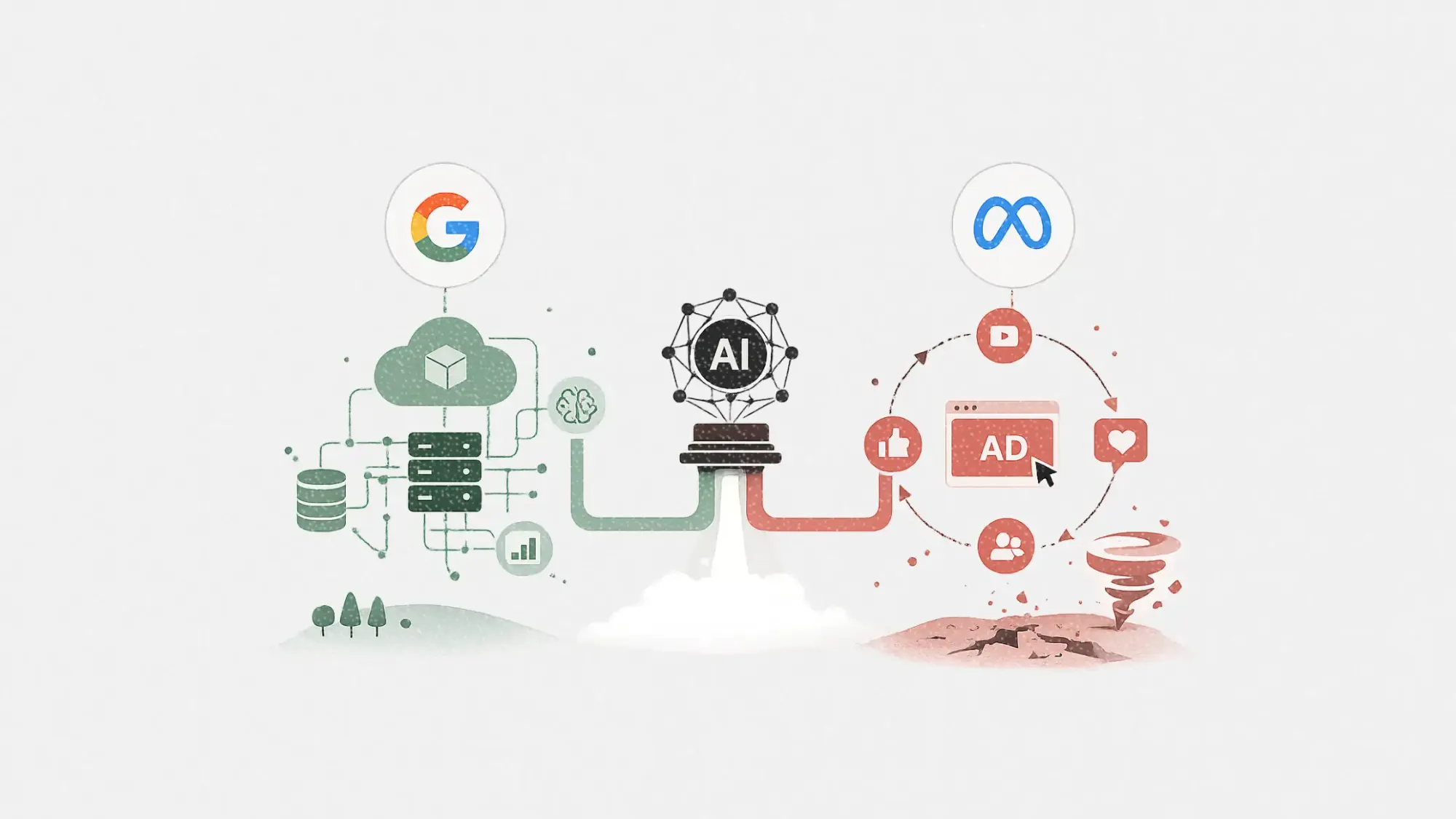
Alphabet and Meta just posted blockbuster Q1 2026 results, and one thing is clear: AI is no longer experimental. It is now the engine behind revenue growth, product adoption, and competitive positioning across digital advertising and cloud.
But beneath the headline numbers, a more nuanced story is emerging. While both companies are scaling aggressively with AI, they are doing it in very different ways, with very different implications for marketers, budgets, and platform risk.
This article breaks down what actually happened, why it matters now, and how B2B marketers and PR teams should respond.
Table of contents
Jump to each section:
- What happened in Google and Meta’s Q1 2026 earnings
- Why AI is now the core growth engine for both companies
- What marketers should know about platform risk and AI spend
- The bigger shift: from ad platforms to AI ecosystems
- AI growth is real, but so is the tradeoff
 Patrecia Meliana
What happened in Google and Meta’s Q1 2026 earnings
Alphabet delivered a standout quarter, with revenue reaching US$109.9 billion, up 22% year over year. The biggest signal for marketers is not just growth, but where it is coming from:
- Search revenue grew 19%, fueled by AI features like AI Overviews and AI Mode
- Google Cloud surged 63% to US$20 billion, driven by enterprise AI demand
- Paid subscriptions hit ~350 million across YouTube and Google One
- AI usage exploded, with 16 billion tokens processed per minute
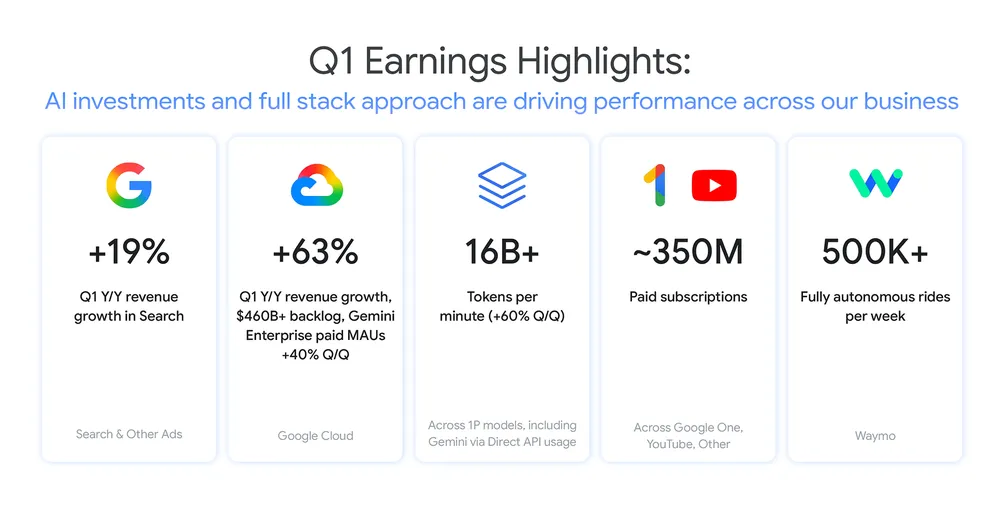
These metrics, also visualized in the earnings highlight graphic, show AI touching every layer of Google’s stack, from infrastructure to consumer products.
Meta, on the other hand, reported even faster top-line growth:
- Revenue reached US$56.3 billion, up 33% year over year
- Ad impressions increased 19%, with pricing up 12%
- Daily active users hit 3.56 billion
On the surface, both companies look equally strong. But the underlying mechanics differ sharply.
Why AI is now the core growth engine for both companies
Google’s strategy is what it calls a “full-stack” AI approach. That means it owns:
- Infrastructure (TPUs, GPUs, cloud)
- Models (Gemini family)
- Distribution (Search, YouTube, Android)
This vertical integration is paying off. Cloud backlog alone surpassed US$460 billion, and enterprise AI products are now the primary growth driver.
Meta, by contrast, is still heavily dependent on advertising as the funding engine for its AI ambitions. Its Family of Apps generated US$55 billion in ad revenue in Q1 alone.
The key difference:
- Google monetizes AI directly through cloud, subscriptions, and APIs
- Meta monetizes AI indirectly through better ad performance
That distinction matters more than it seems.
What marketers should know about platform risk and AI spend
This is where things get uncomfortable.
Meta is going all-in on AI infrastructure, projecting up to US$145 billion in capital expenditures for 2026. That level of spend introduces volatility:
- Costs are rising faster than revenue
- Profit margins could tighten
- Ad pricing pressure may increase
For marketers, this could translate into higher CPMs or more aggressive monetization tactics.
Google, on the other hand, is offsetting AI costs with enterprise demand. Its cloud growth and AI subscriptions create multiple revenue buffers.
That makes Google’s model more diversified, and arguably more stable.
Practical takeaways for marketers
- Diversify platform dependency – Relying too heavily on Meta ads could become risky if cost structures shift.
- Watch AI-driven ad formats – Google’s move toward AI-generated search and ad experiences will reshape click behavior.
- Budget for volatility – AI investment cycles are unpredictable. Expect fluctuations in ad pricing and performance.
- Leverage first-party data – As AI models optimize targeting, your data becomes more valuable than platform signals.
The bigger shift: from ad platforms to AI ecosystems
What we are seeing is not just earnings growth. It is a structural shift.
Google is evolving into an AI ecosystem where:
- Search becomes conversational
- Ads become embedded in AI responses
- Cloud becomes the backbone of enterprise AI
Meta is evolving into an AI-powered media engine where:
- Content feeds are algorithmically generated
- Ads are optimized by AI models
- User engagement funds long-term AI bets
For marketers, the implication is clear: you are no longer just buying media. You are operating inside AI systems that control distribution, targeting, and even creative output.
That changes everything from campaign planning to measurement.
Patrecia Meliana
AI growth is real, but so is the tradeoff
Both Google and Meta are proving that AI can drive massive growth. But they are also exposing the tradeoffs behind that growth.
Google’s diversified AI stack offers stability and multiple monetization paths. Meta’s aggressive AI spending creates upside, but also risk tied to its ad business.
For marketers, the smartest move is not to pick a winner. It is to stay flexible, diversify channels, and adapt quickly as AI reshapes the rules of digital marketing.