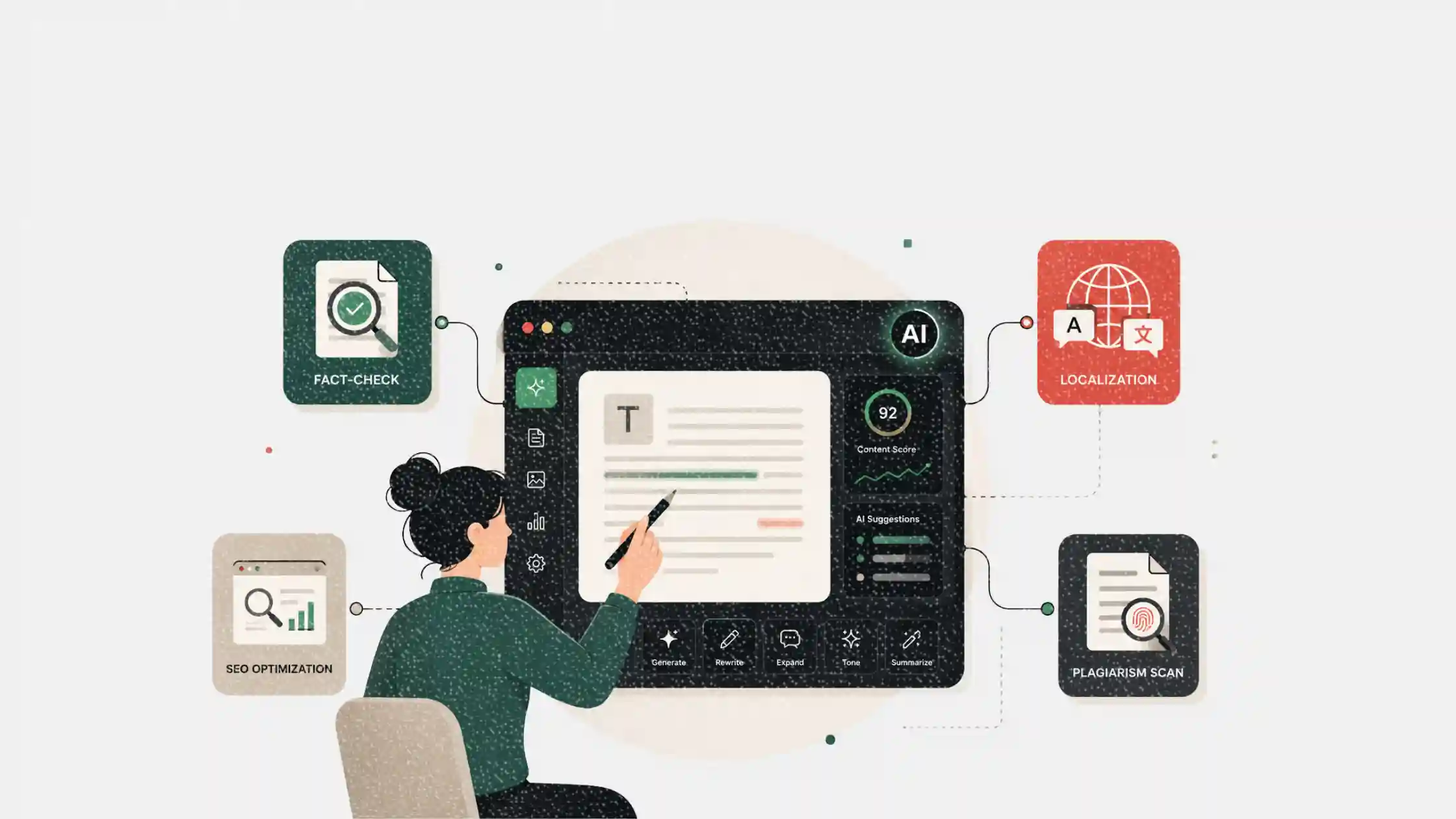
Four years prior, AI copy assistants were barely more than a fad in the form of Chrome extensions that spit out acceptably passable meta-descriptions. Jump to the year 2026, and the assistants are now fully creative co-pilots: they plan and write, fact-check and localize the information in the same window.
To the freelancers who have to maintain blogs for clients, the marketer who has to arrange omnichannel campaigns, and the founder who has to publish notes to investors at midnight, this new generation of tools is now table stakes to master.
Transformer models certainly kept doubling in size, but scale alone didn’t spark today’s leap. The real shift came when vendors fine-tuned large models on domain-specific corpora – product reviews, legal briefs, scientific papers, and wrapped them in interfaces that mirror human workflows.
Mid-sentence outlining, adaptive tone sliders, and citation panels replaced the old “click once and hope” routine. Within that context, an AI writer can now infer brand guidelines, surface supporting statistics, and suggest visual assets without bulldozing the author’s voice.
Consolidation over fragmentation: why a single hub wins
Among the new platforms, Smodin stands out for condensing the entire pipeline – generation, paraphrasing, summarization, grammar correction, and plagiarism scanning – into one dashboard. That consolidation isn’t just convenient; it is the difference between publishing twice a week and shipping daily.
A solo newsletter author can let the research pane pull scholarly abstracts while the editing pane flags tense shifts. An agency copy chief can hand junior writers a locked template that guarantees brand consistency across fifty landing pages. In 2026, hopping between five disconnected apps is the real productivity killer; unified hubs are the antidote.
Capabilities creators rely on every day
Modern products flaunt dozens of toggles, yet three core capabilities determine whether they earn a permanent slot in your stack: ideation speed, factual reliability, and workflow depth. Ideation speed measures how fast a tool converts a seed phrase – “zero-waste candle brand launch” – into an angle list or sectioned outline without generic fluff.
Factual reliability gauges whether generated claims link back to verifiable sources so you can avoid dreaded retractions. Workflow depth shows up after the first draft: can the assistant slide into revision, SEO refinement, and translation without exporting files? Keep those pillars in mind, and you’ll avoid buying a flashy demo with no staying power.
Adaptive generation and ideation
The best engines are like relentless brainstorming associates. Replacing the target audience with Gen Z eco-shoppers with the B2B wholesalers, the outline will rearrange itself automatically.
This is implemented by Jasper, WriteSonic, etc., which incorporate vectorized reader profiles to guide the tone, complexity, and length. The outcome is an instant evaporation of blank-page anxiety; you begin to chisel ideas, instead of tediously gouging them out of the emptiness.
Inline fact-checking and citations
With misinformation penalties now baked into social algorithms, factual accuracy is non-negotiable. Leading suites embed real-time fact-checking that pings trusted databases – Statista, PubMed, Crunchbase – while you write.
If a number looks shaky, the sentence is highlighted in red or quarantined for manual review. GrammarlyGO offers an inline “source it” button, and Notion AI lets you append citations automatically. You still must vet final references, but the heavy lifting of finding them is finally offloaded.
Multilingual localization
Global reach once required armies of translators; in 2026, it takes a single click. Current models carry a multilingual trunk that allows them to translate while preserving idiom, tone, and SEO structure.
DeepL Write and Google’s Gemini Author even suggest region-specific keywords: choose “Spanish – Mexico,” and anglicisms are swapped for locally searched synonyms. Culture checks are built in, flagging phrases that could misfire in certain markets. For entrepreneurs chasing rapid international launches, built-in localization can shave weeks off a go-to-market timeline.
How to evaluate and integrate a new tool
Feature matrices look helpful, but integration friction often decides adoption. Map your actual workflow, briefing, drafting, and approvals, then pilot a single asset end-to-end with the candidate platform. Time for every stage. Did brainstorming drop from forty minutes to ten? Were revision rounds shorter because the tool learned your glossary?
Next, stress-test collaboration: invite a designer to add alt-text guidelines or legal to check compliance. If version control buckles, keep searching. Finally, read the data policy; enterprise clients now insist that prompts and outputs stay inside private tenants. Any vendor that can’t guarantee that security simply won’t make it through procurement.
Budget deserves equal scrutiny. Most subscriptions charge by usage credits rather than seats, so a tiny team pushing long-form pieces may pay more than a big company churning out tweets. Calculate expected token consumption and demand transparent overage pricing. Many “unlimited” plans throttle speed after a hidden ceiling, killing momentum during crunch time.
Also, confirm your exit strategy: if you cancel, do your drafts remain accessible, and can you export model learnings derived from your content? Surprise lock-ins have already sparked lawsuits; no freelancer wants that blaze igniting before a client deadline.
Ethical guardrails and the human voice
Regardless of the sophistication of the system, it is up to the writer to bear the moral responsibility. Prejudice creeps in on the training material; sensationalism steps over restraint. Ethical producers have a last-mile guide: a guideline of representation, diversity of sources, and AI support reporting. Several magazines now include a footnote that a work is AI-written, a practice that is likely to be widespread.
Human texture is as important to save as well. An algorithmic odor of unpolished prose – full of cliches and devoid of anecdotes – comes to the attention of the audience. A personal aside, mention of an experiment gone wrong, a new metaphor restores reality and keeps the readers glued even after clicking on the headline.
Final takeaway
Writing AI in 2026 is not autopilots. Work with them like a director with an editing suite: they cannot work without direction and vision. Select a platform that fits within your workflow, budget, and ethical considerations. And then use the time saved to interview customers, experiment, and fine-tune strategy.
Do it, and you will write more quickly without sounding clichéd, rank higher without stuffing your keywords, and, above all, you will regain the creative juice that made you turn to storytelling in the first place.