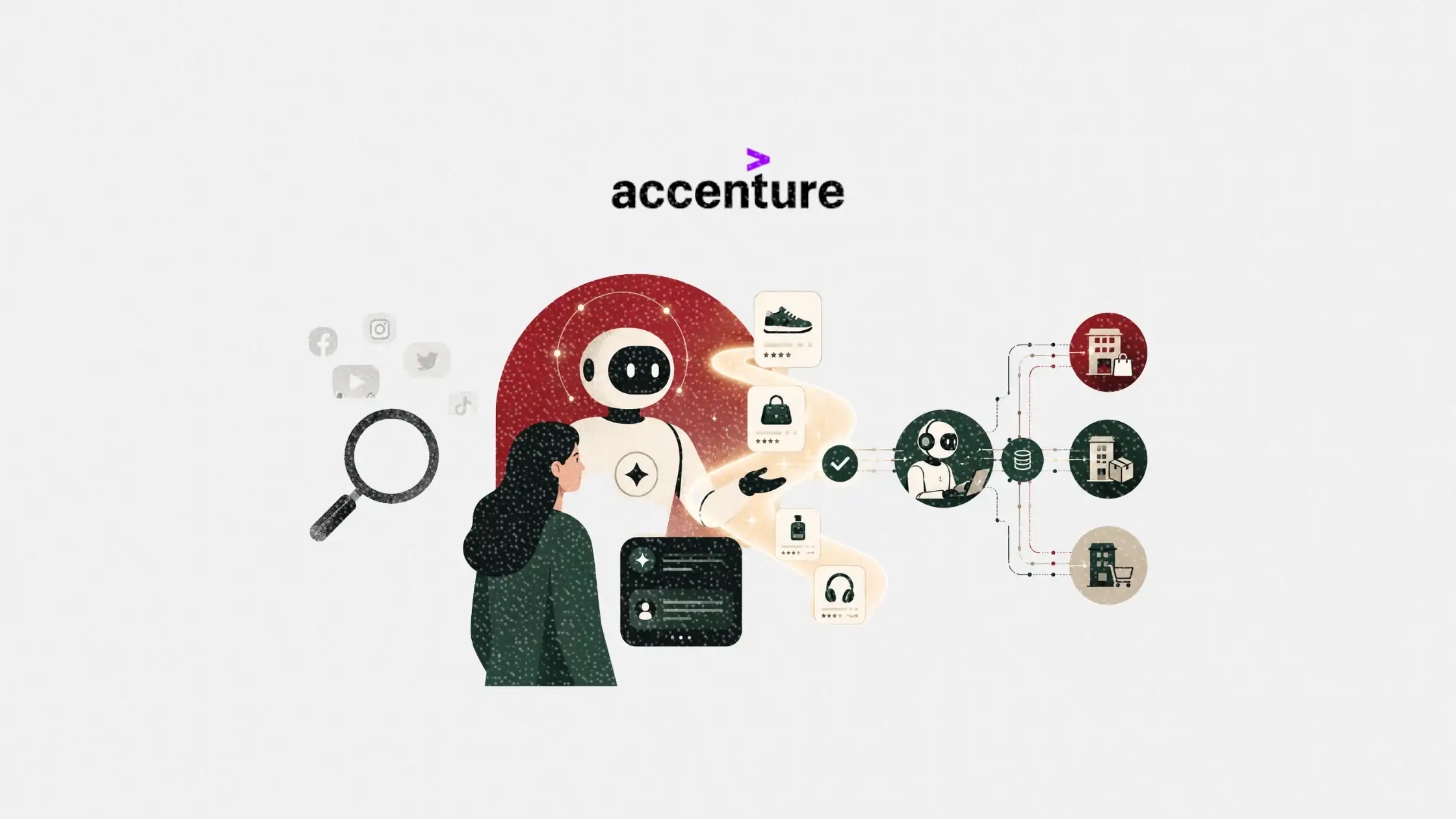
Generative AI is no longer sitting quietly in the productivity stack. According to Accenture’s new Consumer Pulse Research 2025 report, AI is rapidly evolving into a trusted consumer advisor, shopping assistant, and eventually, an autonomous buyer.
That shift has serious implications for marketers. Discovery is moving away from traditional search and social feeds toward AI-mediated recommendations. Consumers are forming emotional relationships with AI tools. And agentic commerce is pushing brands toward a future where AI systems, not humans, increasingly decide what gets purchased.
The report, titled Me, my brand and AI: The new world of consumer engagement, surveyed more than 18,000 consumers across 14 countries and paints a clear picture: brands that fail to adapt to AI-native consumer behavior risk disappearing from the consideration set altogether.
Table of contents
Jump to each section:
- Why Accenture believes AI is becoming a consumer “friend”
- How AI is reshaping discovery and purchase decisions
- Why emotionally intelligent AI experiences matter for brands
- What agentic commerce means for marketers
- What marketers should know about AI-first consumer engagement
- The bigger shift behind AI-driven consumer behavior
Why Accenture believes AI is becoming a consumer “friend”
Accenture’s report argues that generative AI is evolving far beyond content generation or search assistance. The firm says AI is becoming emotionally integrated into people’s lives, with 72% of consumers already using generative AI tools regularly.
More strikingly, 36% of active users describe generative AI as a “good friend,” while 94% say they either have or would use AI for personal development guidance. Another 87% say they would rely on AI for social or relationship advice.
For marketers, this changes the competitive landscape.
The report frames AI in three emerging roles:
- AI as a trusted guide: AI tools increasingly shape product discovery and recommendations.
- AI as a loyal companion: Brands can use emotionally intelligent AI experiences to strengthen loyalty.
- AI as a second self: Agentic AI systems may eventually make purchasing decisions autonomously.
This matters because consumers are no longer treating AI as a passive utility. They are building trust relationships with it.
According to Accenture, 9% of consumers already rank generative AI as their single most trusted source for what to buy. That creates a serious visibility problem for brands still optimizing primarily for traditional search or social algorithms.
How AI is reshaping discovery and purchase decisions
One of the strongest signals in the report is how quickly AI is becoming a commerce discovery layer.
Accenture found that one in two generative AI users has already used AI to inform a purchase decision. Among active users, generative AI is now the second-highest source of purchase recommendations after physical stores.
The report argues that large language models are becoming the new influencers.
This has major implications for:
- SEO and discoverability
- Retail media strategy
- Brand positioning
- Product feed optimization
- Conversational commerce
Traditional digital marketing channels may become less visible as consumers rely more heavily on AI-generated recommendations.
Accenture specifically warns that brands that fail to engage with LLM ecosystems risk being misrepresented or excluded entirely from AI-generated recommendations.
The company points to emerging partnerships between brands and AI platforms like Perplexity as early indicators of where this ecosystem is heading.
The shift also reinforces a broader trend already visible across the industry: marketers increasingly need to optimize not just for search engines, but for generative AI systems that summarize, filter, and recommend products on behalf of users.
Why emotionally intelligent AI experiences matter for brands
Accenture’s report argues that the future competitive advantage for brands may not come from automation alone, but from emotional differentiation.
According to the research, consumers are:
- 1.7x more likely to accept higher prices from brands delivering emotionally engaging experiences
- 1.5x more likely to recommend those brands
- More willing to engage with personalized experiences when they feel authentic
At the same time, consumers remain skeptical of low-quality AI interactions.
The report found that 41% of consumers distrust AI-generated content that feels inauthentic, while 45% distrust AI experiences that lack personality.
That creates a balancing act for marketers.
Brands are being pushed toward AI-native personalization and proactive customer engagement, but consumers still expect emotional authenticity and human-like interaction.
Accenture recommends several strategic directions:
- Move from reactive personalization toward proactive AI experiences
- Build AI systems with more human-like communication styles
- Combine AI with multimodal experiences like voice, video, and augmented reality
- Connect AI systems directly with supply chain and operational data to reduce friction
The report also highlights a growing demand for immersive, sensory-rich digital experiences. That aligns with broader industry movement toward conversational commerce, visual AI interfaces, and AI-powered customer service ecosystems.
What agentic commerce means for marketers
Perhaps the biggest long-term shift in the report is the rise of agentic commerce.
Accenture predicts that AI agents will increasingly act on behalf of consumers, handling tasks like:
- Product research
- Price comparison
- Checkout
- Customer support
- Reordering and subscription management
The company found that 75% of consumers are open to using a trusted AI-powered personal shopper that understands their preferences.
That introduces a major challenge for marketers.
If AI agents optimize primarily for price and specifications, brands risk becoming interchangeable commodities.
Accenture argues that brands must focus on experiences AI cannot easily commoditize, including:
- Exclusive access
- Community-driven engagement
- Immersive brand experiences
- Emotional resonance
- Cross-platform service ecosystems
The report also suggests that future commerce environments may increasingly involve bot-to-bot interactions rather than direct human browsing.
In practical terms, this could reduce the importance of traditional digital touchpoints like banner ads, static landing pages, or even conventional search placements.
Instead, discoverability inside AI systems becomes critical.
What marketers should know about AI-first consumer engagement
Here are the biggest strategic takeaways for marketers from Accenture’s report:
- AI discoverability is becoming a competitive advantage
Brands should prepare for generative engine optimization (GEO), not just traditional SEO. Structured product information, trusted third-party mentions, and AI-readable content are becoming increasingly important.
- Emotional differentiation matters more in AI-driven commerce
If AI systems reduce shopping to utility comparisons, brands need stronger emotional positioning to avoid commoditization.
- First-party and contextual data are becoming more valuable
Accenture recommends building intelligent consumer profiles that combine zero-party, first-party, and contextual signals to support more personalized AI interactions.
- AI agents will reshape customer journeys
Marketing teams should begin experimenting with AI-native workflows, conversational interfaces, and agent-compatible commerce systems.
- Trust and transparency remain critical
Consumers are still wary of AI-generated interactions that feel manipulative or fake. Responsible AI governance, consent-based personalization, and cybersecurity will become core brand issues.
 Patrecia Meliana
The bigger shift behind AI-driven consumer behavior
Accenture’s report is less about individual AI tools and more about a structural change in how consumer engagement works.
The core warning for marketers is simple: AI is becoming an intermediary layer between consumers and brands.
As that layer becomes more autonomous, emotionally intelligent, and transaction-capable, marketers may lose direct influence over discovery and conversion unless they adapt quickly.
That means the future of marketing may depend less on interruptive advertising and more on:
- AI discoverability
- Trusted brand signals
- Structured data ecosystems
- Conversational experiences
- Emotional loyalty
- Agent-compatible commerce systems
The brands that succeed will likely be the ones that understand how to influence both humans and the AI systems acting on their behalf.
Accenture’s findings suggest that this transition is already happening faster than many marketers realize.