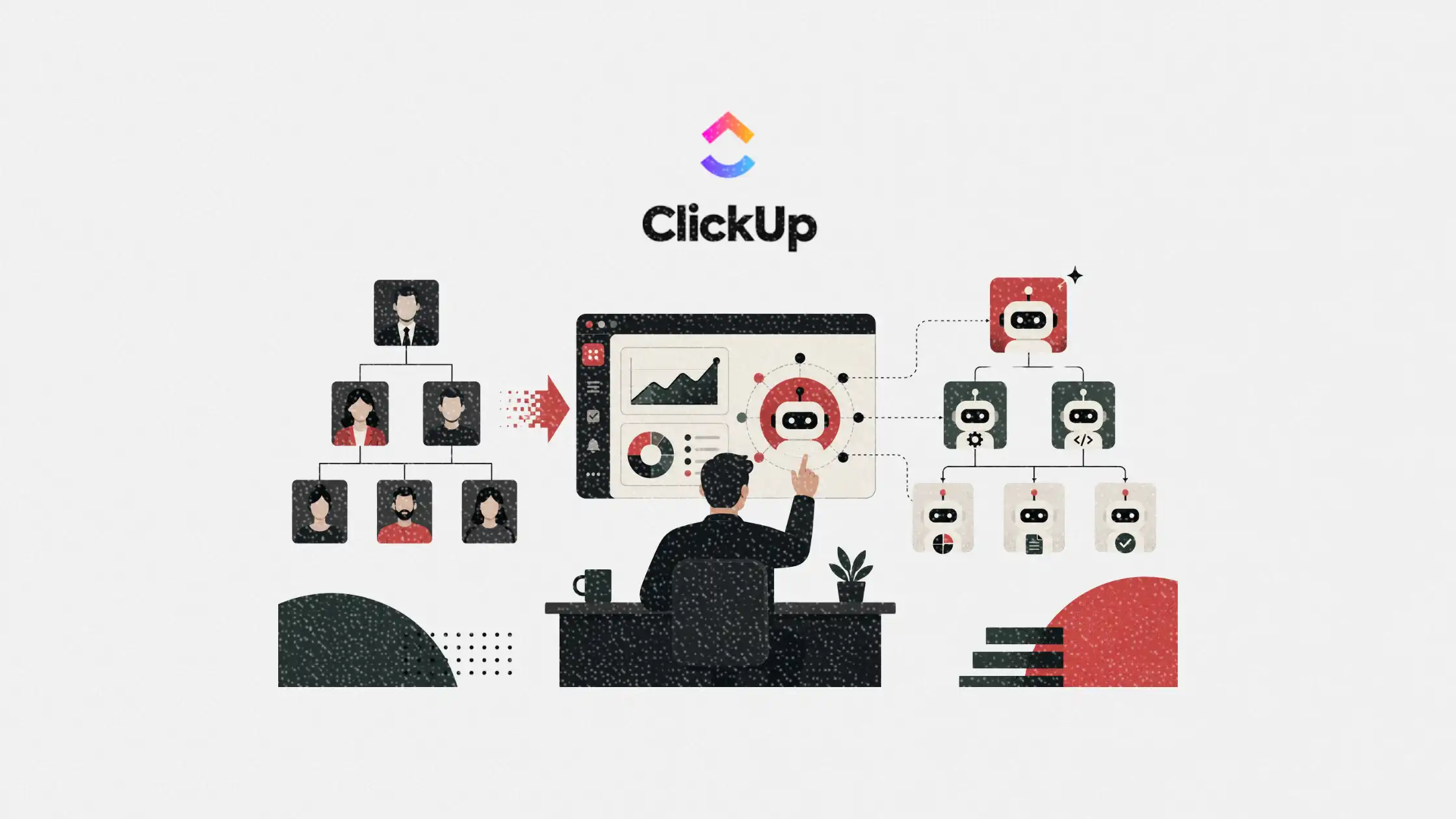
ClickUp’s decision to cut 22% of its workforce while simultaneously expanding its use of AI agents is one of the clearest examples yet of how artificial intelligence is beginning to reshape organizational structures.
The collaboration software company is framing the move not as a traditional cost-cutting exercise, but as a strategic shift toward an AI-first operating model. According to CEO Zeb Evans, employees who can effectively leverage AI will become significantly more valuable, while repetitive work increasingly moves to software agents.
For marketers, the announcement offers a glimpse into a future where AI adoption is no longer optional. Instead, the ability to manage, direct, and evaluate AI systems may become a core job requirement across departments.
Table of contents
Jump to each section:
- Why ClickUp laid off 22% of its workforce
- How AI agents are reshaping company operations
- Why AI-driven productivity gains remain controversial
- What marketers should know about the future of AI-powered work
- The bigger question facing businesses
 Patrecia Meliana
Why ClickUp laid off 22% of its workforce
Last week, ClickUp CEO Zeb Evans announced that the company had reduced its workforce by 22%, affecting roughly one in five employees.
What made the announcement unusual was the rationale. Rather than citing economic conditions, operational efficiency, or slowing growth, Evans described the layoffs as part of a broader AI transformation strategy.
In a post on X, Evans said ClickUp plans to redirect savings into top performers and introduce million-dollar salary bands for employees who create outsized impact through AI.
Today we reduced headcount by 22%. The business is the strongest it’s ever been. So I think it’s important to be direct about what I’m seeing and why.
First, I made this decision and I own it. I did it because the way to operate at the highest level of productivity is changing,…
— Zeb Evans (@DJ_CURFEW) May 21, 2026
The company, last valued at US$4 billion in 2021, believes AI can fundamentally change how work is performed and scaled.
How AI agents are reshaping company operations
According to recent reporting, ClickUp has deployed approximately 3,000 internal AI agents that perform a wide range of tasks previously handled by employees.
Instead of executing work directly, staff are increasingly expected to supervise AI systems, provide instructions, and review outputs before delivery.
Evans describes the company’s goal as becoming a “100x org,” suggesting that AI could multiply organizational productivity far beyond traditional workforce growth.
This reflects a broader shift taking place across the technology sector. Rather than viewing AI as a simple productivity tool, many companies are beginning to treat AI agents as digital coworkers capable of handling increasingly complex workflows.
The trend is also spreading beyond software development into customer support, sales operations, marketing, content production, analytics, and administrative functions.
Patrecia Meliana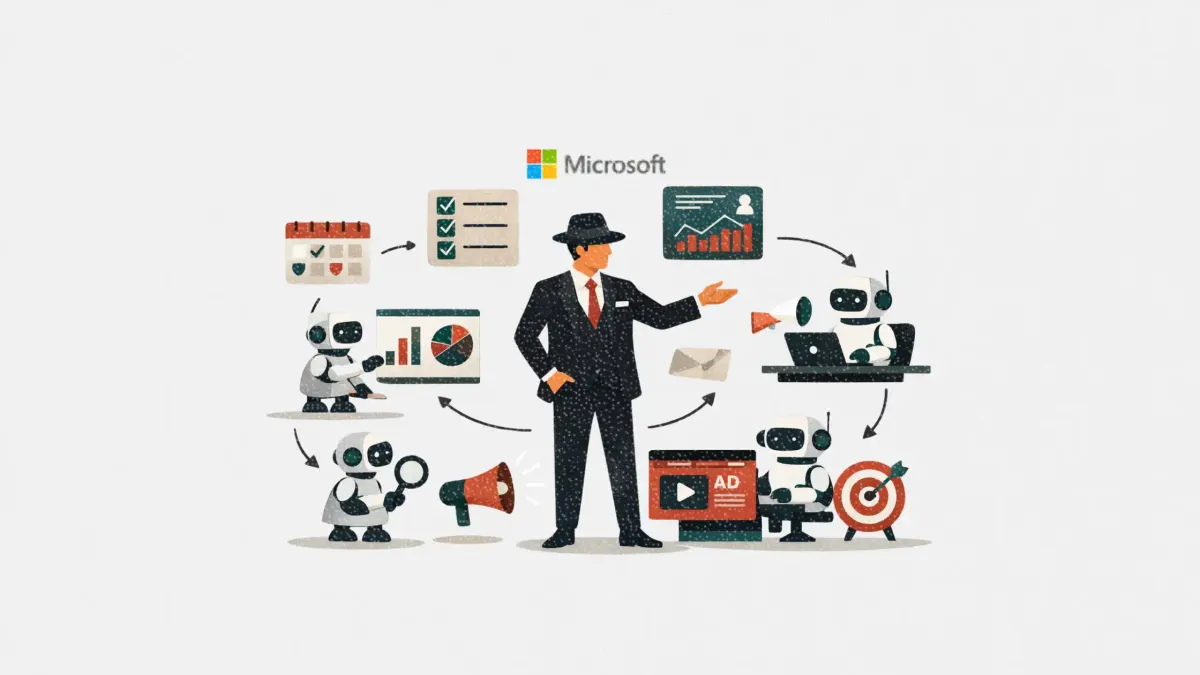
Why AI-driven productivity gains remain controversial
While many executives champion AI as a productivity breakthrough, the financial results remain mixed.
A recent Gartner survey found that roughly 80% of organizations using autonomous technologies have reduced headcount. However, the study also suggested that many companies have yet to realize significant financial gains from those workforce reductions.
This raises an uncomfortable question: are organizations genuinely becoming more productive, or are some using AI narratives to justify downsizing?
ClickUp argues it falls into the first category.
According to Evans, the company is actively measuring AI-generated productivity gains internally and plans to incorporate those insights into future customer-facing products.
The company also rejects the growing practice of tracking AI adoption through token consumption alone. Instead, Evans says ClickUp focuses on measuring value creation and time saved rather than raw AI usage metrics.
What marketers should know about the future of AI-powered work
For marketing leaders, ClickUp’s strategy offers several important lessons.
1. AI proficiency is becoming a competitive advantage
The most valuable employees may not be those who perform tasks manually, but those who can orchestrate AI systems effectively.
Prompt engineering, workflow design, quality control, and AI supervision are increasingly becoming high-value skills.
2. Productivity metrics will evolve
Traditional measurements based on hours worked or output volume may become less relevant.
Organizations will likely focus more on business outcomes, strategic impact, and the ability to scale results through automation.
3. Teams may become smaller but more specialized
If AI agents can handle execution-heavy tasks, companies may require fewer generalists while increasing demand for specialists who can manage systems, strategy, and decision-making.
4. Human oversight remains critical
Despite advances in AI capabilities, human review continues to be essential.
Brand safety, compliance, factual accuracy, customer trust, and creative judgment remain difficult to automate completely.
For marketers, this means AI is more likely to change job responsibilities than eliminate human involvement altogether.
Patrecia Meliana
The bigger question facing businesses
ClickUp’s layoffs may be remembered as an early indicator of how AI transforms workforce structures over the next decade.
The central debate is no longer whether AI can improve productivity. Increasingly, the question is how organizations distribute the benefits.
Will AI create higher-paying opportunities for workers who adapt, as Evans suggests? Or will it primarily reduce headcount while concentrating value among a smaller group of employees?
The answer will likely vary from company to company.
What is clear is that AI is moving beyond experimentation and into operational decision-making. Businesses that can successfully combine human expertise with AI-driven execution may gain significant competitive advantages. Those that fail to adapt could find themselves struggling to keep pace in an increasingly automated economy.