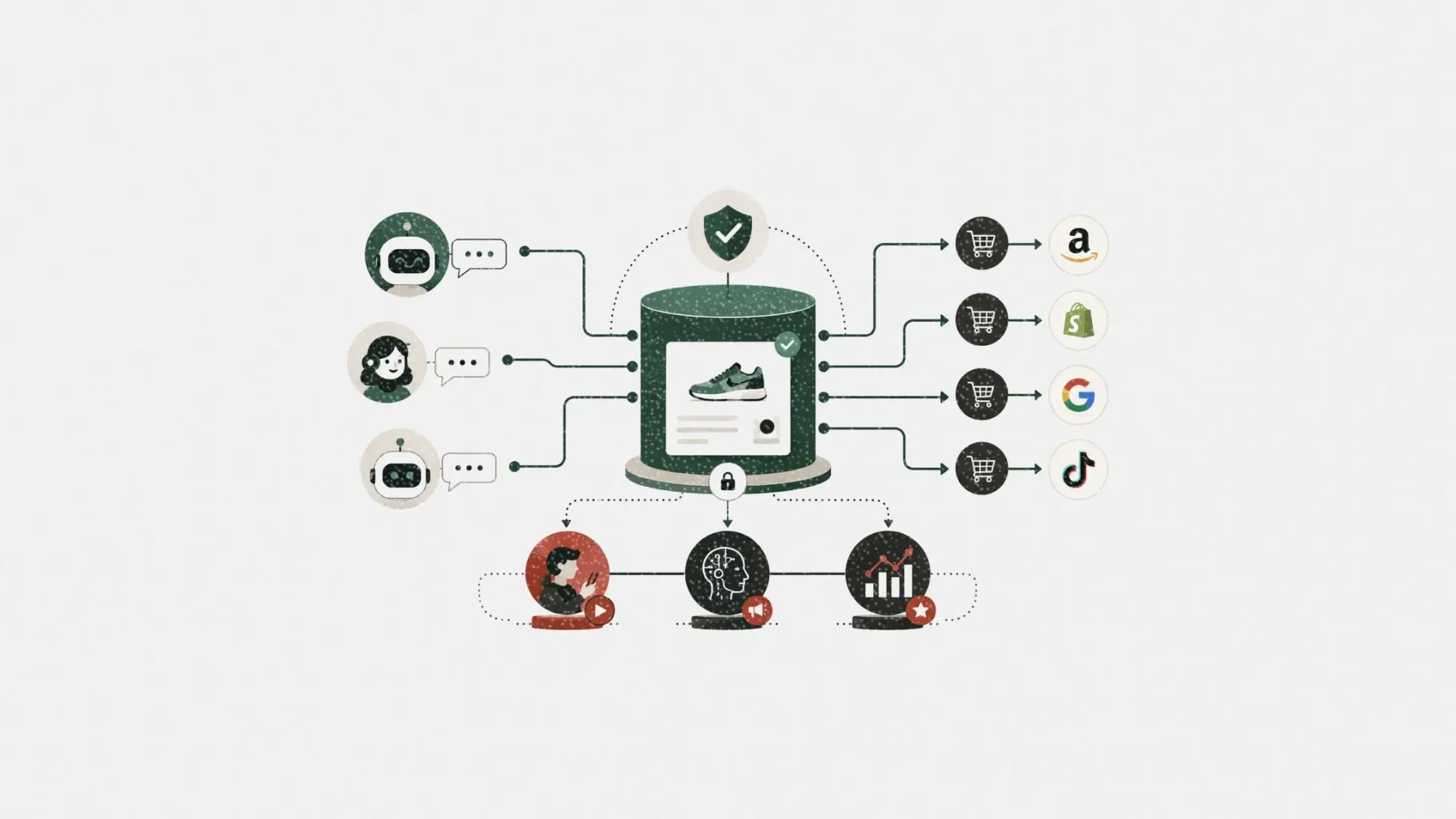
AI is not just changing how people find products. It is changing where product decisions are made, who explains the offer, and which systems decide whether a buyer ever reaches a brand’s owned experience.
That is the strategic pressure behind the latest wave of commerce, advertising, creator, and lifecycle launches. Google is turning shopping into a cross-surface cart. Creator platforms are trying to influence answer engines. Adtech vendors are selling agentic performance outside search and social. Ecommerce discovery platforms are consolidating search, recommendations, guided selling, and conversational interfaces into fewer decision layers.
For senior marketing and content operators, the practical implication is uncomfortable: product truth is no longer contained in product pages, landing pages, sales decks, and approved campaign copy. It now has to survive translation through AI explainers, product feeds, creator content, reviews, ad agents, CTV decisioning systems, and lifecycle automation.
The team that treats this as an SEO problem will under-scope it. The team that treats it as a content governance problem will move closer to the real operating model.
Table of contents
Jump to each section:
- The transaction is moving upstream
- Product truth now lives across surfaces
- The website is still important, but it is no longer enough
- Content governance needs to include machine use
- The new workflow is closer to product ops than publishing
- What to prioritize before the next AI commerce pilot
- The operator advantage is controlled consistency
The transaction is moving upstream
The most visible signal came from Google. Its new Universal Cart is designed to let people add products while using Search, Gemini, YouTube, or Gmail, with checkout supported by Universal Commerce Protocol. Google says people shop across its products more than a billion times a day and that its Shopping Graph contains more than 60 billion product listings, making the cart less like a site feature and more like a transaction layer inside Google’s ecosystem.
ContentGrip’s coverage of Google’s Universal Cart and AI Mode ad formats captured the shift clearly: Google is tightening the loop between discovery, advertising, and checkout while adding AI-generated explanatory layers into the ad experience.
That matters because the old operating assumption was that a brand could win the click, then use its own site to explain the product, resolve objections, merchandise the offer, and control conversion. In an agentic commerce environment, more of that work happens before the visit or instead of the visit.
Adobe’s April 2026 retail analysis shows why this is not theoretical. In the first quarter of 2026, traffic from AI sources to U.S. retail sites grew 393% year over year, and in March 2026 AI-sourced traffic converted 42% better than non-AI traffic. Yet Adobe also found that individual product pages averaged only 66% machine readability across U.S. retail sites.
The gap is the point. AI-assisted shoppers may be higher intent, but the systems guiding them can only use what they can read, structure, trust, and reconcile. If your product information is inconsistent across feeds, reviews, creator posts, merchant data, comparison pages, and help content, the AI layer will not politely wait for your brand team to clarify the story.
Product truth now lives across surfaces
Recent ContentGrip coverage shows the same pattern across different parts of the stack.
Later’s Creator AEO launch frames creator content as a way to influence how brands appear in AI-generated answers, using citation rate, sentiment, and Share of Model as measurable outputs. The important shift is not the label AEO. It is the acknowledgement that third-party content now shapes product understanding inside answer systems.
Zoovu’s acquisition of XGEN AI points in a similar direction from the ecommerce side. Search, recommendations, guided selling, bundling, personalization, and conversational AI are being pulled into a single product discovery engine. The buyer question is not just whether relevance improves. It is whether the same product logic, merchandising rules, and analytics can govern every surface where a shopper asks for help.
OuterSignal’s Monocle acquisition brings the pattern into lifecycle marketing. Customer intelligence and autonomous journey execution are moving closer together, with agents deciding timing, channel, discount sensitivity, and purchase intent. Once that happens, the brand’s content system is no longer only a publishing system. It becomes an input into per-customer decisions.
The same pressure shows up in media. Taboola’s agentic AI research argues that advertisers want AI-powered performance beyond the search and social walled gardens, but remain concerned about vendor complexity, attribution, workflow integration, and brand safety. Olyzon’s CTV funding story reflects the related need for decisioning layers that coordinate planning, activation, and measurement across fragmented video environments.
Different categories, same operator problem: marketing systems are becoming decision systems. Once a tool can choose what to show, say, recommend, bid, route, discount, or suppress, the accuracy of the underlying product and brand truth becomes a control issue.
The website is still important, but it is no longer enough
This does not mean owned websites stop mattering. It means the website is no longer the only canonical experience the market sees.
For years, content operations teams treated the website as the source of truth and everything else as distribution. That model worked when search results, social posts, email campaigns, and ads mostly pointed users back to owned pages. The new model is more distributed. AI systems can summarize the product before the click. Commerce interfaces can hold the cart across merchants. Creator posts can become evidence in answer engines. Lifecycle agents can personalize the next touch without a marketer writing every branch.
Gartner’s 2025 marketing technology research says martech utilization has dropped to 49%, with only 15% of organizations qualifying as high performers that meet strategic goals and demonstrate positive ROI. That matters here because adding AI commerce and orchestration layers on top of underused, poorly governed stacks will not solve the coordination problem. It will make the control surface bigger.
The near-term advantage will not go to the team with the most AI modules. It will go to the team that can keep product claims, offers, eligibility rules, inventory logic, compliance language, proof points, and customer context consistent across the systems AI uses to make or influence decisions.
Content governance needs to include machine use
Most content governance models were built around human review. They answer questions such as: Who approved this claim? Is this page on brand? Is the offer current? Is this asset compliant? Those questions still matter, but they are incomplete when AI systems use content as input rather than as a final asset.
Operators now need to ask a harder set of questions.
Can machines read the canonical version? Product pages, comparison pages, help content, pricing details, return rules, shipping policies, ratings, and FAQs need to be structured and accessible enough for AI systems to interpret. If a product page looks persuasive to a human but hides critical information in scripts, images, collapsed modules, or inconsistent markup, it may underperform in AI-mediated discovery.
Can the same claim survive across channels? A product benefit might appear in a landing page, Merchant Center feed, creator brief, review response, retail media unit, chatbot answer, and lifecycle email. If those versions drift, AI systems may amplify the wrong one. Content operations should track claim families, not just pages.
Can teams explain automated decisions? If a lifecycle agent sends a discount, an ad agent generates a product explainer, or a CTV layer reallocates spend, someone should be able to explain which inputs shaped the decision. IAB’s 2026 State of Data report describes measurement systems as under strain from privacy regulation, signal loss, platform-embedded optimization, and fragmented data environments, which is precisely the environment where unexplained automation becomes a budget risk.
Can the brand disclose and govern AI-mediated experiences? IAB’s 2026 research on AI-generated advertising found that 82% of ad executives believed younger consumers felt positive about AI-generated ads, compared with 45% of consumers themselves. The same study found that disclosure can help purchase consideration. The lesson for AI commerce is broader than creative disclosure: customers may tolerate AI assistance, but only when the experience feels useful, honest, and under control.
The new workflow is closer to product ops than publishing
The content team cannot own this alone. Product truth now sits across marketing, ecommerce, legal, merchandising, customer support, data, analytics, lifecycle, media, and agency partners. That makes it tempting to create another committee. A better starting point is to define the operating layer.
Senior teams should identify which content and data objects are now conversion-critical. That list usually includes product attributes, price and promotion rules, inventory status, claims and disclaimers, customer review summaries, comparison language, creator talking points, eligibility rules, return policies, and support answers.
Then they should map where each object appears and which systems consume it. The answer will usually be messier than expected: CMS, PIM, DAM, Merchant Center, retail partner feeds, affiliate networks, creator briefs, CRM, ESP, CDP, product recommendation tools, chatbot knowledge bases, analytics taxonomies, and media platforms.
Only after that map exists can governance become practical. Teams can assign owners, define refresh cycles, flag regulated claims, standardize metadata, decide which sources are canonical, and set review thresholds for AI-generated or AI-mediated outputs.
This is not glamorous work, but it is where AI commerce becomes commercially usable. A cart that can reason about compatibility is only as reliable as the product data behind it. A creator AEO program is only as strong as the claims and proof creators repeat. A lifecycle agent is only as good as the customer context and brand rules it can access. A CTV decisioning layer is only useful if the KPI definitions and measurement inputs are trusted.
What to prioritize before the next AI commerce pilot
The best pilots will not start with the most impressive demo. They will start with a narrow workflow where the brand can test whether product truth remains intact as it moves through an AI-mediated surface.
For ecommerce teams, that may mean auditing the top 100 revenue-driving product pages for machine readability, feed consistency, review coverage, FAQ completeness, and claim alignment before expanding agentic shopping integrations.
For content and PR teams, it may mean building a prompt portfolio around high-intent category questions, then comparing AI answer narratives against owned content, earned media, creator content, review sites, and sales objections.
For lifecycle teams, it may mean testing one autonomous journey with strict guardrails around offer eligibility, frequency, suppression, creative tone, and incrementality before allowing agents to optimize across broader segments.
For media teams, it may mean requiring every agentic buying or orchestration tool to show how product claims, audience logic, exclusions, and measurement definitions flow into optimization decisions.
The common thread is traceability. If the team cannot see which version of the product truth an AI system used, it cannot responsibly scale the workflow.
The operator advantage is controlled consistency
AI commerce will reward speed, but not speed alone. It will reward teams that make their product information legible, their proof points portable, their claims consistent, and their decision rules explicit.
That is a different muscle from traditional content production. It is closer to running a distributed truth system for the business.
For senior marketers, the decision is not whether to participate in AI-mediated commerce. The traffic, conversion, platform, and vendor signals suggest that buyers are already moving there. The real decision is whether the brand enters that environment with governed product truth or lets every platform, model, creator, retailer, and agent reconstruct the story on its behalf.
The latter may still produce clicks. The former is how marketing keeps control when discovery, persuasion, and checkout collapse into the same interface.