AI is becoming a core business tool for solo founders, helping them move from idea to revenue faster while reducing the workload that traditionally slows down small business growth.
New survey data from Clarify Capital suggests that AI is no longer an experimental technology for many solopreneurs. Instead, it is increasingly being used to handle marketing, analysis, administration, and operational tasks.
The findings also reveal a more nuanced reality. While AI is helping founders launch and operate more efficiently, it is not eliminating the classic challenges of entrepreneurship. Funding, cash flow, and customer demand remain the biggest obstacles standing between solo founders and sustainable growth.
Table of contents
Jump to each section:
- How quickly are solopreneurs turning ideas into revenue?
- How AI is changing day-to-day operations for solo founders
- Why ChatGPT dominates the AI toolkit for solopreneurs
- The growth challenges AI still cannot solve
- What marketers should know about the rise of AI-powered solopreneurs
- The bigger picture for AI and entrepreneurship
 Patrecia Meliana
How quickly are solopreneurs turning ideas into revenue?
Clarify Capital surveyed 255 business owners, including 194 solo founders, to understand how AI is influencing launch speed, business operations, and growth.
One of the most striking findings is how quickly many solopreneurs reach revenue. According to the survey, 58% generated their first dollar within three months of launching. That includes 26% who earned revenue within the first month and 32% who did so within one to three months.
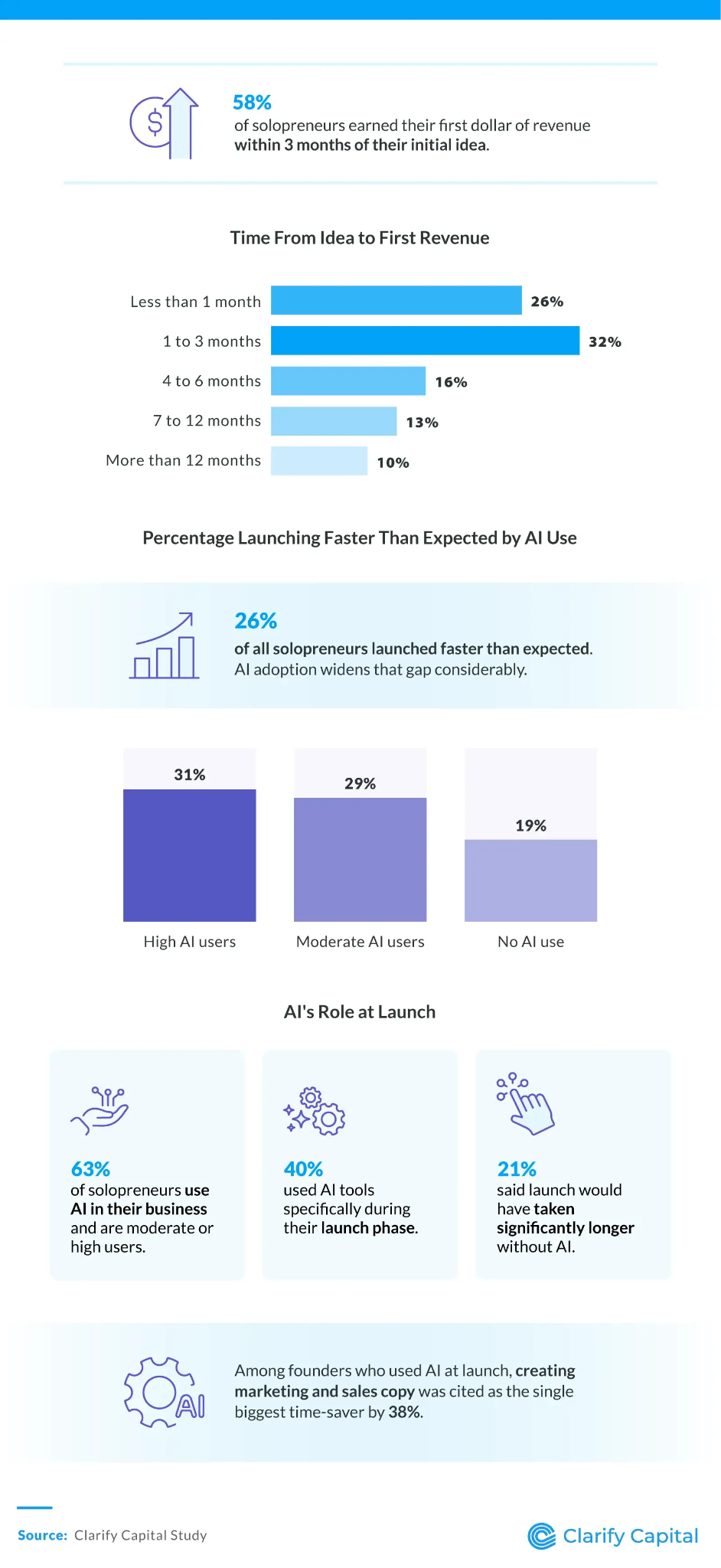
AI appears to be playing a meaningful role in accelerating those timelines. High AI users were significantly more likely to report launching faster than expected, with 31% saying they beat their original timelines. That compares to 29% among moderate AI users and 19% among founders who do not use AI.
The data also suggests AI is helping reduce friction during the launch phase. Forty percent of founders who used AI during launch said they specifically relied on it at that stage, while 21% said launching would have taken substantially longer without it.
How AI is changing day-to-day operations for solo founders
While AI is often associated with automation and productivity, the survey highlights specific areas where solo founders are already delegating work.
Marketing copy and content creation emerged as the most common AI use case, with 34% of solopreneurs relying on AI tools for those tasks. Other popular applications include:
- SEO and website optimization (18%)
- Data analysis and reporting (17%)
- Social media management (14%)
- Scheduling and administrative work (14%)
- Product or service development (13%)
The impact is measurable. Solopreneurs reported saving an average of 6.1 hours per week through AI use.
Interestingly, the survey found that most founders are not fully AI-driven businesses. Fifty-five percent describe themselves as moderate users who apply AI to specific tasks, while only 8% classify themselves as high adopters who use AI across strategy, operations, and execution.
Why ChatGPT dominates the AI toolkit for solopreneurs
Among AI-powered founders, ChatGPT has established a clear lead.
According to the survey, 42% of solopreneurs use ChatGPT, making it the most widely adopted AI platform among respondents. Gemini followed at 27%, while Canva AI, Claude, and Copilot trailed behind.
The dominance of ChatGPT is particularly notable because the most common AI use case among founders is content creation. Marketing copy, sales messaging, and content production are areas where generative AI can deliver immediate value without requiring deep technical expertise.
For marketers, this trend reinforces a broader industry reality: conversational AI platforms are increasingly becoming foundational business tools rather than niche productivity applications.
The growth challenges AI still cannot solve
Despite the productivity gains, the survey makes it clear that AI is not a cure-all for business growth.
Access to capital remains the most frequently cited barrier to scaling, identified by 25% of solopreneurs. The pressure is even stronger among founders in pre-revenue stages and those actively trying to scale their businesses.
Other major obstacles include:
- Market demand (19%)
- Time constraints (18%)
- Skills gaps (5%)
Growth bottlenecks are also common. Forty-three percent of founders cited slowing demand as a key challenge, while 41% pointed to cash flow gaps.
Perhaps most importantly, 59% of solopreneurs reported needing funding to scale, and that figure rises to 80% among early-revenue businesses.
The findings suggest that while AI can increase efficiency and speed, sustainable growth still depends heavily on financial resources and market conditions.
What marketers should know about the rise of AI-powered solopreneurs
The rise of AI-enabled solo businesses carries several implications for marketers, agencies, and technology providers.
1. Content creation is becoming a baseline capability
When one-third of founders are already using AI for content production, content creation itself becomes less of a competitive advantage. Differentiation increasingly comes from strategy, brand positioning, and audience understanding.
2. Speed is becoming a competitive weapon
AI is helping founders launch and execute faster. Brands that continue relying on slow approval processes and manual workflows may find themselves competing against leaner, more agile operators.
3. Demand generation remains the real challenge
The survey shows that customer demand remains a larger obstacle than technology adoption. Marketers should focus less on AI novelty and more on how AI supports customer acquisition, retention, and revenue growth.
4. Funding and profitability still matter
AI can reduce operating costs and improve productivity, but it cannot replace healthy cash flow or access to capital. Marketing leaders should continue tying AI initiatives directly to measurable business outcomes.
 Patrecia Meliana
The bigger picture for AI and entrepreneurship
The survey paints a picture of a new generation of solo founders who are increasingly comfortable building businesses alongside AI.
These entrepreneurs are launching faster, reclaiming hours every week, and using AI to handle tasks that previously required outside contractors or larger teams. Yet the traditional realities of business remain unchanged. Capital, demand, and profitability still determine long-term success.
For marketers, the takeaway is clear: AI is becoming part of the standard operating system for modern entrepreneurship. The businesses that combine AI-driven efficiency with strong customer acquisition strategies and sound financial planning will likely be the ones that scale most effectively.