Most B2B marketing content treats UGC and influencer marketing as interchangeable variations of the same tactic. They are not. One gives you audience reach through a trusted voice; the other gives you rights-owned proof you can deploy across every paid and owned channel you control. Conflating them leads to misallocated budgets, wrong success metrics, and campaigns that underperform at every stage of the funnel.
This guide separates the two clearly, maps each to the realities of B2B buying behavior, and tells you exactly when to deploy one, the other, or both.
Table of contents
Jump to each section:
- Why B2B brands keep conflating two different tools
- What UGC is (and what it is not)
- What influencer marketing is (and what it is not)
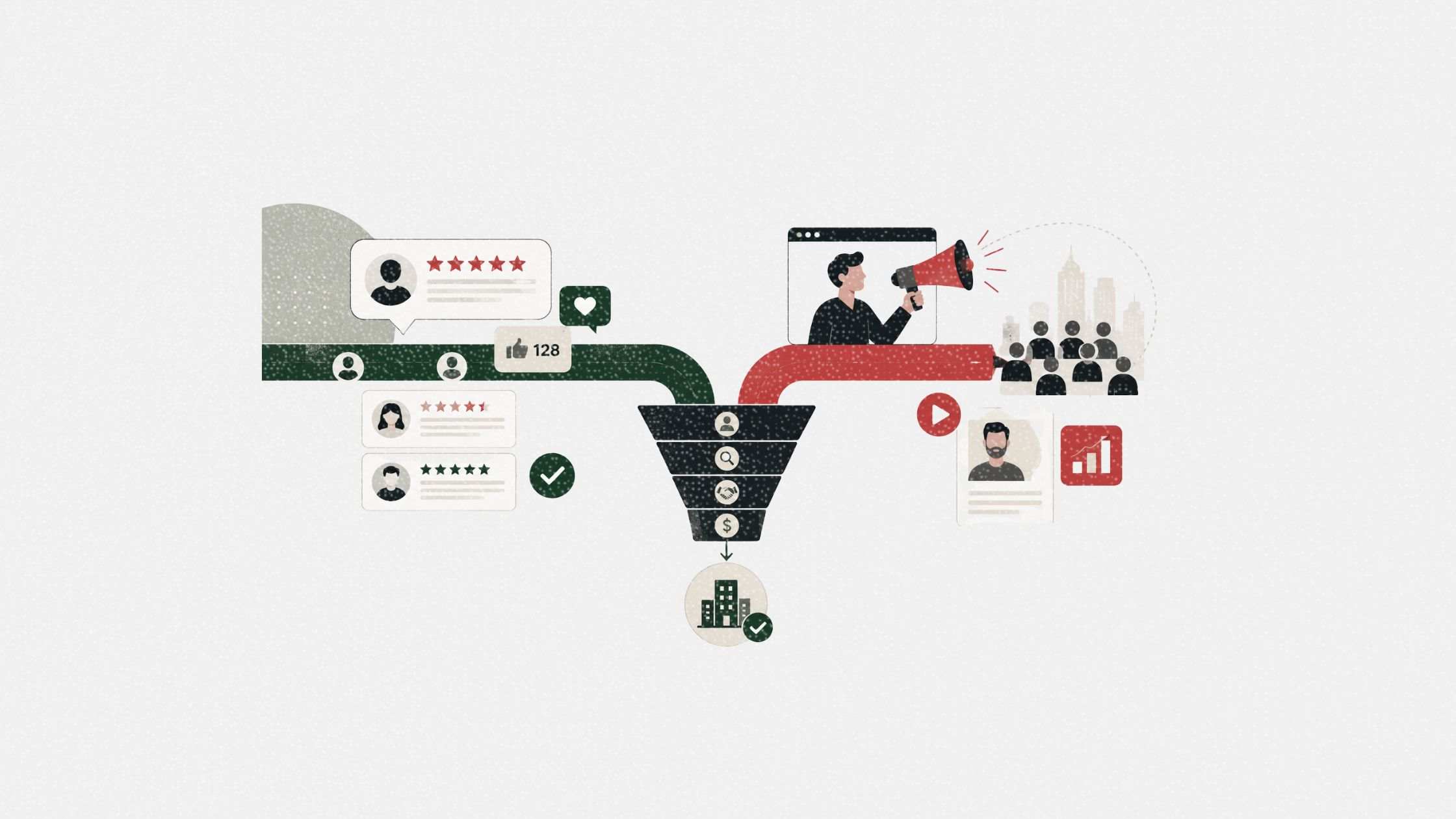
- How the B2B buyer funnel maps to each tactic
- When UGC is the right call for B2B
- When influencer marketing is the right call for B2B
- The hybrid model: running both without doubling your budget
- Rights, contracts, and what to get in writing
- Metrics that prove your approach is working
Why B2B brands keep conflating two different tools
The confusion starts with a surface-level similarity: both tactics involve content made by people who are not on your payroll, and both carry more credibility than anything your brand produces directly. That similarity ends there.
The conflation became common as “creator-led content” blurred the categories. UGC creators on platforms like Collabstr are often commissioned to produce content in a customer style, without any audience distribution obligation. Meanwhile, influencer campaigns that include usage rights get repurposed as paid ads, which looks and functions like UGC. The formats bled into each other, and the strategic logic behind them got lost.
For B2B marketers specifically, the stakes of the confusion are higher than in consumer marketing. B2B buying involves longer cycles, multiple stakeholders, and far more risk-aversion at the decision stage. The right proof asset at the wrong funnel stage does not just underperform; it can actively erode trust with a committee that is already skeptical.
What UGC is (and what it is not)
User-generated content is any content created by actual users or customers, rather than the brand. In B2B contexts, this includes G2 and Capterra reviews, LinkedIn testimonial posts from clients, case study quotes, customer success video clips, and unboxing or integration walkthroughs recorded by users without brand direction.
The defining characteristic of UGC is that the content reflects a genuine user experience. The brand’s role is to collect, license, and deploy that content, not to brief or script it. Once licensed, the brand typically owns usage rights and can republish across owned channels, embed it in ads, or place it on landing pages and product pages.
What UGC is not: commissioned content from a creator who has no relationship with your product. A paid creator producing “customer-style” video content for a brand they have never used is technically a UGC creator by job title, but the content lacks the authenticity signal that makes UGC work in B2B environments specifically. Buyers notice. Peer content that looks staged gets treated like brand content.
What influencer marketing is (and what it is not)
Influencer marketing is a paid or earned collaboration with a creator who distributes content to their own established audience. The value you are paying for is access to that audience and the creator’s credibility with it. The content lives on the creator’s channels first, and whatever trust transfer happens comes from the creator’s relationship with their followers, not from any rights the brand holds.
In B2B, the relevant creator category is not lifestyle or entertainment influencers. It is the operator-creator: the SaaS founder who publishes weekly LinkedIn posts about growth; the DevOps engineer with a YouTube channel reviewing CI/CD tools; the marketing consultant who sends a newsletter to 12,000 senior buyers. Their audiences are small by consumer standards and extremely valuable by B2B standards.
What influencer marketing is not: a content production service. If you are briefing a creator purely to generate assets you can repurpose in your own channels, with no expectation that their audience will see or engage with the content, you are buying UGC production, not influencer marketing. The audience access is the product.
How the B2B buyer funnel maps to each tactic
The clearest way to separate the two tactics is to plot them against the stages of a typical B2B buying journey.
At the top of the funnel, buyers are identifying problems and exploring categories. They have not yet shortlisted vendors. This is influencer territory. A LinkedIn post from a recognized operator-creator can introduce your solution to a buyer who has never heard of you, framed through the credibility of someone they already trust.
At the consideration stage, buyers are actively comparing vendors. According to research published by Salesgenie, 92% of B2B buyers trust peer recommendations over branded content when making purchase decisions, and 64% consult peer reviews during the awareness phase, rising to 68% in the consideration stage. This is where UGC earns its keep. A review on G2, a client testimonial on a landing page, or a case study quote from a named customer reduces the perceived risk of selection in ways no creator campaign can replicate.
At the decision stage, buyers are seeking final validation before committing. The Winterberry Group found that 44% of B2B buyers report that UGC and peer reviews are playing a greater role in their purchasing process. This is not top-of-funnel brand building; it is bottom-funnel deal acceleration.
Dinda Anandita, Account Director at Content Collision, puts the distinction plainly: “B2B marketers often ask us whether they should invest in UGC or influencer marketing, as though the answer is one or the other. The real question is: which stage of the buyer’s journey are you trying to move? Influencer marketing opens the door with an audience that does not know you yet. UGC closes the deal with proof that a buyer who looks like your prospect has already walked through it.”
When UGC is the right call for B2B
There are four situations in B2B marketing where UGC consistently outperforms influencer content:
High-intent conversion pages. Product pages, demo request pages, and pricing pages are where risk-averse B2B buyers make their sharpest evaluations. Customer reviews, embedded testimonials, and social proof widgets on these pages convert visitors who are already interested but need validation. Research from Nosto shows that brands featuring UGC on key pages see a 29% increase in web conversion rates compared to those without it.
Paid social amplification. UGC-style creatives consistently outperform brand-produced ads in paid social environments. According to research cited by TheHypeSociety, UGC-based ads can lower cost-per-click by 50%, and viewers spend 28% longer engaging with them than with polished brand content. For B2B campaigns on LinkedIn and Meta, this translates directly into lower customer acquisition costs.
Account-based marketing (ABM) campaigns. In ABM, you are targeting a defined set of accounts with highly specific messaging. Customer proof from the same vertical, company size, or use case as your target accounts is more persuasive than any thought leadership content. A testimonial from a CFO at a Series B SaaS company carries more weight with another CFO at a comparable company than any influencer post could.
Long sales cycles with committee buying. The 2025 Edelman-LinkedIn B2B Thought Leadership Impact Report found that 71% of hidden decision-makers in complex B2B purchases have little or no interaction with sales, yet they still influence outcomes. UGC seeded across G2, LinkedIn, and email nurture flows reaches these invisible stakeholders in the research phases where sales has no footprint.
When influencer marketing is the right call for B2B
Influencer marketing earns its place in B2B budgets in four scenarios:
Category creation and new market entry. If your target buyers do not yet know they have the problem you solve, no amount of UGC will move them. Influencer campaigns with credible operator-creators who frame the problem compellingly are the fastest way to create demand from scratch. This is why category-defining B2B brands like Gong and Notion have invested heavily in creator ecosystems rather than just paid search.
Reaching buyers that sales cannot. The LinkedIn-Ipsos 2025 B2B Marketing Benchmark found that brands running influencer programs on LinkedIn outperform non-users by up to 39% on customer engagement and brand awareness, and by 30% on revenue growth and lead generation. The gap reflects the reality that creator content surfaces in feeds, newsletters, and communities that branded content never reaches.
Thought leadership distribution at scale. B2B influence on LinkedIn is audience-gated. A post from your company page reaches your followers. The same idea published by a creator with 50,000 relevant followers reaches an entirely different set of buyers. Influencer partnerships function as a distribution layer for ideas your own channels cannot amplify.
Product launches and event amplification. When you need concentrated attention around a specific moment, influencer campaigns deliver faster reach than UGC collection cycles can provide. Live events, product launches, and major announcements benefit from creator amplification in ways that are difficult to replicate with owned-channel proof content.
The hybrid model: running both without doubling your budget
The most sophisticated B2B programs do not choose between UGC and influencer marketing. They design workflows where each feeds the other.
The core mechanism: when you commission influencer content, negotiate usage rights as part of the deal. Creator content that performs well on the influencer’s channel, and that you have rights to repurpose, functions as high-quality UGC in your paid and owned channels. According to the Collabstr 2026 Influencer Marketing Report, platform-agnostic UGC campaigns grew 133% year-over-year on their marketplace, with more brands treating creator content as a reusable asset rather than a one-time distribution event.
The reverse flow works too. Genuine customer UGC, such as a detailed G2 review or a LinkedIn post from a client describing their results, can be amplified by sharing or co-promoting it through creator networks, adding reach to content that already carries authentic proof value.
The practical starting point for a hybrid approach:
- In every influencer contract, include a content usage rights clause covering at least 12 months of paid and organic repurposing across your owned channels.
- Set up a systematic UGC collection process for G2, LinkedIn, and customer success conversations, so you always have fresh proof assets to deploy in bottom-funnel placements.
- Test creator-produced content in paid social before investing in studio production. If the authentic creator format outperforms branded creative (which it typically does), scale it rather than replacing it with a polished version.
Rights, contracts, and what to get in writing
The gap between a successful hybrid program and an expensive legal dispute is almost always a contract that was not specific enough. For both UGC and influencer content, rights documentation is not optional.
For UGC, you need explicit written permission from the creator before republishing or using their content in paid campaigns. A social media repost is not a license. Build a simple permissions request into your customer success workflow, or use a UGC platform that handles licensing automatically.
For influencer content, usage rights must be negotiated before the campaign starts, not after. Default influencer contracts grant the creator ownership of the content and the brand only a non-exclusive license to repost organically. If you want to run creator content as paid ads (whitelisting), extend the usage window beyond 30 days, or use the content in email or on landing pages, those rights need to be specified and priced separately.
A solid influencer contract template should address usage rights, exclusivity window, FTC disclosure obligations, content approval process, and what happens if either party wants to exit the arrangement early.
 Ariana Sorensen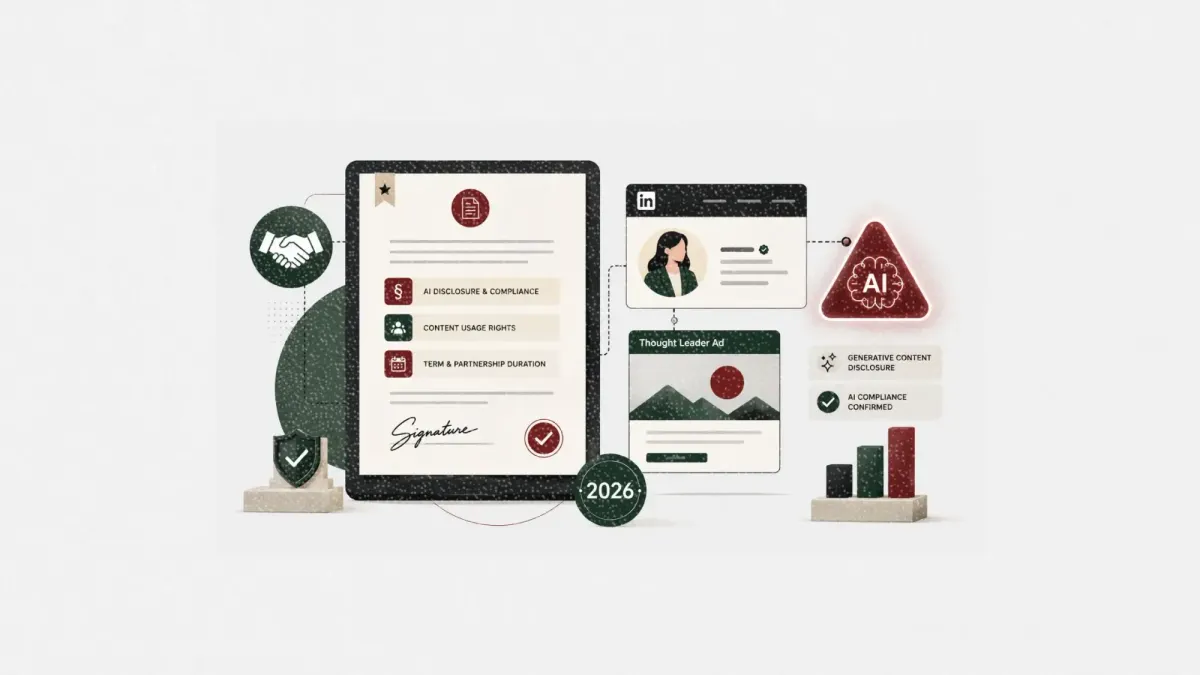
Metrics that prove your approach is working
UGC and influencer marketing require different measurement frameworks, and mixing them produces misleading results.
For UGC, the relevant metrics are conversion-oriented: landing page conversion rate lift from pages with vs. without UGC, cost-per-click improvement on paid ads featuring customer content, review velocity on G2 or Capterra, and time-on-page for testimonial-rich pages. These metrics connect UGC directly to commercial outcomes and are defensible in budget conversations.
For influencer marketing, the metrics shift toward awareness and pipeline signals: reach and share of voice in target segments, branded search volume lift in the weeks following a creator campaign, LinkedIn follower growth among target-account employees, and, for programs with proper attribution, pipeline influenced by creator touchpoints. The influencer marketing ROI framework for B2B requires multi-touch attribution to capture the indirect effect creator content has on deals that close months after the first exposure.
 Ariana Sorensen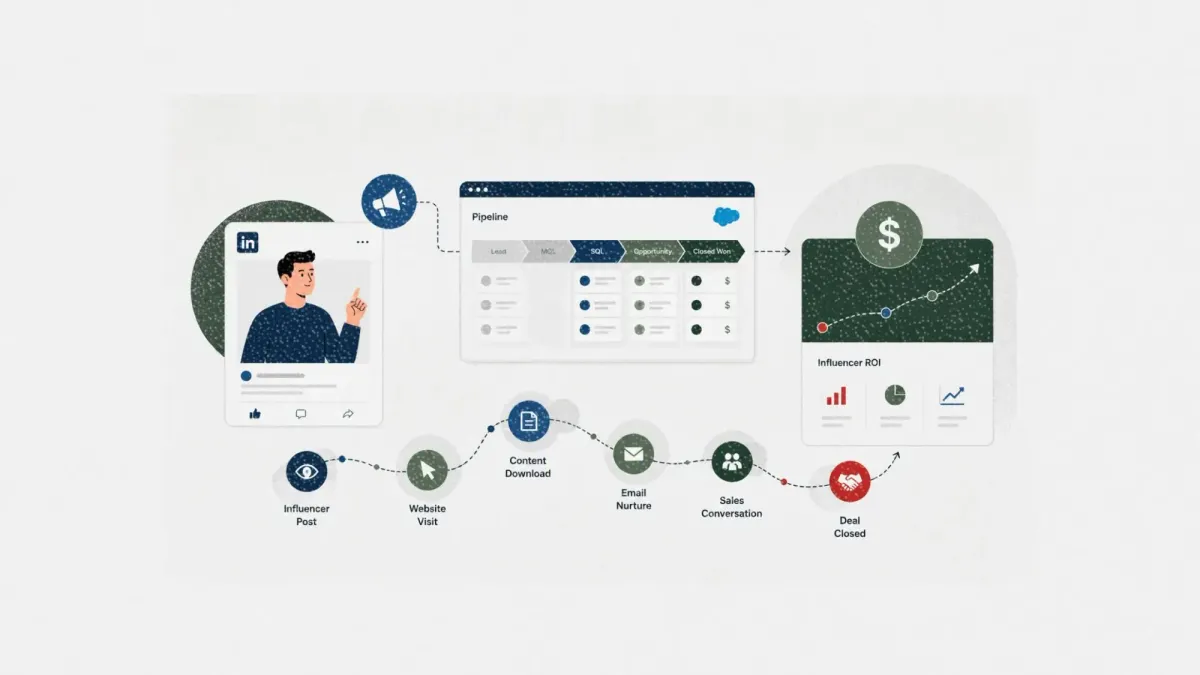
One metric that applies to both: content efficiency. How many reusable assets does each investment produce, and how long do those assets remain effective? Creator content with full usage rights that runs as a paid ad for six months delivers a far better return than a one-time sponsored post that disappears from the feed within 48 hours. Tracking asset longevity alongside performance data will consistently push your team toward higher-value content investments.
 Lena Marlowe
Budget planning for both tactics works best when they are treated as complementary line items rather than competing ones. A useful starting framework is available in ContentGrip’s influencer marketing budget guide.