Fractl surveyed 1,008 U.S. consumers and 150 marketers in Q2 2026 and found a widening gap between AI adoption and AI trust. Consumer use of AI for search continues to rise, but perceived helpfulness and brand trust signals are moving in the opposite direction.
The company outlined the full findings in its official research write-up, including year-over-year comparisons to the same questions fielded in 2025. The practical takeaway for marketing teams is not “AI is replacing search,” but that search behavior is fragmenting across multiple surfaces while expectations around transparency and accuracy are tightening.
Table of contents
Jump to each section:
- What the 2026 survey says about AI search adoption
- Why AI “helpfulness” is dropping even as usage rises
- Trust, disclosure, and the growing backlash risk for AI content
- What marketers should know about AI visibility, GEO, and measurement
- What this means for marketers
What the 2026 survey says about AI search adoption
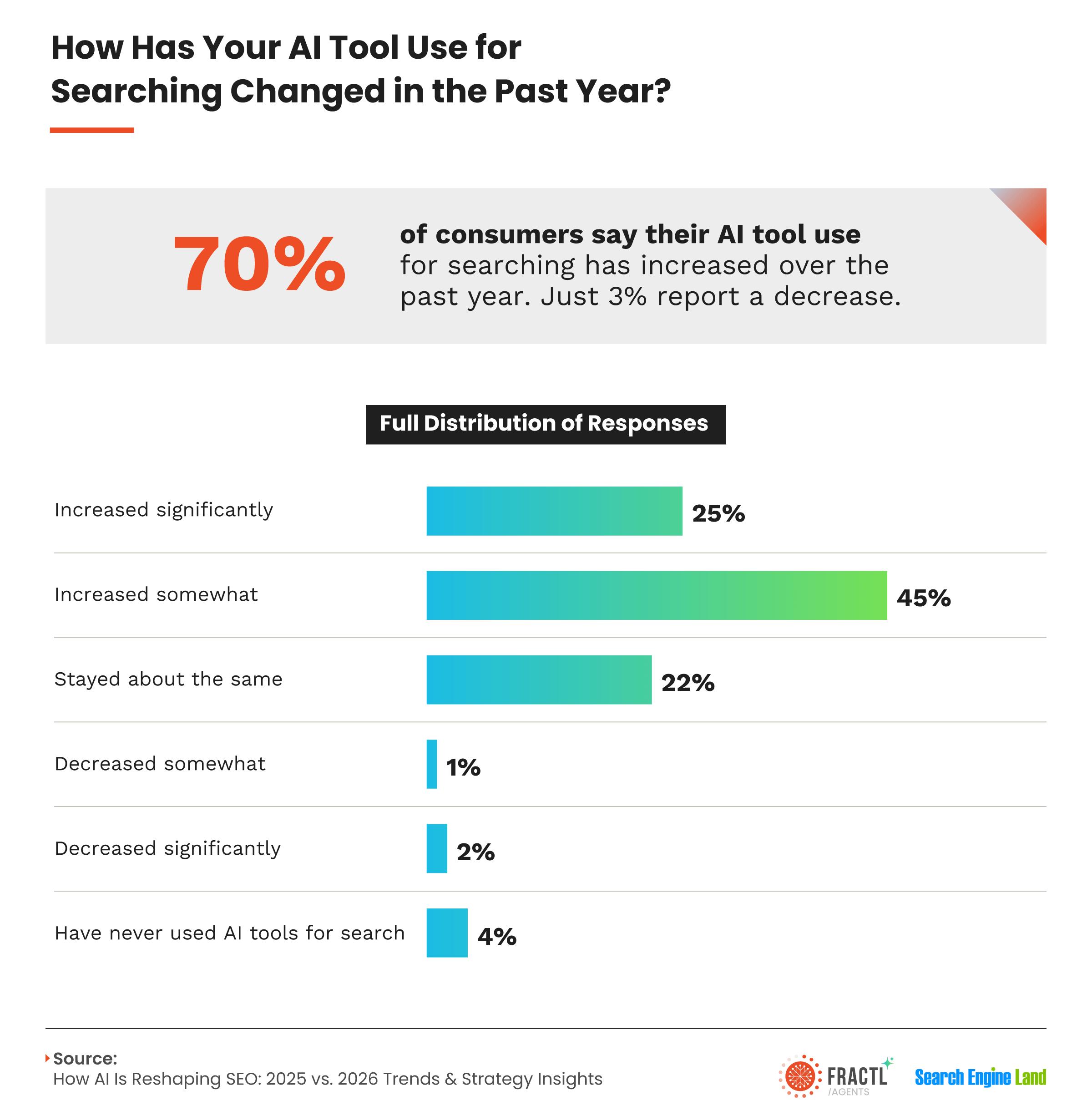
Consumer usage is no longer the limiting factor. Fractl found that 70% of consumers said their AI use for search increased over the past year, while only 4% said they have never used AI tools for search.
This matters because it changes what “AI strategy” should optimize for. If adoption is already saturated, incremental gains will come from trust, differentiation, and presence across the places consumers verify information, not from simply being early.
Why AI “helpfulness” is dropping even as usage rises
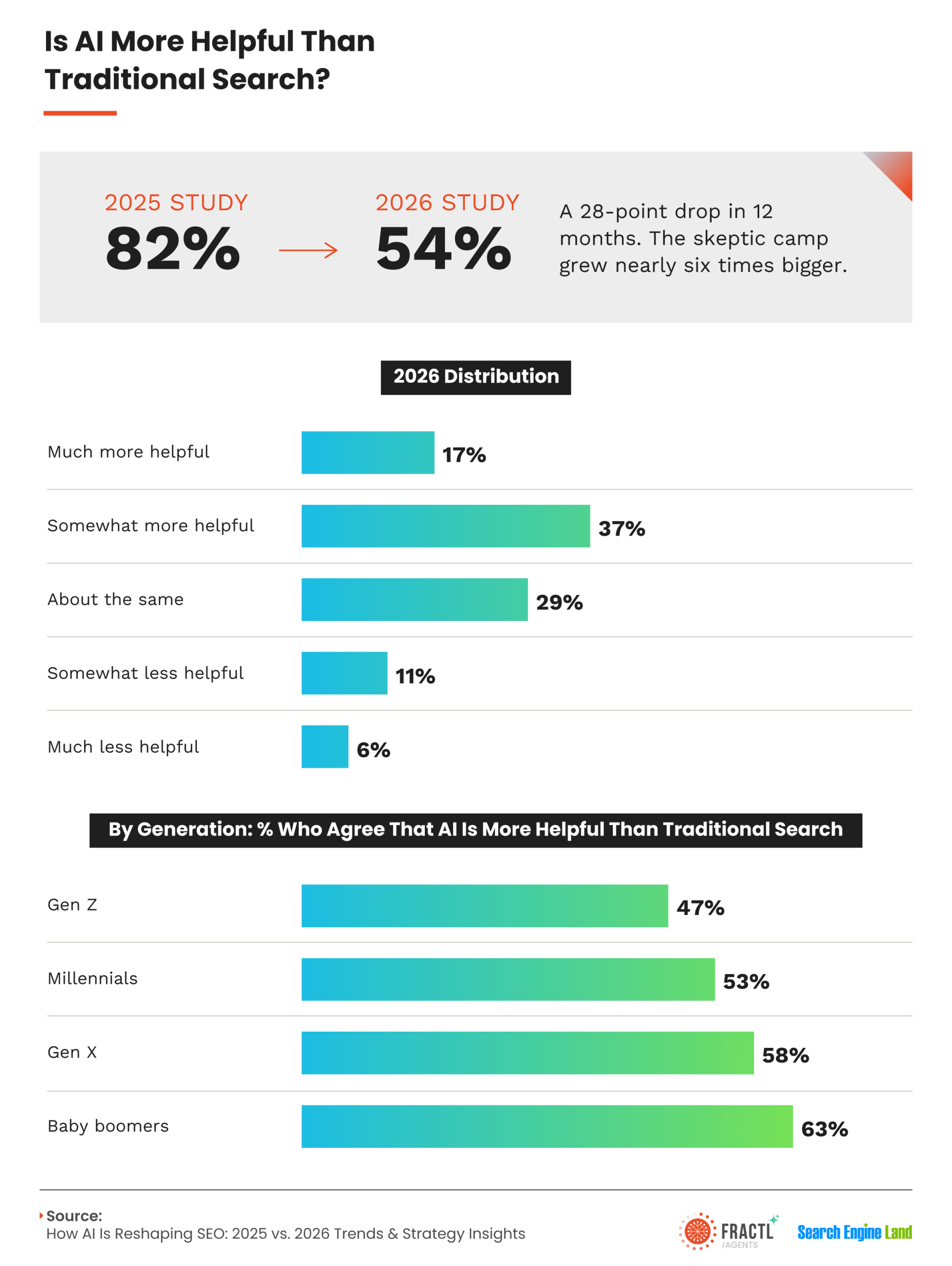
The most striking year-over-year change in the research is perceived helpfulness. In 2025, 82% of consumers said AI was more helpful than traditional search. In 2026, that number fell to 54%, a 28-point drop.
At the same time, the share of consumers who rate AI as less helpful than traditional search rose from 3% to 17%. The implication is not that AI tools are unused, but that consumers are becoming more critical as the novelty wears off and as they encounter issues like low-confidence answers or generic responses.
The generational split is also worth noting: Baby Boomers (63%) were more likely than Gen Z (47%) to say AI is more helpful than traditional search. That is a reminder that “AI-native” does not automatically mean “AI-tolerant,” especially when content feels repetitive or unreliable.
Trust, disclosure, and the growing backlash risk for AI content
The survey points to a specific reputational problem: consumer concern is shifting from “AI exists” to “AI is being overused, and I cannot tell what is real.” Fractl found that the share of consumers who say heavy AI use would decrease their trust in a favorite brand doubled from 20% in 2025 to 40% in 2026. Only 14% said they would trust a brand more for using AI heavily.
Gen Z showed the highest likelihood of reduced trust: 54% said their trust would decrease if a favorite brand used AI for most marketing. Women were also more likely than men to penalize heavy AI marketing use (44% vs. 34%).
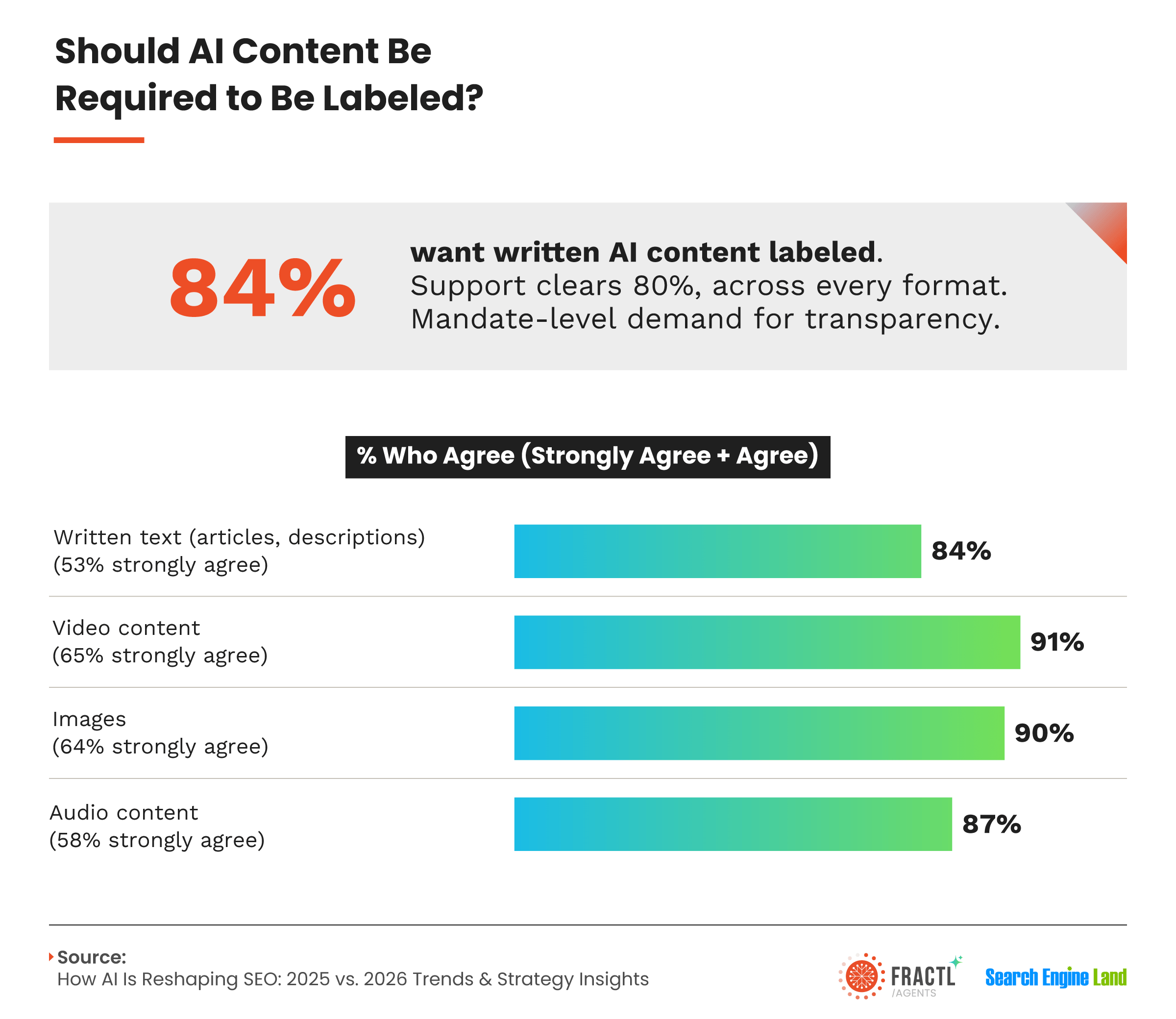
That trust dynamic connects directly to disclosure expectations. Consumers in the survey overwhelmingly wanted AI content labeled across formats: 84% for written content, 91% for video, 90% for images, and 87% for audio. Against that backdrop, the marketer-side governance signals look thin: only 20% of organizations always disclose AI use to audiences, while 33% never disclose.
For marketing leaders, this combination is a policy and positioning issue. When disclosure expectations are that high, “we did not disclose because competitors do not” stops being a defensible rationale and starts looking like an avoidable trust risk.
What marketers should know about AI visibility, GEO, and measurement
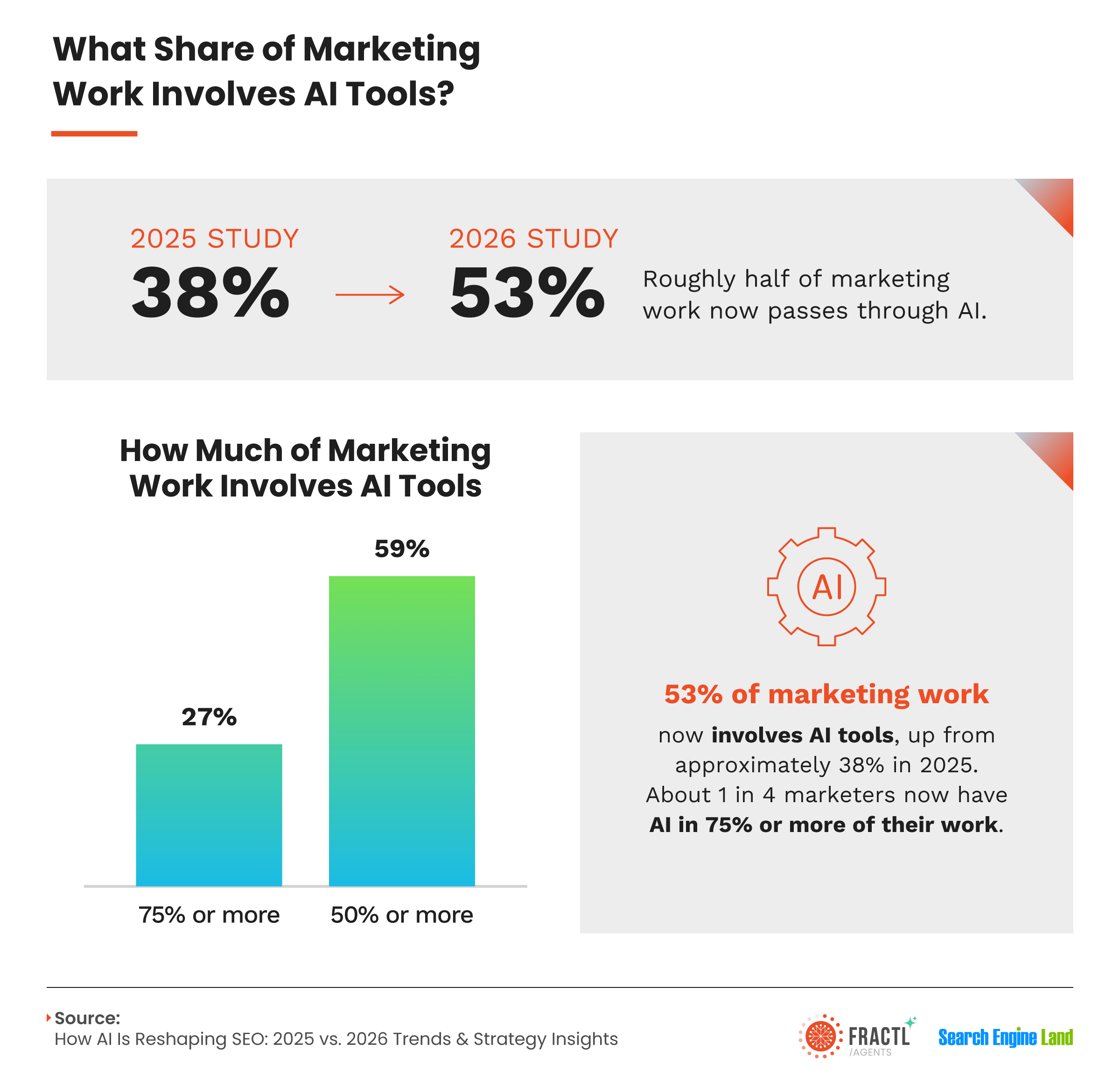
On the marketer side, Fractl found that 53% of marketing work now passes through AI tools, up from about 38% in 2025. That is a big operational shift in one year, and it helps explain why many teams feel adoption pressure (average 6.4 out of 10, with 55% reporting 7 or higher).
However, speed is coming with a clear tradeoff. 48% of marketers said AI made their work faster but more average in quality. Only 26% reported being faster and better, and 7% said quality declined. If “average” becomes the default output, the competitive edge moves to teams that can add distinctiveness through proprietary inputs, strong editorial standards, and recognizable expertise.
The data also suggests brand visibility work is broadening beyond classic Google SEO. Fractl found:
- 50% of marketers reported decreased organic traffic since AI Overviews launched.
- 57% cited visibility growth from social platforms like TikTok, Reddit, and YouTube.
- 40% cited visibility growth from AI assistants such as ChatGPT, Gemini, and Perplexity.
- 31% cited growth in direct or branded traffic.
At the same time, measurement is lagging. While 61% expressed some confidence in their GEO strategy, only 12% were very confident with measurable results, and many are executing without clear attribution. That creates a budget and planning risk: tactics can scale faster than a team’s ability to prove what is working.
Finally, brand risk is increasingly about third-party AI outputs. In the survey, 27% of marketers said their brand has been inaccurately described in an AI-generated response, and 14% said an AI inaccuracy impacted a real customer relationship, sale, or PR situation. Yet only 24% have a formal documented monitoring process for AI brand mentions.
What this means for marketers
The survey results point to a year where brand advantage comes from governance and distinctiveness, not just AI throughput.
- Treat disclosure as a brand decision, not a compliance afterthought
With 84% to 91% of consumers asking for AI labeling across formats, non-disclosure is a bet against audience expectations. If your category relies on trust, you should assume the bar will rise further. - Plan for multi-surface verification, not single-channel “SEO”
Consumers check an average of 2.4 platforms before making a purchase decision. That means your brand story needs to hold up across traditional search, social platforms, reviews, and AI assistant outputs, not just one ranking surface. - Build differentiation that AI cannot easily flatten
Nearly half of marketers say AI makes output faster but more average. The more “good-enough” content floods the market, the more valuable it becomes to publish assets that are harder to replicate, such as original research, named expert perspectives, and source transparency. - Monitor AI brand mentions like a reputation channel
With 27% of marketers seeing AI misrepresentation and only 24% having a documented monitoring process, the exposure-to-readiness gap is the problem. If a false AI answer can affect sales or PR, monitoring belongs in the same risk tier as reviews and social listening. - Do not scale GEO tactics faster than your measurement model
Confidence without attribution can create noisy decision-making. If your team cannot yet measure GEO impact reliably, align on leading indicators (visibility, inclusion, sentiment, citation patterns) and treat budget shifts as experiments rather than permanent reallocations.
The underlying pattern is consistent: consumers are adopting AI faster than they are trusting it, and marketing teams are operationalizing AI faster than they are governing it. That combination creates a window where transparency, quality controls, and proprietary signals can become competitive levers.
In practice, 2026 marketing strategy may look less like “winning one algorithm” and more like building repeatable credibility across several discovery environments. The teams that formalize review, disclosure, and monitoring will be better positioned to benefit from AI distribution without inheriting avoidable trust damage.