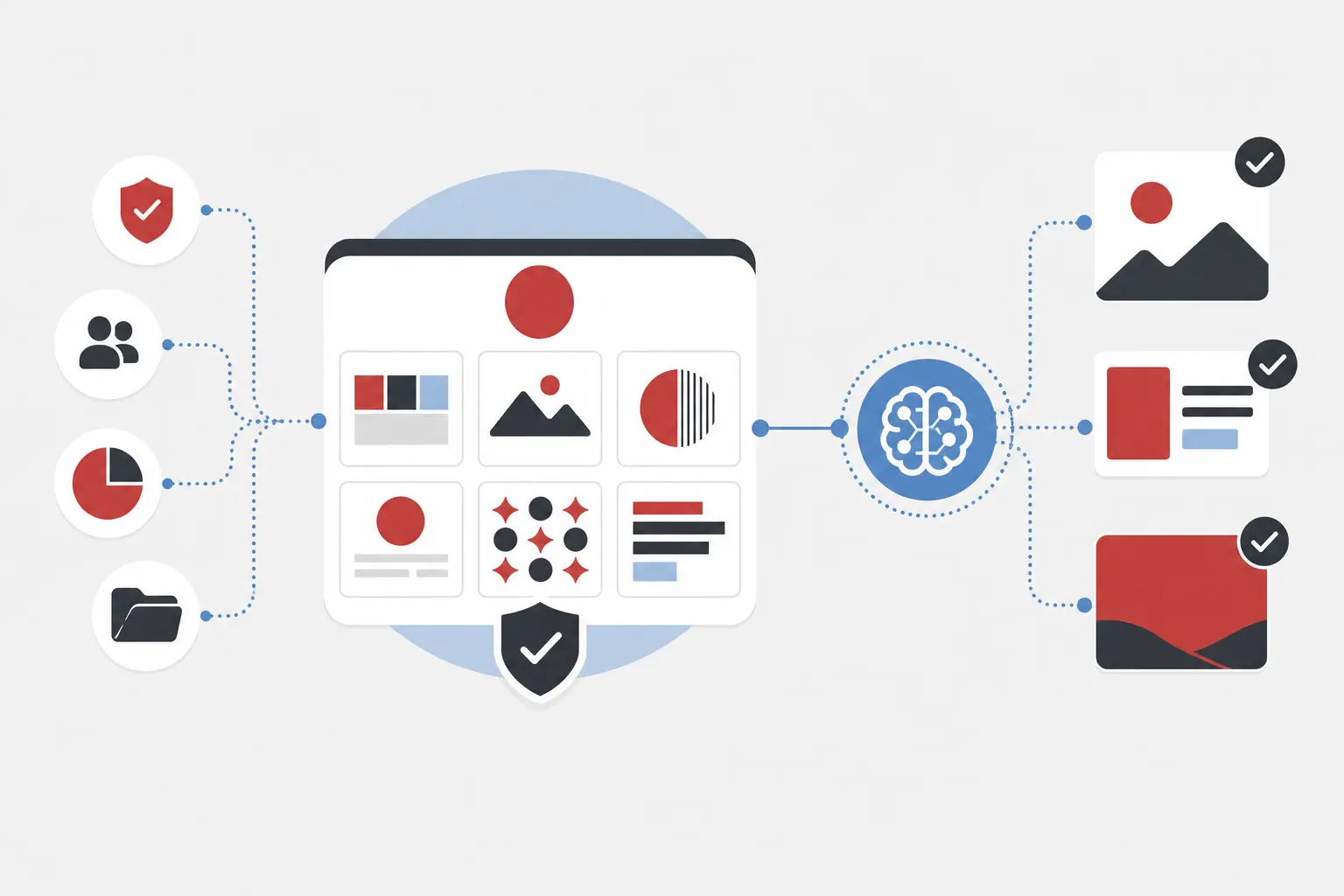
AI creative is making production easier and brand management harder. The old problem was getting enough assets made. The new problem is making sure every asset still carries the same memory of the brand when production has been spread across internal teams, agencies, templates, tools, prompts, local markets, and automated workflows.
That changes the value of brand systems. A guideline document is no longer enough if creative work is being generated, adapted, and shipped at higher speed than a central brand team can manually review. The operating question becomes whether the brand has enough distinctive assets, workflow rules, and approval logic to survive creative velocity.
Consumers are already grading AI-era work on feel. Canva’s 2026 State of Marketing and AI research, conducted with The Harris Poll, found that 97% of marketing leaders use AI in daily creative work and 99% plan to increase AI investment in 2026. The same research found that 70% of consumers say they can usually spot AI-generated ads because something feels missing, while 87% believe the best advertising still needs a human touch.
The market has moved past the question of whether AI belongs in creative workflows. The harder question is whether the brand itself has been made operational enough for AI to use without sanding away the parts people recognize.
Table of contents
Jump to section:
- AI creative has turned brand systems into production infrastructure
- Distinctive assets are now governance assets
- The trust risk is sameness as much as disclosure
- Agencies will be judged by brand control not tool fluency
- The real AI advantage is governed creative memory
AI creative has turned brand systems into production infrastructure
Most brand guidelines were built for a slower production environment. They assumed that creative work moved through recognizable stages: brief, concept, design, copy, review, adaptation, approval, launch. AI compresses those stages. A market team can generate social variants before the global team has finished debating the campaign platform. An agency can test character ideas, packaging mockups, ad scripts, and video treatments before the client has decided which brand assets are non-negotiable.
That speed is useful, but it exposes a structural weakness. If the brand system lives mainly as a PDF, a deck, or institutional memory inside a small team, AI will treat it as optional context rather than as operating logic.
This is why Coca-Cola’s recent visual identity refresh matters beyond design news. The company is not only tightening core assets across more than 200 markets. It is pairing the refresh with brand-center and design-intelligence tooling so internal teams and agency partners can produce more consistently. ContentGrip’s coverage of Coca-Cola’s global identity update framed the move as a brand governance problem, not a cosmetic one.
The strongest brands will not use AI to create infinite variation. They will use AI inside systems that know which variation still belongs to the brand.
Distinctive assets are now governance assets
Distinctive assets used to be discussed mainly as memory structures. Colors, shapes, characters, typography, jingles, product forms, and recurring visual devices helped people recognize the brand faster. In AI-enabled production, those same assets become governance assets because they give machines and humans a shared boundary for acceptable variation.
A brand without clear distinctive assets becomes harder to automate safely. If the team cannot say which elements must remain stable, AI-assisted production will optimize toward style, category convention, or prompt fluency. That can create work that looks polished but could belong to anyone.
The issue is not only visual. A brand character, a recurring campaign world, or a recognisable editorial voice can also act as governance. ContentGrip’s report on Ziggo’s AI-made Octopus campaign showed the same pattern from a production angle. The point was not that AI made a mascot. The more useful signal was that AI let the team prototype and refine a durable brand asset that could carry future executions.
This is where many AI creative pilots are still thin. They measure speed, output volume, or cost reduction, but they do not ask whether the work strengthens brand memory. A campaign can be cheaper and still be strategically expensive if every asset teaches the market a slightly different version of the brand.
In a high-velocity production environment, distinctive assets are not decoration. They are the control layer that keeps scale from becoming drift.
The trust risk is sameness as much as disclosure
AI disclosure is becoming a visible trust issue, but disclosure alone will not solve the deeper creative problem. A labeled AI ad can still feel generic. A human-made ad can still feel manipulative. The audience is reacting to a mix of usefulness, craft, provenance, and control.
Gartner’s October 2025 survey of 1,539 U.S. consumers found that 50% would prefer to give business to brands that do not use GenAI in consumer-facing messages, advertising, and content. It also found that 68% frequently wonder whether the content and information they see is real.
That skepticism is now moving into assessments of quality. Gartner’s March 2026 consumer survey found that 49% of U.S. consumers agree GenAI has made content quality worse, rising to 57% among Gen Z and millennials. The same release argued that brands need to be more recognizable, credible, and intentional about context.
That last word matters. Context is what makes AI output feel designed instead of merely generated. A brand asset placed inside a familiar customer ritual, a product truth, a local setting, or a well-established visual system is easier to trust because the work has a reason to exist.
Recent ContentGrip coverage of AI disclosure as a brand trust decision focused on labels, consent, and control. Those are now table stakes. The next level is making sure the creative system itself gives people enough proof that a real brand with real judgment is still behind the work.
When AI makes mediocre content abundant, recognizability becomes a trust signal because it tells the audience someone is still accountable for the experience.
Agencies will be judged by brand control not tool fluency
For agencies and production partners, AI fluency is becoming too common to function as a durable point of difference. The more valuable capability is brand control. Can the partner build faster workflows without weakening the assets, tone, approvals, and legal boundaries that make the brand commercially usable?
This changes the client brief. A useful AI creative brief should not only ask for outputs. It should define which brand signals must remain stable, which areas can flex by market, which claims require substantiation, which visual or verbal patterns are off limits, and who owns approval when the system creates an edge case.
The legal layer is not theoretical. WFA research published in 2025 reported that 66% of brands identified legal challenges as the main barrier to GenAI adoption, with 77% most concerned about IP and copyright risks. That concern sits directly inside creative operations. The more assets a team generates, the more it needs provenance, usage rights, review discipline, and records of human judgment.
That does not mean agencies should slow everything down until AI looks like the old production model. It means they need to make the new model legible. A client should be able to see how inputs are controlled, how brand rules are enforced, how sensitive claims are escalated, and how final assets are approved for actual use.
The agency that can say “we made this faster” is useful. The agency that can say “we made this faster without weakening brand memory, proof, or rights control” is harder to replace.
The real AI advantage is governed creative memory
AI will keep lowering the cost of producing variants. That is not where the long-term advantage will sit. As more teams gain similar production capabilities, differentiation will move upstream into the quality of the brand memory that feeds the system.
Governed creative memory is more than a style guide. It is a working record of what the brand must repeat, what it can reinterpret, what it must never imply, and which proof points support its claims. It includes the assets people recognize and the rules teams use when those assets are adapted. It also includes the judgment to know when an output is technically on brand but strategically empty.
That is why the next phase of AI creative investment should look less like a race to generate more and more like a rebuild of the brand operating layer. Teams need asset libraries that machines can read, approval systems that capture reasoning, prompts tied to brand strategy, and feedback loops that measure whether faster work is making the brand more distinctive or more disposable.
The risk is not that AI will make every brand look identical overnight. The risk is slower and easier to miss. Each convenient asset, each slightly generic variant, each locally adapted execution that forgets the masterbrand, and each unreviewed prompt can pull the brand away from itself.
AI will reward brands that know what should not change.