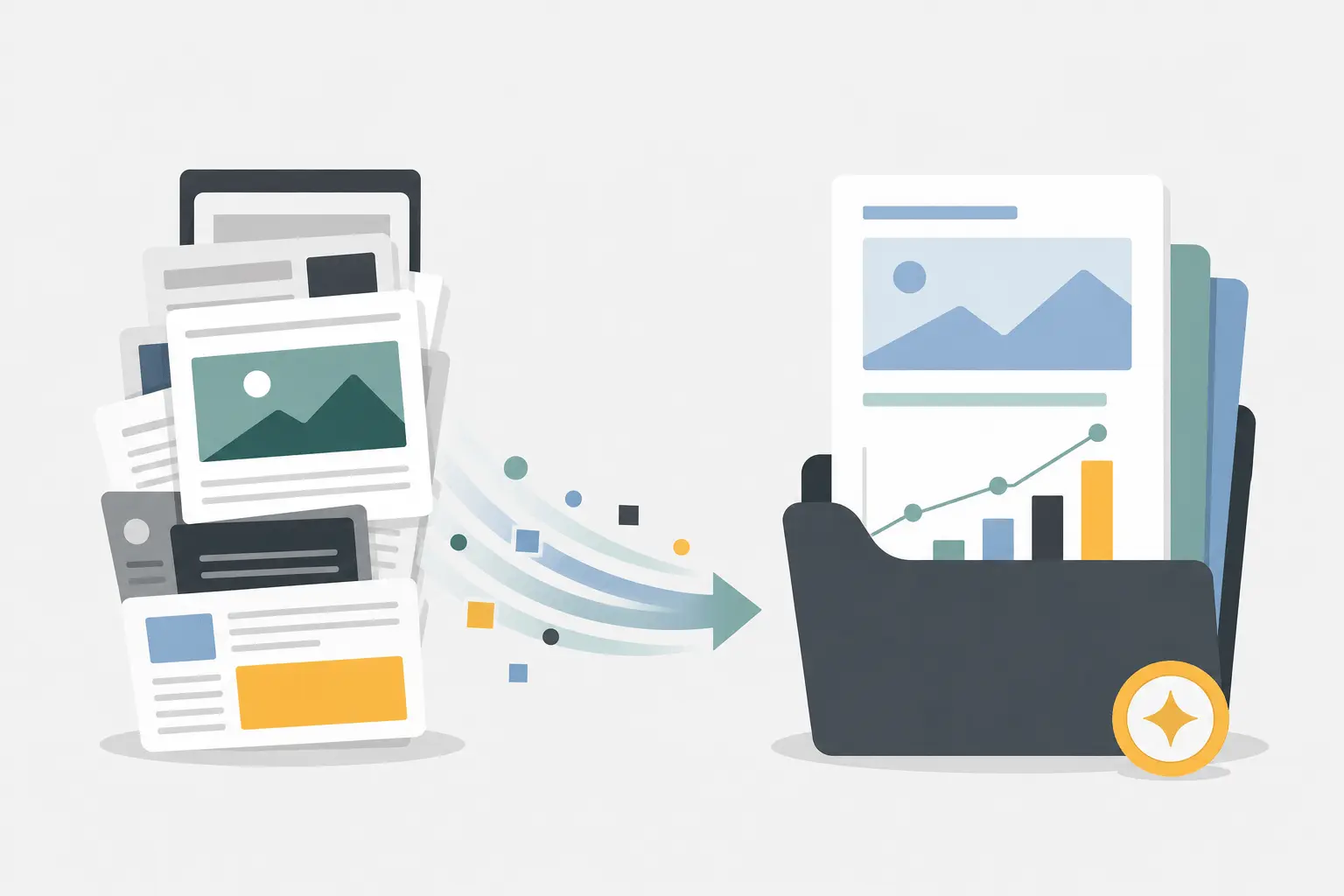
PR clipping is the habit of collecting earned media mentions and turning them into a useful record of what coverage actually said. For B2B PR teams, the point is not nostalgia for old newspaper cuttings. The point is to make coverage searchable, comparable, and useful for decisions after the campaign has moved on.
That matters now because earned coverage has a longer afterlife. A mention can influence buyers, support analysts, surface in search, or become part of the public evidence that AI answer systems summarize later. If PR teams only keep a loose folder of links, they can prove activity, but struggle to explain quality, message accuracy, or what to brief next.
Key Takeaways
- PR clipping turns earned media mentions into a structured record that teams can analyze, share, and reuse.
- The strongest clipping workflow captures context, message quality, audience fit, and next actions, not just URLs.
- PR teams should connect clipping to reporting, brand monitoring, and message pull-through so coverage becomes a learning system.
Table of contents
Jump to each section:
- What is PR clipping?
- How is PR clipping different from media monitoring?
- Why does PR clipping still matter for B2B teams?
- What should a PR clipping record include?
- How do you build a PR clipping workflow?
- How should teams judge clipping quality?
- What mistakes make PR clipping less useful?
- How should PR teams use clippings after the report?
What is PR clipping?
PR clipping is the process of collecting media mentions of a brand, campaign, executive, product, or issue so PR teams can evaluate coverage and preserve proof of earned visibility.
At its simplest, a clipping is a captured media mention. It may be an online article, newsletter mention, podcast transcript, broadcast segment, print article, analyst note, forum thread, or social post. The term comes from newspaper clippings, but the modern version is mostly digital.
If your team is still building the outreach foundation, ContentGrip’s media relations guide explains how earned coverage is planned before clippings ever appear.
The useful version of PR clipping is more than collecting screenshots. It records what the publication said, where the mention appeared, which message landed, which spokesperson was quoted, what link or visual appeared, and what the team should learn from it.
Several ranking competitor pages define the practice in similar ways. Determ frames PR clipping as collecting media mentions to analyze the effectiveness of public relations activity. Indeed describes PR clippings as a tool for assessing media campaign success. Those definitions are useful, but B2B teams should add one more layer: what did the clipping prove that leadership can act on?
How is PR clipping different from media monitoring?
PR clipping is the collected record of relevant coverage, while media monitoring is the broader system that finds mentions across channels.
The terms often overlap because the same software may do both jobs. Media monitoring scans for mentions. PR clipping decides which mentions deserve to be saved, scored, reported, and used later. One is the collection engine. The other is the editorial and measurement discipline around the evidence.
| Practice | Main job | Typical output | Best question |
|---|---|---|---|
| Media monitoring |
Find brand, competitor, campaign, or category mentions across selected sources. |
Alerts, dashboards, mention feeds, sentiment views, volume trends. | What is being said, where, and how fast is it changing? |
| PR clipping |
Select and preserve relevant earned mentions for evaluation and reporting. |
Clip log, screenshots, article links, summaries, coverage book, report appendix. |
Which mentions matter enough to prove, analyze, or reuse? |
| Brand monitoring |
Track reputation, message drift, competitor context, and public understanding over time. |
Risk notes, stakeholder briefings, trend summaries, escalation decisions. |
What is the market learning about the brand? |
This distinction matters because a dashboard can create false confidence. A monitoring feed may show hundreds of mentions, but many may be irrelevant syndications, passing references, scraped duplicates, or low-value posts. A clipping process forces the team to ask whether each mention helps explain campaign impact.
Brand24 makes a similar distinction, noting that PR clipping focuses on gathering coverage for campaign, reputation, and reporting purposes, while media monitoring is broader. For ContentGrip’s audience, the more practical rule is this: monitor everything relevant, clip only what you can explain.
Why does PR clipping still matter for B2B teams?
PR clipping matters because B2B coverage needs to be evaluated for credibility, message accuracy, buyer relevance, and future use, not just counted.
Many B2B campaigns do not create instant conversions. They build evidence. A trade article may help a sales team explain a category shift. A founder quote may make an analyst briefing easier. A podcast mention may show that the market is starting to use the company’s language. A clipping log helps teams preserve that evidence before links disappear, pages change, or memories become fuzzy.
The value is especially clear when PR has to report beyond vanity metrics. A leadership team rarely needs a folder with every mention. It needs a short explanation of what changed because the coverage happened. That means clippings should be tied to objectives such as category education, launch awareness, investor confidence, crisis containment, executive visibility, or demand support.
Tommy Prayoga, Head of Agency at digital PR service provider Content Collision: “A clipping is only useful when it keeps the context intact. The headline, quote, outlet, audience, message, and follow-up implication all matter. If the team only saves the URL, it loses the part of the coverage that tells you whether the story actually worked.”
That quote gets to the operational problem. PR teams often collect clippings at the end of a campaign when everyone is tired. The campaign looks finished, so the clipping work becomes administrative. In reality, this is the moment when the team has the clearest evidence about which angles worked, which journalists understood the story, which proof points carried, and which messages need repair.
What should a PR clipping record include?
A PR clipping record should include the placement, source context, message quality, audience relevance, evidence captured, and the recommended follow-up action.
A good clipping record should be compact enough to maintain and detailed enough to defend. If the log takes too long to update, the team will abandon it. If it only stores links, it will not support analysis.
At minimum, include:
- Publication name, URL, author, date, and article type.
- Screenshot or PDF capture in case the page changes.
- Campaign, announcement, spokesperson, product, or issue connected to the clip.
- Outlet relevance, audience fit, and market or region.
- Mention prominence, such as headline, lead, body mention, quote, image caption, or link.
- Message pull-through, including whether the intended point appeared clearly, partially, or not at all.
- Sentiment and framing, especially when the placement contains criticism, caveats, or competitor comparisons.
- Backlink status, anchor text, and destination URL when the article links to the brand.
- Recommended follow-up, such as thank the journalist, brief sales, update the press room, correct an error, pitch a deeper angle, or monitor reactions.
The screenshot or PDF matters more than many teams realize. Online articles can be updated, syndicated pages can vanish, and newsletters may not remain public. A saved copy protects the record when a client, executive, or legal stakeholder later asks what was actually published.
For reporting, connect the clipping record to ContentGrip’s PR report guide, which frames coverage as evidence that should explain quality, message performance, audience relevance, and next steps. That is the job a clipping log should support.
How do you build a PR clipping workflow?
Build a PR clipping workflow by defining tracked terms before launch, reviewing mentions on a schedule, scoring useful placements, and turning the findings into action.
The easiest mistake is starting after coverage lands. By then, teams may miss early syndications, untagged mentions, or social amplification. Start before outreach begins.
Use this workflow:
- Define campaign goals, target outlets, tracked brand terms, spokesperson names, product names, campaign phrases, competitor names, and risk terms.
- Set up monitoring across news, blogs, newsletters, social platforms, forums, podcasts, and broadcast sources where relevant.
- Create a clipping log with agreed fields, including source, date, URL, screenshot, prominence, message score, sentiment, audience fit, and follow-up action.
- Review alerts daily during launch windows and weekly during always-on programs.
- Remove duplicates, irrelevant syndications, scraper pages, and low-context passing mentions.
- Score each useful clip against the campaign objective and message map.
- Package the strongest clips into a report, but keep the full log available for audit and learning.
- Use the findings to brief the next pitch, spokesperson session, owned content update, or stakeholder note.
This workflow does not require an enterprise platform on day one. A small team can start with search alerts, a spreadsheet, a shared folder, and a weekly review habit. A larger team may need monitoring software, automated exports, sentiment tagging, alerts, and report templates.
| Layer | Use case |
|---|---|
| Search alerts |
Catch simple web and news mentions for brand, executive, and campaign terms. |
| Media monitoring platform |
Track broader coverage across online media, social, broadcast, podcasts, and forums. |
| Shared clipping log |
Preserve reviewed mentions, scores, screenshots, links, and follow-up notes. |
| Reporting workspace |
Turn selected clippings into executive summaries, client reports, and campaign retrospectives. |
The stack matters less than the discipline. A clean spreadsheet with consistent scoring is more useful than a powerful dashboard nobody interprets.
How should teams judge clipping quality?
Teams should judge clipping quality by relevance, prominence, message accuracy, source credibility, audience fit, and whether the placement creates a useful next action.
Clip volume is tempting because it gives PR a number. But volume alone can reward the wrong thing. A campaign that earns many shallow pickups from irrelevant sites may look busy while doing little for buyer trust. A campaign that earns fewer but stronger placements may create more useful visibility.
Use a simple scorecard:
| Criterion | What to check | Why it matters |
|---|---|---|
| Outlet relevance | Does the publication reach the audience the campaign cares about? | Relevant reach beats broad but mismatched exposure. |
| Prominence |
Did the brand appear in the headline, lead, quote, body, list item, or passing mention? |
Prominence affects whether readers notice and remember the brand. |
| Message accuracy | Did the article repeat the intended point without distorting it? | Coverage can create confusion when the wrong message travels. |
| Evidence quality |
Did the placement include data, customer proof, product context, or a useful quote? |
Evidence makes a clipping more useful for sales, analysts, and future pitches. |
| Search and AI value |
Did the article create a relevant backlink, entity mention, category association, or source likely to be cited later? |
Earned coverage can outlive the campaign as public proof. |
This is where PR clipping connects directly to message pull-through. A clipping proves that a placement happened. Message pull-through proves whether the intended story survived. Teams need both to improve the next campaign instead of only celebrating the last one.
A practical scoring model can stay simple. Give each relevant placement a 0 to 2 score for outlet fit, prominence, message accuracy, and evidence quality. The total does not need to become a universal KPI. It gives the team a consistent way to compare clips inside one campaign and explain why some mentions matter more than others.
What mistakes make PR clipping less useful?
PR clipping becomes less useful when teams save every mention, ignore context, overcount syndication, miss untagged references, or fail to connect clips to decisions.
The first mistake is treating the clipping log as a trophy cabinet. A report packed with every pickup can look impressive, but it often hides the story leadership needs. Strong clipping separates the full archive from the executive view.
The second mistake is overcounting syndication. Wire pickups, scraped pages, and duplicated articles can inflate clip counts. They may still matter when distribution reach is the goal, but they should not be presented as separate editorial wins unless the placement added new context or reached a distinct audience.
The third mistake is ignoring negative or mixed mentions. A clipping process that only captures praise is not a measurement system. PR teams need to preserve criticism, corrections, skeptical framing, and competitor-led stories because those signals shape reputation and future messaging.
The fourth mistake is losing the surrounding context. A quote clipped without the paragraph around it may look stronger than it really was. A brand mention in a listicle may not carry the same value as a feature interview. A backlink from a low-relevance site may not deserve the same weight as an unlinked mention in a trusted trade publication.
The fifth mistake is failing to use the clip after the report. A good clipping record should feed sales enablement, spokesperson coaching, owned content, analyst updates, investor notes, partner proof, and future pitch planning. If the clipping log sits untouched after the report is sent, the team has preserved evidence but missed the learning.
How should PR teams use clippings after the report?
PR teams should use clippings to brief stakeholders, improve future outreach, support sales conversations, update owned assets, and monitor how public narratives evolve.
The best clippings become inputs for the next round of work. A strong trade article can become sales proof. A misunderstood quote can become a media training note. A recurring journalist question can become a blog post, FAQ, or analyst briefing. A weak product description in coverage can reveal that the team’s public messaging is still too vague.
Think about clippings in five after-report uses:
- Sales enablement: share the strongest third-party proof with sales teams, especially when the coverage explains the category or validates the buyer problem.
- Message repair: identify phrases that journalists misunderstood or ignored, then update the message map, pitch, boilerplate, or spokesperson prep.
- Relationship building: note which journalists covered the story thoughtfully and what they may want next.
- Owned content: turn repeated questions from coverage into explainers, landing page updates, or newsroom resources.
- Visibility monitoring: watch whether the same language appears in search results, AI answers, social posts, and competitor comparisons.
For teams building an always-on reputation view, ContentGrip’s brand monitoring guide is the natural next step. PR clipping explains what the campaign earned. Brand monitoring explains what the market keeps saying after the campaign has faded from the calendar.
The core discipline is simple: do not let coverage become a pile of links. Capture the clip, preserve the context, score the quality, and use the finding. PR clipping is the bridge between earned visibility and the next smarter decision.