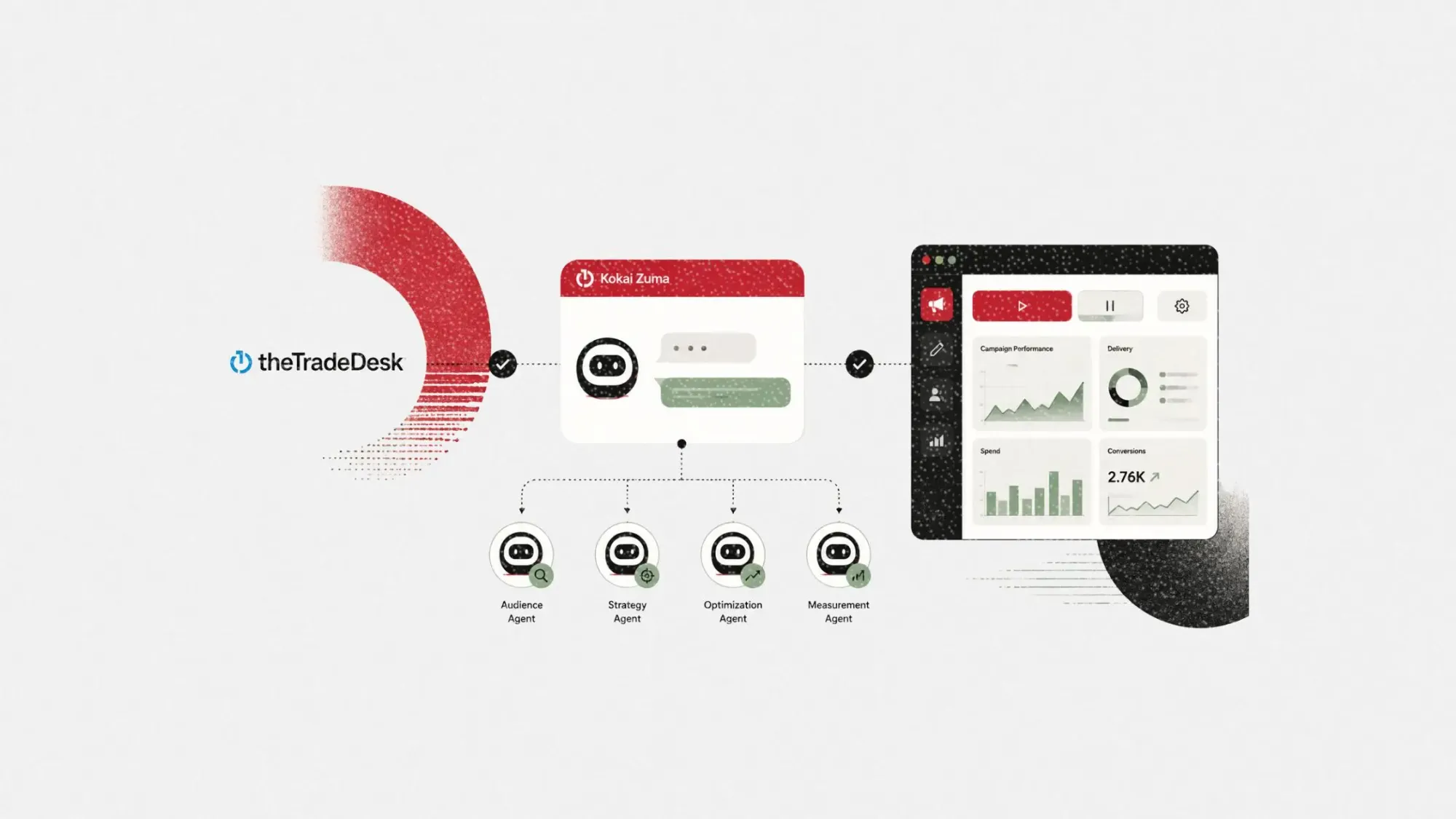
The Trade Desk is giving Kokai its biggest usability overhaul since the DSP platform launched in 2023. The new Zuma update adds a conversational Koa Assistant, multiple AI agents, simpler campaign controls, and faster measurement setup for programmatic buyers.
The update is less about introducing a single breakthrough AI capability and more about reducing the number of steps buyers need to take inside Kokai. That matters because agentic assistance is quickly becoming expected across major DSPs, so usability may be just as important as the underlying models.
Key Takeaways
- Kokai Zuma adds a central Koa Assistant plus specialized agents for audience creation, optimization, troubleshooting, and campaign insights.
- The Trade Desk is also simplifying Kokai’s interface, including moving away from the periodic-table view as the default experience.
- The practical test is whether buyers can complete media buying and measurement tasks faster without giving up control.
Table of contents
Jump to each section:
- Zuma puts AI agents closer to the buying workflow
- The interface changes may matter more than the AI label
- Measurement gets its own set of easy buttons
- The competitive gap is shifting from AI access to execution
Zuma puts AI agents closer to the buying workflow
The most visible change is Koa Assistant, a conversational layer that gives buyers one place to prompt specialized agents across Kokai. According to AdExchanger, the assistant is now in open beta, while some of the new agentic capabilities remain in closed beta.
The agent roster covers several routine programmatic jobs. An Audience Creation agent can suggest audiences to target or exclude from a campaign prompt, while other agents handle frequency optimization, troubleshooting, campaign-template creation, customer support, and mid-flight performance insights.
The practical idea is straightforward: buyers should spend less time moving between tools and more time deciding what to do next. Jaime Nash, senior director of product marketing at The Trade Desk, said the audience tooling is “making purchase-level data more accessible and discoverable for advertisers.”
That still leaves the advertiser in control. The AI features are opt-in, and buyers can choose whether to act on recommendations rather than handing full campaign ownership to an autonomous system.
The interface changes may matter more than the AI label
Kokai has faced criticism for an interface built around a periodic-table layout that some buyers found less intuitive than The Trade Desk’s older Solimar platform. Zuma changes that balance by making the periodic-table view optional rather than the default.
The dashboard is also designed to surface key campaign metrics and visualizations immediately, without forcing users to click through multiple ad-group views. Buyers can make bulk changes across many ad groups at once and model the expected impact before applying those edits.
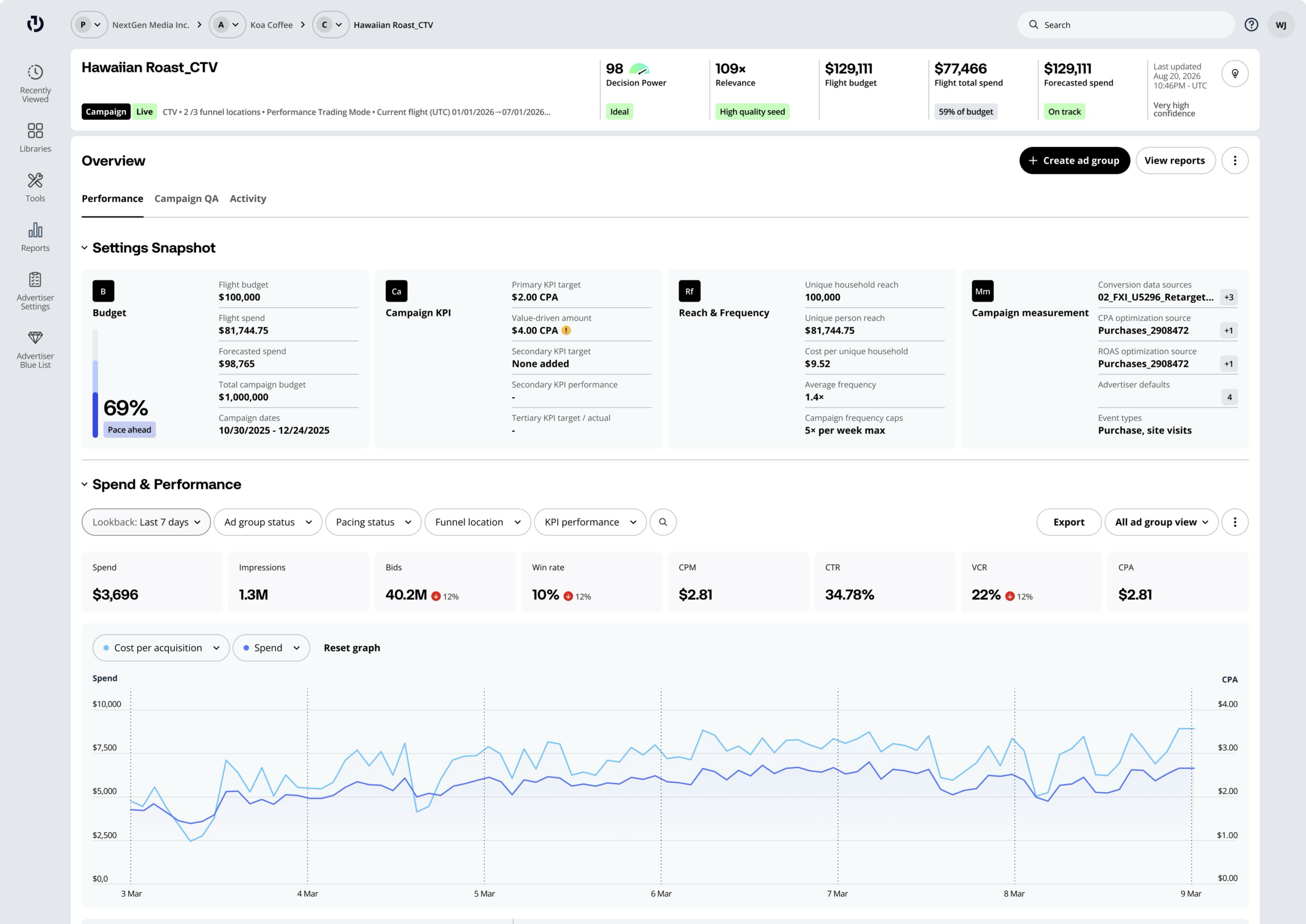
A new Applied Settings view brings targeting and campaign parameters into one place, highlighting settings that may be blocking delivery and separating those from recommended changes. For teams already comfortable with programmatic buying, that kind of simplification may save more time day to day than another standalone AI feature.
Measurement gets its own set of easy buttons
Zuma also streamlines the process of launching lift studies. Buyers can initiate Lucid brand-lift studies inside Kokai without coordinating setup checks manually, and a NielsenIQ integration brings similar automation to sales-lift measurement.
The Trade Desk is also adding geo-based incrementality measurement and ecommerce reporting that uses retail sales data to show household penetration and shopping frequency. The broader direction is clear: The Trade Desk wants measurement to sit closer to campaign execution instead of living in a separate workflow.
That is strategically important because advertisers increasingly need to defend programmatic spend with business outcomes rather than proxy metrics. Faster setup does not guarantee better measurement, but lowering the operational burden can make lift testing more practical for teams that previously skipped it because the process was too cumbersome.
The competitive gap is shifting from AI access to execution
The Trade Desk is not alone in adding AI to media buying. Google DV360, Amazon DSP, Yahoo DSP, and several independent adtech vendors are also adding assistants, automated recommendations, and agentic workflows.
That makes the presence of AI less differentiating on its own. The more useful question is whether Zuma helps buyers get from analysis to action with fewer clicks, fewer handoffs, and fewer manual setup steps.
For The Trade Desk, the update also addresses a product-design problem at the same time as it expands automation. If buyers find Kokai easier to navigate and measurement easier to launch, Zuma could improve adoption of features that already existed but were harder to use. If the new agents simply add another layer of recommendations, the practical gain will be smaller.
The near-term signal to watch is not how many agents The Trade Desk can add. It is whether buyers actually complete campaign and measurement work faster while keeping enough visibility into why the platform is recommending each action.