Amazon has blocked Meta’s Muse personal AI agent from shopping on Amazon.com, turning a broad debate about agentic commerce into a concrete question of platform permission.
The dispute matters for marketers because discoverability is only one part of an AI-mediated customer journey. A product may be visible to an external agent, but the retailer still controls whether that agent can enter customer accounts, browse protected surfaces and complete a transaction.
Table of contents
Jump to each section:
- Amazon’s block is about permission, not product discovery
- Amazon already has explicit rules for AI agents
- Meta and Amazon disagree on how credentials are handled
- Agentic commerce is becoming a channel-governance problem
- What marketers should watch next
Key Takeaways
- Amazon blocked Meta’s Muse from shopping on Amazon.com after saying the agent had not been authorized to access the store.
- Amazon’s current Conditions of Use require third-party agents to identify themselves and forbid attempts to bypass agent-control measures.
- For brands, AI-agent distribution may depend as much on retailer permission and checkout access as on product data and discoverability.
Amazon’s block is about permission, not product discovery
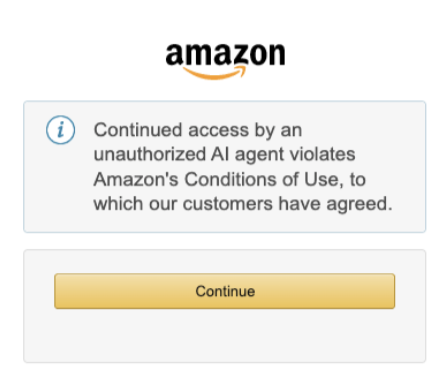
GeekWire reported that Amazon cut off Muse after asking Meta to exclude Amazon from the shopping experience. Users attempting to continue through Amazon began seeing a notice that access by an unauthorized AI agent violated Amazon’s Conditions of Use.
Amazon told GeekWire and ADWEEK that it had not been told in advance that Muse would access its store and had not authorized the activity. The company also said Muse did not identify itself while browsing.
That distinction matters. The issue is whether an outside agent can operate inside Amazon’s customer environment and execute actions there without Amazon agreeing to the arrangement.
For marketers, that creates a second gate in agentic commerce. The first is being understood by the agent. The second is being reachable through infrastructure the agent is actually allowed to use.
Amazon already has explicit rules for AI agents
Amazon’s Conditions of Use, last updated August 14, 2026, now include a dedicated section for autonomous and semi-autonomous agents.
Those terms require agents to identify themselves in HTTP requests, disclose the agent name, avoid disguising automated activity as human behavior and avoid circumventing measures designed to limit or block agent access.
That makes Amazon’s action against Muse more than an improvised technical response. The retailer has formalized a policy position that third-party agents need to be transparent and respect Amazon’s controls.
For commerce teams, this is an important constraint on the assumption that any public website automatically becomes a usable transaction layer for AI assistants. A site can be technically reachable while still imposing rules on how automated agents interact with it.
Meta and Amazon disagree on how credentials are handled
Amazon’s security concerns focus partly on the account access required for a shopping agent to work. The company said Muse appears to capture and store customer credentials and can reach account pages and order history when users ask it to do so.
Meta’s Muse launch announcement describes the setup differently. Meta says credentials are kept in secure storage and that Muse itself cannot see a user’s passwords or payment methods. It also says people approve sensitive actions such as purchases.
At the time of verification, Meta had not issued a fresh public response to Amazon’s block in the media reports reviewed for this article. That means the strongest available Meta position is still the security architecture it described when Muse launched.
The disagreement is therefore partly technical and partly about authority. Meta is emphasizing how credentials are protected inside its system. Amazon is emphasizing whether the outside agent was authorized to operate on Amazon at all.
Agentic commerce is becoming a channel-governance problem
ContentGrip previously covered how Muse could become another intermediary in the marketing funnel. Amazon’s response adds a new layer to that thesis.
An agent may be capable of discovering a product, comparing options and making a recommendation. None of that guarantees the agent can complete the final purchase on the retailer’s site.
That makes agent compatibility a distribution issue. Brands may increasingly need to understand which agents can access their commerce partners, which checkout rails those agents support and what permissions sit between a recommendation and a completed order.
The comparison with Amazon’s own agentic tools is also useful. GeekWire reports that Amazon says its Buy for Me feature identifies itself when it accesses outside brand sites and allows brands to opt out. Amazon is effectively arguing for a permissioned model rather than open-ended agent browsing.
For marketers, the practical implication is that structured catalog data alone will not solve agentic commerce. Product feeds, pricing and inventory can make a brand legible to an AI system, but actual conversion can still depend on agreements and policies controlled by the platform hosting the transaction.
What marketers should watch next
The immediate question is whether Amazon and Meta reach an arrangement that lets Muse return under different technical or commercial terms. Amazon told GeekWire that the companies were in direct conversation.
The broader question is whether retailers converge on a common access model. Amazon’s current rules point toward explicit agent identification and respect for opt-out or blocking controls. Other commerce platforms may choose to expose APIs, approved agent partnerships or checkout integrations instead.
For brands, the operating model could start to resemble other platform-dependent channels. Visibility, attribution, access and conversion may all be governed by different intermediaries.
That means the next phase of agentic commerce will not be decided only by which assistant has the best model or interface. It will also depend on which commerce platforms choose to let those assistants transact.