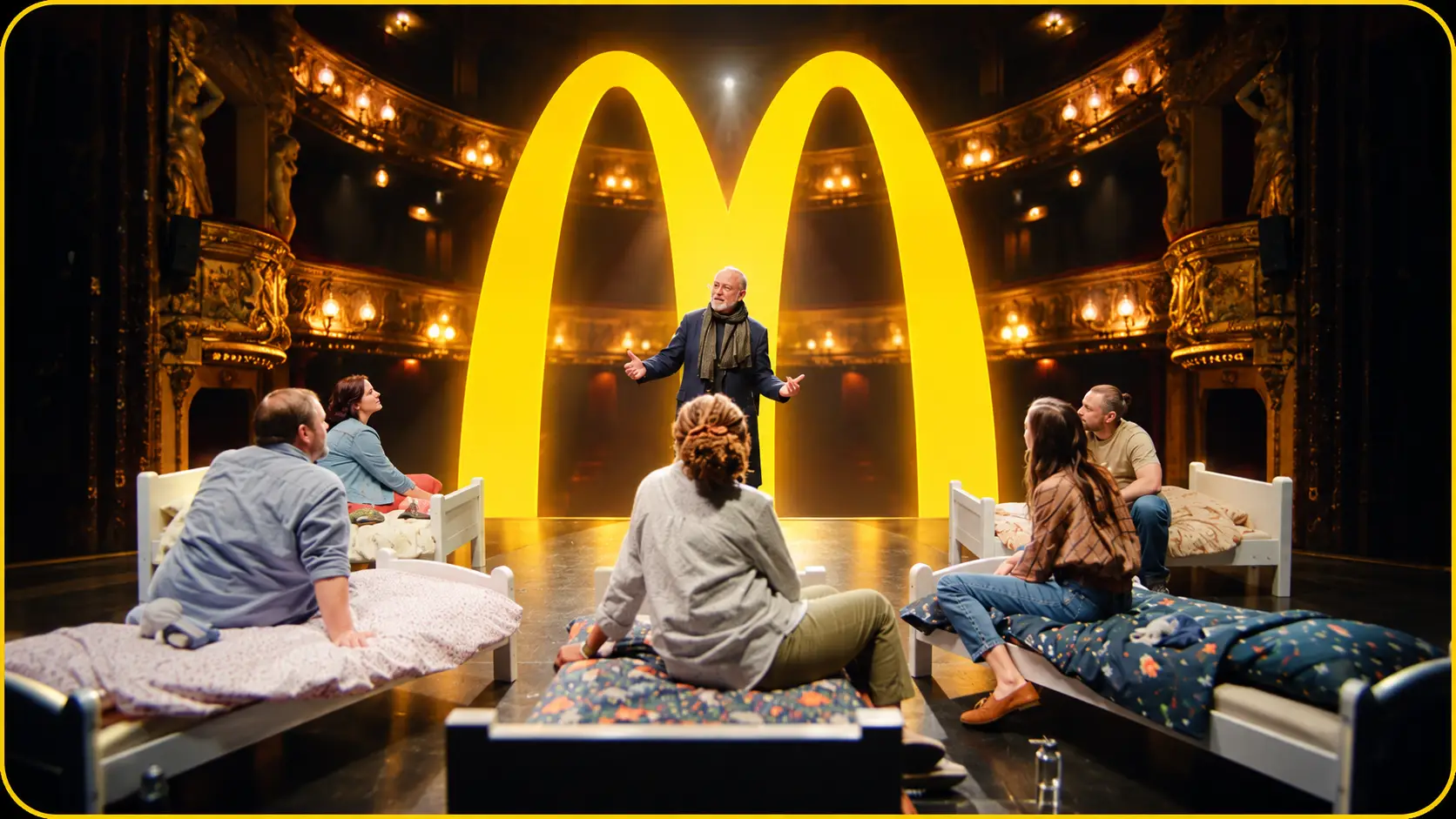
McDonald’s France has handed out more than 180 million children’s books since it began offering a book instead of a toy with Happy Meals in 2015.
The brand’s newest effort does not add another book. It teaches parents how to perform the ones they already have.
The campaign is called BedTellers School, built by TBWAParis and launched earlier this month with an event in Paris. It trains parents in theatre techniques, intonation, pauses, gestures and eye contact, so a bedtime story feels less like a script being read aloud and more like a performance for an audience of one or two.
The reasoning behind it comes from a McDonald’s France figure: only 40% of parents still say they enjoy reading to their children. Handing over a book solves distribution. It does not solve what happens once the book is actually opened.
ContentGrip spoke with Swann Richard, copywriter, and Julien Sens, art director on the campaign, about why the brand moved from giving out books to teaching parents how to read them, how the channel mix works, and what would count as evidence that a bedtime habit has actually changed.
Table of contents
- Inside BedTellers School
- Why the brand moved from books to performance
- Give creators room to teach it their way
- Measure the bedtime habit
- The habits behind the campaign
Inside BedTellers School
The centerpiece is a film shot at the Théâtre de la Renaissance in Paris, featuring actor and theatre teacher Oscar Sisto walking a group of parents through acting fundamentals: characterization, gestures, rhythm and eye contact. Online tutorials extend the same lessons so families can practice at home.
The program moves beyond a single video. A traveling Book Bus, hosted by actress Mélanie Sitbon, is touring French cities with stops including Reims, Aix-en-Provence and Lorient, bringing immersive storytelling sessions directly to families.
Three parenting content creators are also translating Oscar Sisto’s lessons into native social content, showing their own audiences how to make story time more engaging. A regional press partnership carries the campaign into daily print across France.
Julien said the program is designed to return annually, and the team is already working on a second year.
Why the brand moved from books to performance
Julien said the book program was already a meaningful distribution effort. The problem BedTellers School tries to address comes later, at the moment a parent opens the book.
Children can treat reading like schoolwork when the experience feels flat. Their first encounters with stories often happen at home, and Julien argued that the parent’s delivery can shape whether that moment feels enjoyable.
Swann put the idea plainly: “Who better than theatre professionals to teach parents how to bring stories to life?”
That led the team to build an acting school with professional teachers, training parents as if they were preparing a performance, with children as the audience.
Give creators room to teach it their way
Parent creators were brought into the workshops alongside the families in the launch film.
Swann said they trained with a professional acting teacher, tried the techniques with their own children, and then shared what they learned with their communities.
The underlying techniques stayed simple enough to pass on. The creators had room to explain them in a way that felt natural to their own families and audiences.
That approach gives the creator something concrete to demonstrate. They can show a pause, a change in voice or another storytelling technique instead of repeating campaign copy.
For marketers, the useful lesson is in the handoff. A creator brief can hold onto the behavior the campaign wants to spread while leaving the person enough space to make the demonstration feel native to their channel.
Measure the bedtime habit

The campaign’s hardest outcome is also the least visible: whether parents actually change what they do at bedtime.
Julien said the first goal is to remind parents that the reading moment matters. Fatigue and lack of time can make the routine mechanical. A reminder can help a parent be more present the next time they sit down with a child.
The workshops and online lessons give parents a way to build on that reminder. The team also plans to watch the conversation generated around children’s reading.
That leaves a gap between campaign participation and a durable habit, but the structure gives the brand several observable signals: workshop attendance, tutorial use, creator engagement and the public conversation around reading.
The larger test will take longer. A program designed to return each year has more room to see whether the behavior survives beyond the launch window.
The habits behind the campaign
The two creatives ended the interview with habits of their own.
Julien plays chess online every day. He said Chess.com shows a streak of about 1,800 days. The appeal is the repeated cycle of learning from each game and seeing improvement over time.
Swann keeps coming back to reading. His interests move from one genre to another, from contemporary American fiction and French classics to Westerns and fantasy. He said science fiction may be next.
Both answers echo the mechanism behind BedTellers School in a small way. Repetition becomes easier to sustain when the activity itself stays enjoyable. That is the behavior the campaign is trying to build around bedtime stories.