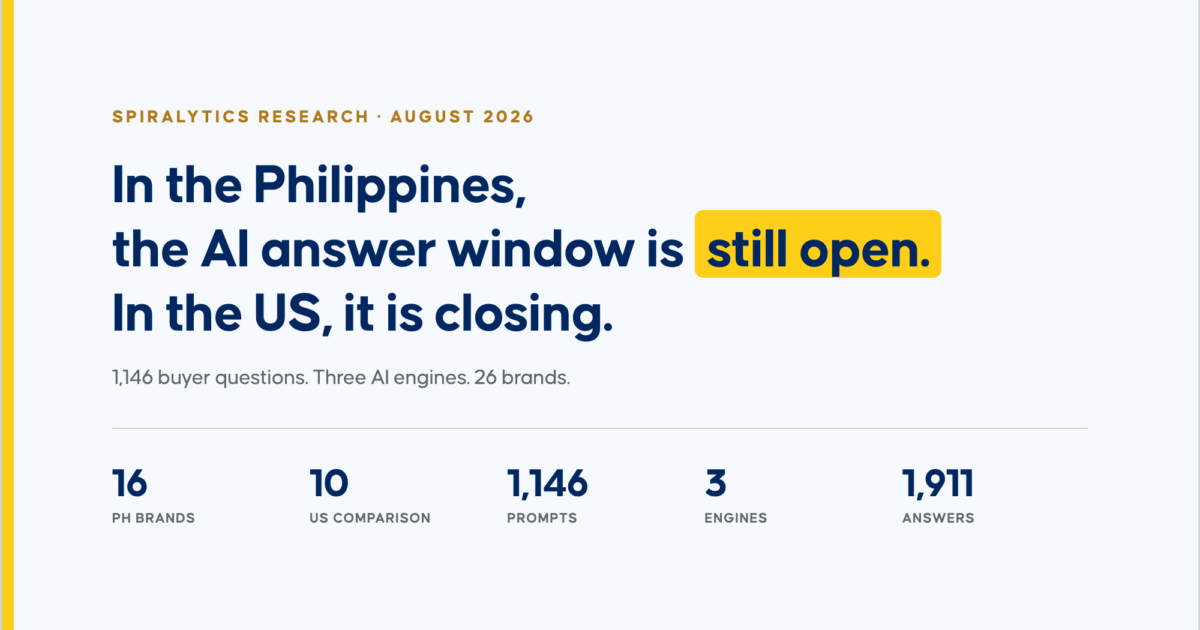
Spiralytics has put a Philippine lens on a question many search teams are only beginning to measure: when a buyer asks an AI assistant for recommendations, does the brand actually appear in the answer?
The agency published a study of AI visibility in the Philippines based on buyer questions tested across ChatGPT, Gemini and Perplexity. The result is less useful as a national ranking than as a signal that search measurement is starting to move beyond traffic and keyword positions.
83.2% of the Philippine-brand questions Spiralytics classified as winnable produced a mention from at least one of the tested AI engines, according to Spiralytics.
That figure comes with important limits. Spiralytics tested a brand-specific panel rather than a random sample of the Philippine market, prompt mixes varied by brand, and each question was run once per engine in the main snapshot. The study is also produced by an agency that sells answer engine optimization services.
Even with those caveats, the measurement problem it highlights is becoming harder to ignore.
Table of contents
Jump to each section:
- What Spiralytics measured in the Philippines
- Why AI visibility is becoming a distribution problem
- Why third-party mentions matter more than brand websites
- What marketers should know about AI search measurement
What Spiralytics measured in the Philippines
Spiralytics built buyer questions from the services, locations and audiences of brands in its research panel, then screened those questions to identify cases where a brand had a genuine claim to appear. Those winnable questions were then tested across the three AI engines.
The design matters because AI visibility is not the same thing as referral traffic. A buyer can see a brand recommended in an answer without clicking through to the company website, while another brand can earn a citation without being named prominently enough to influence the shortlist.
That creates a measurement layer between ranking and traffic: answer presence.
The study also found meaningful differences between engines. In Spiralytics’ panel, Gemini mentioned Philippine brands more often than Perplexity or ChatGPT. That does not establish a permanent platform hierarchy, but it does show why a single-engine dashboard can give marketers an incomplete view.
The broader category is moving in the same direction. Semrush has expanded its own AI visibility research around how brands are mentioned, cited and represented in AI discovery. Ahrefs has separately examined which web signals correlate with brand visibility across AI systems.
Search teams are no longer measuring only whether a page ranks. They are measuring whether a brand enters the answer at all.
Why AI visibility is becoming a distribution problem
Traditional SEO gives marketers a familiar object to optimize: the page. Improve relevance, authority, technical accessibility and user experience, then track the page’s position and traffic.
AI discovery makes the object less tidy. An answer can be assembled from publisher coverage, directories, competitors, video platforms, forums and first-party pages. The brand’s visibility therefore depends partly on information it does not control directly.
That distinction changes the strategic question.
The common assumption is that AI search is mainly another version of SEO, so the brand website should remain the center of optimization. The contrasting reality in Spiralytics’ research is that most citations in its Philippine answer set came from somewhere else. The implication is that earned and distributed brand presence becomes part of search strategy, not merely a communications outcome.
This is where AI visibility starts to resemble a distribution problem. A company can publish accurate, optimized content on its own domain and still leave the surrounding web with weak or inconsistent signals about who it is, what it sells and where it belongs in a category.
For marketing leaders, that brings SEO, content, PR and brand governance closer together. The work is no longer only about getting a page discovered. It is also about giving answer engines enough consistent external evidence to place the brand in context.
Why third-party mentions matter more than brand websites
Spiralytics’ most strategically useful finding may be its citation mix.
5% of the citations in Spiralytics’ Philippine answer set pointed to websites owned by the brands being studied, according to Spiralytics.
The percentage should not be treated as a universal benchmark. It comes from one research panel. But the direction is consistent with Ahrefs’ broader finding that branded web mentions correlate more strongly with AI visibility than several classic link-volume and domain-strength measures.
That makes digital PR, editorial coverage and credible category listings more relevant to search teams than they used to be.
A brand website remains necessary because it establishes first-party facts and gives engines an authoritative place to resolve products, services, locations and identity. But the website is only one participant in the evidence environment.
A useful way to think about this is that owned content defines the brand, while third-party content helps validate and position it.
That creates a new tension for marketers. The channels that are easiest to control may not be the channels that carry the most weight in an AI-generated recommendation. Improving AI visibility can therefore require investment in information consistency and earned presence rather than simply publishing more pages.
The deeper shift is from optimizing documents to managing evidence.
What marketers should know about AI search measurement
AI visibility metrics are useful when they answer a business question, not when they become another isolated dashboard.
Measure mentions separately from clicks. A brand can influence a buyer inside an AI answer without generating a website session. Traffic remains important, but it no longer captures the full discovery surface.
Test more than one engine. Spiralytics found different mention behavior across ChatGPT, Gemini and Perplexity. Teams should avoid treating one assistant as a proxy for the whole category.
Audit the sources around the brand. If answer engines rely heavily on third-party pages, marketers need to know whether those pages describe the company accurately, distinguish it from namesakes and connect it to the right buying situations.
Keep methodology visible. Prompt selection, engine settings, geography and repeatability all shape an AI visibility score. A single percentage without those details can look more precise than the underlying measurement deserves.
The most important change may be organizational rather than technical. AI discovery makes search visibility partly dependent on the same external reputation signals that PR and brand teams have managed for years.
That does not make SEO less important. It makes the boundary around SEO less useful.
As AI assistants become another place where buyers build shortlists, marketers will need to connect owned content, earned coverage and brand identity into one measurement model. The advantage will come less from finding a universal AI-ranking formula and more from understanding how a brand is represented across the information ecosystem that answer engines can see.