
Fresh Step is putting AI-generated talking cats into a new US advertising campaign. The Clorox-owned litter brand and creative agency RECE produced three short films in 30 days, at what the team describes as one-tenth the cost of a traditional production.
The work follows Fresh Step’s February brand refresh, which sought to sharpen how the brand communicates benefits such as odor control. The new films turn that practical positioning into improbable scenes featuring talking cats. They are rolling out on television and social channels, with the distribution expected to be in place by November 9.
For marketers, the production claim is striking. The more consequential question is whether the same approach can produce better decisions, not merely cheaper assets. AI can compress production time without compressing the business problem.
Table of contents
Jump to each section:
- How Fresh Step compressed creative production
- The cost number needs a baseline
- Why modular ads change the economics of testing
- What marketers should learn from Fresh Step
How Fresh Step compressed creative production
Fresh Step had a recognizable product benefit but a creative challenge: making odor control noticeable in an advertising category where consumers had reasons to compare alternatives. Brand leaders wanted an idea that could get into market quickly rather than wait through a long conventional filming schedule.
The team developed three 15-second spots around computer-generated cats with different personalities and voices. In the scenarios, a dog’s nose fails to find a litter box, a giant cat presents an exaggerated test, and a line of cats forms outside a home. Each turns the same product promise into a different comic situation.
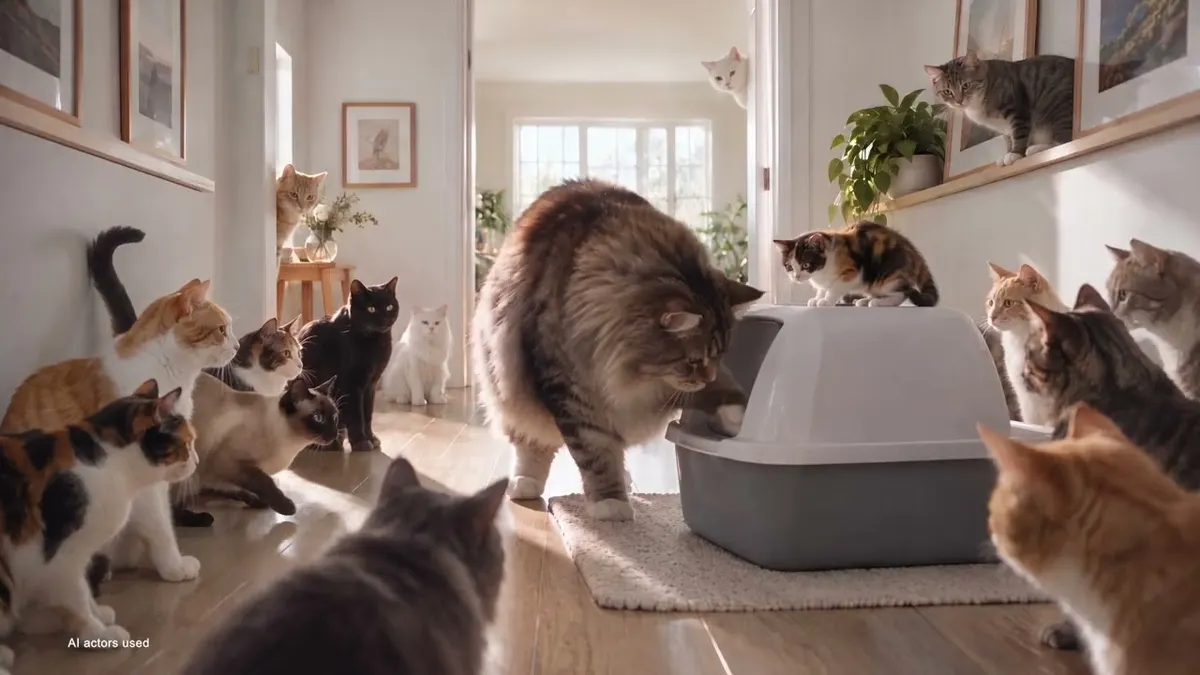
The production process reportedly brought strategy, concepts, writing, direction, AI artists, editing and composition into overlapping work rather than a strictly sequential handoff. RECE founder and chief creative officer Toygar Bazarkaya described the process as “closer to a tech startup’s prototyping process than a traditional ad agency’s.”
That comparison is useful because a prototype invites earlier evaluation. Instead of debating whether a script might be funny, the team could watch a version of the scene, assess its emotional effect and refine the idea. AI did not independently determine the brand proposition. Humans still had to decide which cat scenarios made odor control memorable.
The challenge is not simply generating a plausible cat. It is using that flexibility to test multiple expressions of one defensible brand idea without losing consistency.
The cost number needs a baseline
The production economics need careful reading. Fresh Step and RECE describe a dramatic reduction in cost, but have not disclosed the conventional-production estimate, detailed spending, model costs or how internal labor was counted. Their experience is a campaign-specific claim, not a verified industry benchmark.
Three 15-second ads in 30 days, at a claimed one-tenth of traditional production cost. The figures describe Fresh Step’s specific campaign, not average AI advertising savings, according to Fresh Step and RECE executives.
The brand says the savings create room to invest in additional ideas. That makes an important distinction between cost efficiency and effectiveness. Lower cost per asset can free budget for more creative variants, but it cannot show whether any of those variants improves sales, attention or brand preference.
Production efficiency is a budget choice, not a performance result.
There is also a measurement question. A fair comparison would need to include concept development, human review, revision work and the costs of deploying the ads, alongside the conventional production baseline. The sources do not disclose those figures. Nor do they provide campaign lift or controlled audience outcomes for the new spots, which are only now rolling out.
Why modular ads change the economics of testing
The bigger operational point is that Fresh Step deliberately built the ads to change. Clorox executives have described the work as modular, with benefits, packaging and messages adaptable after the campaign begins receiving consumer feedback.
That puts the production story next to Clorox’s broader effort to treat creative as an ongoing learning system. It also makes the distinction between two kinds of AI use clearer.
| Clorox example | What AI changes | Evidence boundary |
|---|---|---|
| Fresh Step talking-cat films | Shortens prototyping and production of multiple concepts before and during launch | Reported time and cost, not demonstrated sales lift |
| Clorox PURE creative updates | Helps the marketing team interpret in-market signals and revise existing work | Described workflow, without publicly established incremental ROI |
The shared idea is responsiveness, but the business problems differ. Fresh Step starts with production: can an idea become a usable film quickly enough to enter market while it is still relevant? The Clorox PURE example starts after launch: can a brand identify signals worth acting on and revise a creative asset without another shoot?
A cheaper first cut matters only when the next creative decision becomes better. More variations without a testing discipline can produce more activity, not more understanding. Conversely, a modular production process may give marketing teams the freedom to retire weak concepts before substantial additional spending.
The human decision rights remain important. Fast rendering does not resolve who approves claims, whether the creative feels appropriate to customers, or what evidence justifies changing a message. The disclosed campaign does not establish that those questions are automated.
What marketers should learn from Fresh Step
Fresh Step illustrates a practical opportunity for brand teams, but also the limits of what a production case can prove before results arrive.
Define the business problem first. Fresh Step’s brief centered on odor-control differentiation. Its AI-generated characters served that message rather than becoming the message themselves.
Separate creation speed from campaign impact. The reported 30-day timetable is relevant to production planning. It says nothing on its own about how shoppers respond to the ads once distribution is complete.
Preserve the ability to revise. A modular set of cat scenarios may allow Fresh Step to adjust benefit claims and creative details without rebuilding the campaign from scratch. The value depends on whether the brand gathers useful feedback and acts on it.
Ask what the cost comparison includes. Production invoices are only one part of creative economics. Human strategy, review, media spending and repeated testing still matter, even when generating the initial visuals becomes faster.
The broader shift for agencies is subtle. If clients can afford more first versions of a campaign, the premium on a single polished execution may decline. The premium on choosing the right idea, knowing what to test and interpreting customer response may rise instead.
That is not evidence that creative expertise is becoming irrelevant. Fresh Step’s campaign required a recognizable insight, humor and a coherent product promise before AI could make the cats perform. As generative production becomes easier to access, the scarcity may move from making an ad to knowing which ad deserves to run.
