
Global expansion is picking up pace again heading into 2026. But while companies are entering more markets, their localization strategies are not keeping up.
For B2B marketers, product leaders, and growth teams, the implications are hard to ignore. Localization is no longer operational support. It is directly tied to revenue, speed, and market success.
This article explores new data from Lokalise’s survey of 500 global business leaders, revealing a growing disconnect between expansion ambitions and localization readiness.
Short on time?
Here’s a table of contents for quick access:
- The localization revenue gap is widening
- Global expansion plans are accelerating but readiness lags
- AI translation adoption rises but trust remains fragile
- What marketers should do next about localization strategy
 Patrecia Meliana
The localization revenue gap is widening
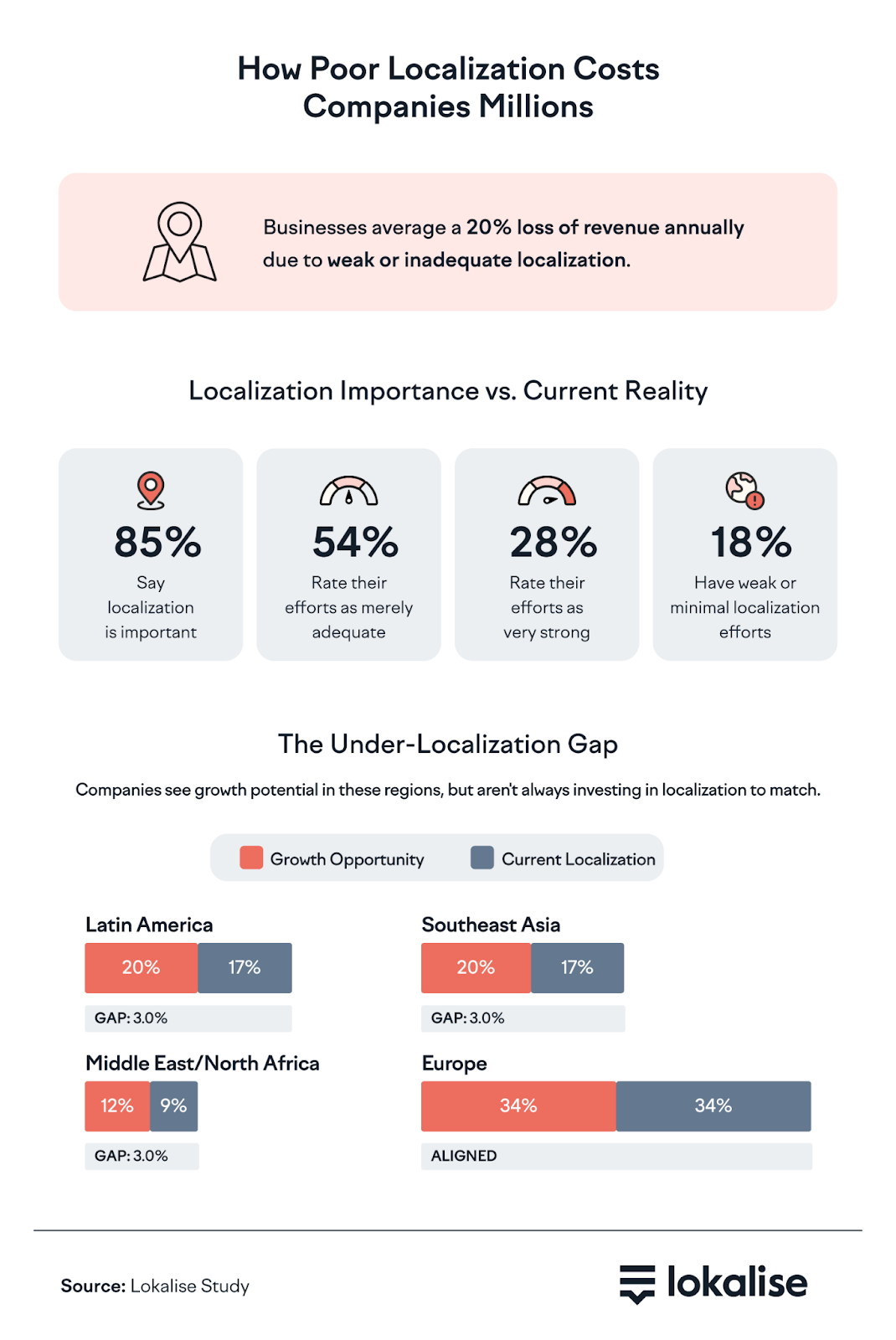
The headline finding is blunt. Poor localization is costing businesses an average of 20% of potential revenue annually.
At the same time, perception and performance are out of sync. While 85% of leaders say localization is important, only 28% believe their efforts are very strong. That gap signals missed opportunity at scale.
The disconnect becomes clearer at the regional level. Companies see growth potential in Latin America and Southeast Asia, yet localization investment in both regions lags behind demand. Each shows a measurable underinvestment gap, despite being flagged as high-growth markets.
Europe stands out as the exception, where investment and opportunity are aligned. Everywhere else, companies are effectively leaving revenue on the table by not localizing where it matters most.
 Atikah Amalia
Global expansion plans are accelerating but readiness lags
Expansion is not slowing down. Companies entered an average of 1.1 new markets in 2025 and plan to increase that to 1.5 in 2026, a 36% jump. 42% of businesses plan to enter two or more new markets, signaling aggressive growth strategies.
But confidence in localization readiness does not match that ambition:
- 63% say they are confident in their localization capabilities
- 24% are unsure
- 12% say they cannot support expansion with their current setup
Cost is the biggest blocker, cited by 61% of respondents. Other friction points include:
- Local market understanding at 39%
- Speed to market at 32%
- Technology limitations and translation quality
More telling is that 36% of companies have already delayed or pulled back from entering a market due to localization challenges. That is not a future risk. It is already impacting growth decisions.
Budget flexibility could change priorities quickly. Nearly half of companies say they would prioritize expansion if localization budgets doubled, while others would invest in cultural nuance or shift toward hybrid AI-human workflows.
 Patrecia Meliana
AI translation adoption rises but trust remains fragile
AI-powered translation is now mainstream. 63% of companies use it in some capacity, with many adopting hybrid models that combine human and machine workflows.
But adoption does not mean full trust. Top concerns remain consistent:
- Inaccuracy at 53%
- Cultural understanding at 41%
- Lack of nuance at 40%
- Loss of brand voice at 30%
- Legal or regulatory risks at 28%
Despite this, satisfaction levels are relatively strong. 78% of respondents report being somewhat or very satisfied with their current translation processes. This suggests that while skepticism remains, real-world performance is improving.
The shift toward hybrid workflows reflects this balance. Most companies are not choosing between AI and humans. They are combining both:
- 41% mostly human with some AI
- 36% mixed human and AI
- 15% AI-only
- 6% mostly or fully AI strategies
Newer approaches, such as AI systems trained on brand-specific data, are also pushing quality higher. These systems use past translations, terminology databases, and style guides to produce more consistent and context-aware outputs.
For marketers, this signals a transition from experimentation to operational reliance.
 Atikah Amalia
What marketers should do next about localization strategy
For marketing and growth teams, the takeaway is not just that localization matters. It is that localization strategy is now a competitive lever.
Here are practical ways to respond:
1. Treat localization as a revenue driver, not a cost center
Only 30% of companies currently see localization as a growth driver. That mindset needs to shift. Localization decisions directly impact conversion, retention, and market penetration.
2. Prioritize regions based on opportunity, not convenience
The data shows clear mismatches between investment and growth potential. Align localization budgets with high-growth regions like Latin America and Southeast Asia.
3. Adopt hybrid AI workflows deliberately
AI can scale output, but human oversight ensures brand consistency and cultural accuracy. The most effective teams are designing workflows, not just choosing tools.
Patrecia Meliana
4. Build localization into go-to-market planning early
Too many teams treat localization as a final step. Integrating it earlier improves speed to market and reduces costly rework.
5. Invest in brand-aware AI systems
Generic AI translation is no longer enough. Systems that incorporate brand voice, terminology, and past content will deliver stronger results at scale.
Global expansion is accelerating, but localization readiness is uneven. That gap is already translating into lost revenue, delayed market entry, and missed opportunities. The companies that win in 2026 will not just expand faster. They will localize smarter, aligning strategy, budget, and technology with real market demand.