Topical authority has quietly become one of the most decisive forces in modern SEO. Yet many B2B marketers are still stuck in an outdated playbook, publishing more content without seeing meaningful gains in traffic or visibility.
This article explores what topical authority actually means in 2026, why it now sits at the center of AI-driven search, and how marketers can build it quickly with a structured, scalable approach.
Table of contents
Jump to each section:
- What is topical authority in 2026
- Why topical authority matters more than ever in 2026
- What topical authority looks like in practice
- How to build topical authority fast practical framework
- Common mistakes to avoid
What is topical authority in 2026
Most marketers still treat SEO as a mix of keywords and backlinks. That model is increasingly obsolete.
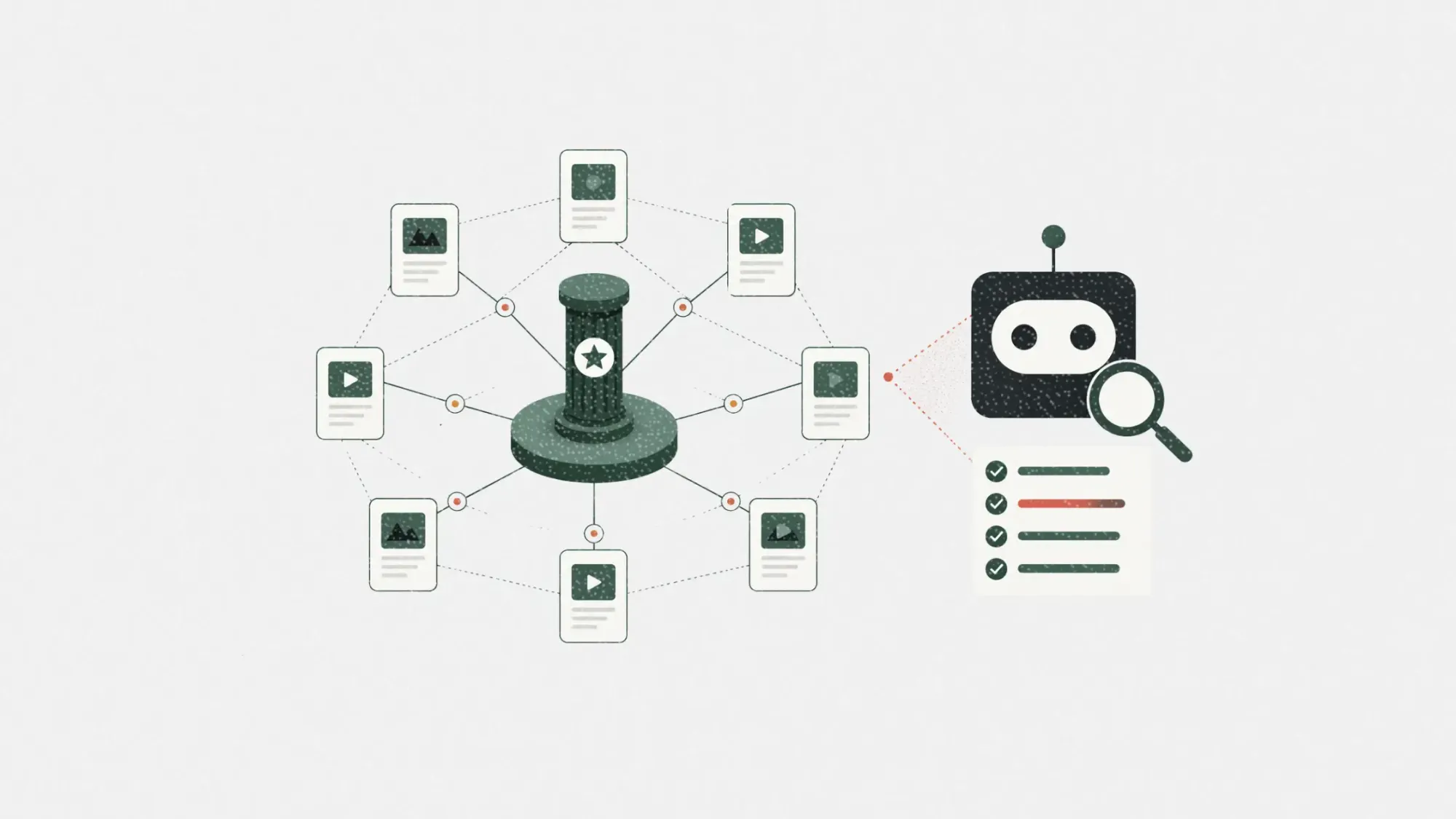
Topical authority now refers to how deeply and systematically a website covers a single subject. It is not about ranking one article. It is about building a complete content ecosystem that signals expertise, relevance, and clarity to both search engines and AI systems.
Instead of targeting isolated keywords, brands are expected to cover entire topic clusters. For example, a site focused on content marketing would need to address strategy, distribution, SEO, tools, case studies, and measurement as interconnected pieces.
The shift is structural. Search engines now evaluate semantic relationships between pages, not just individual rankings. Sites that demonstrate depth and cohesion consistently outperform those with scattered content strategies.
Why topical authority matters more than ever in 2026
The rise of AI-first search has changed the rules of visibility.
Search engines are no longer just ranking pages. They are generating answers. A significant portion of searches now ends without a click, which means only a handful of trusted sources get surfaced in AI-generated responses.
At the same time, authority has become more democratized. Smaller, focused sites can now outrank large domains if they demonstrate stronger topical depth. This flips the traditional advantage of scale into an advantage of focus.
There is also a measurable impact. Sites with strong topical authority see faster ranking improvements and are more likely to be cited in AI-generated answers. This directly affects discoverability in zero-click environments.
Finally, topical authority aligns closely with how search engines evaluate trust signals like expertise and experience. Depth, consistency, and structured coverage now matter more than volume alone.
 Patrecia Meliana
What topical authority looks like in practice
In practice, topical authority is built through structured content layers.
A typical execution starts with a pillar page that introduces a broad topic. This is supported by cluster content that explores specific angles, which then connects to deeper supporting articles and real-world examples.
For instance, a content cluster around Gen Z marketing might include strategy guides, statistics, glossaries, and brand case studies. Each piece reinforces the others through internal linking and contextual relevance.
This model is already visible across high-performing SEO sites. Instead of a single “ultimate guide,” they build interconnected networks of content that dominate entire search categories.
For SaaS companies, this often translates into focusing resources on one niche and publishing dozens of related articles rather than spreading efforts across unrelated topics. The result is stronger visibility across hundreds of queries within that niche.
How to build topical authority fast practical framework
Building topical authority is less about creativity and more about disciplined execution.
- Start by choosing a single core topic
Most brands fail because they try to cover too much. The narrower the focus, the faster authority compounds.
- Map the topic comprehensively
This means identifying subtopics, questions, comparisons, and trends. Think in terms of relationships between ideas rather than isolated keywords.
- Create a pillar page that acts as the central hub
This page should link to all related content and provide a high-level overview of the topic.
- The real acceleration comes from publishing cluster content quickly
A batch of 20 to 30 articles around one topic signals depth far more effectively than occasional posts.
- Internal linking is critical
Every piece should connect back to the pillar and to related articles. This helps search engines understand the structure and reinforces topical relevance.
- Marketers must also add original insights
This could include frameworks, opinions, or unique interpretations of data. This “information gain” is what makes content more likely to be cited by AI systems.
- Topical authority is not static
It requires continuous updates, expansion, and refinement as new angles emerge and search behavior evolves.
Common mistakes to avoid
Many content strategies fail not because of lack of effort, but because of structural issues.
One of the most common mistakes is covering too many unrelated topics, which dilutes authority signals. Another is publishing content without a clear internal linking strategy, leaving pages disconnected.
Marketers also tend to chase high-volume keywords without building supporting context. This leads to thin content that struggles to rank or sustain visibility.
Treating content as one-off assets rather than part of a system is another major issue. Without a cohesive structure, even high-quality articles fail to compound over time.
Patrecia Meliana
Topical authority is no longer a “nice to have” in SEO. It is the foundation of visibility in an AI-first search landscape.
For marketers, the implication is clear. Winning is no longer about producing more content. It is about building structured, interconnected knowledge that signals expertise and earns trust from both search engines and AI systems.