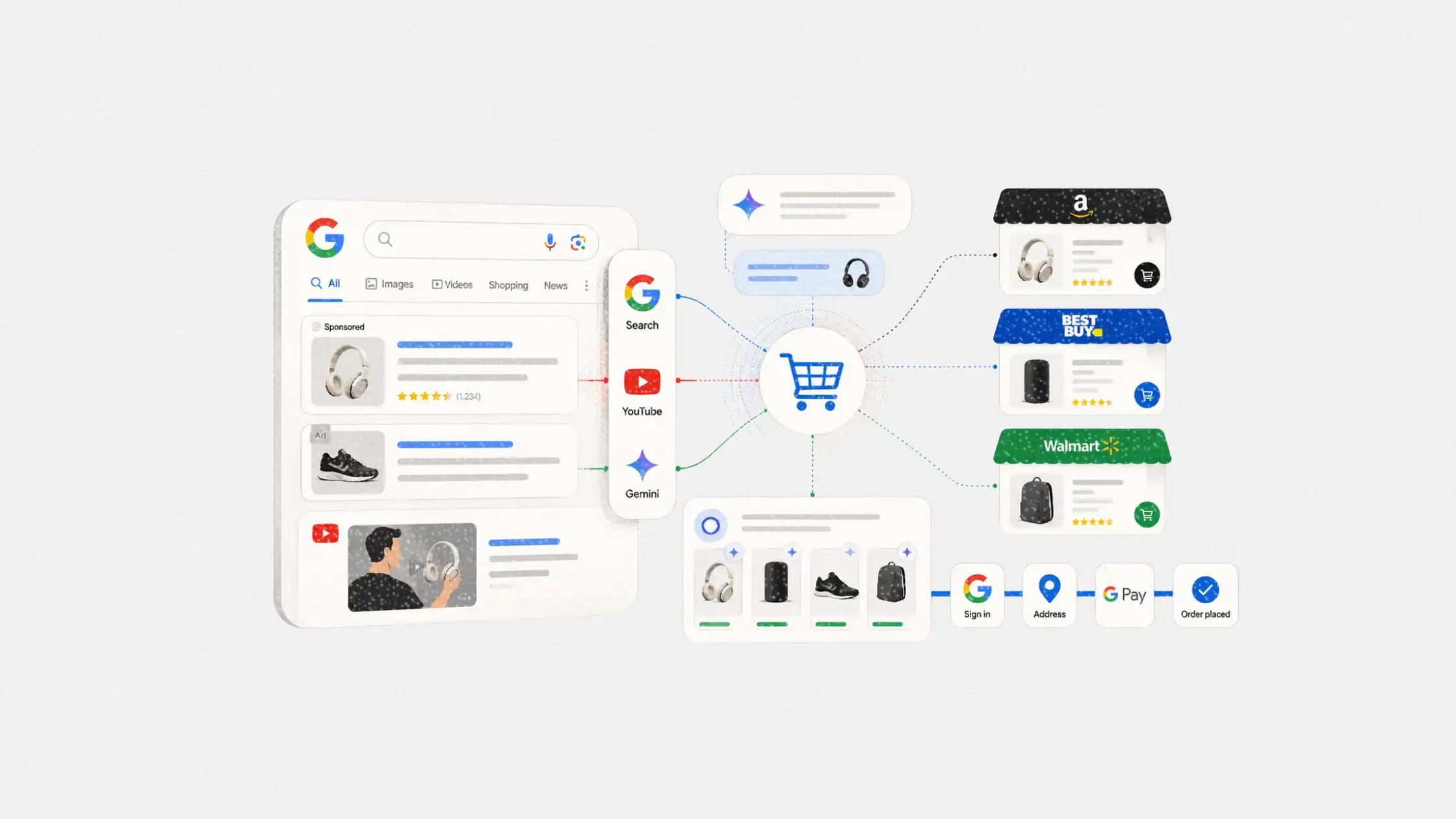
Google is standing up new commerce and advertising infrastructure that keeps shopping and ad interactions inside its own products, including Search, YouTube, and the Gemini app.
The update centers on a native checkout capability called Universal Cart, alongside new ad formats in AI Mode and a cross-product marketing agent experience called Ask Advisor.
Table of contents
Jump to each section:
- Universal Cart and UCP: what “native checkout” means inside Google
- AI Mode ad formats and the new “explainer” layer
- Ask Advisor: agentic orchestration across Google’s marketing stack
- Practical implications for advertisers: feeds, measurement, and brand control
Universal Cart and UCP: what “native checkout” means inside Google
Google’s Universal Cart is designed as a single cart that works across multiple merchants and multiple Google surfaces. A shopper could add items while using the Gemini app, then add more via Google Search or from a YouTube video, and complete checkout in one flow.
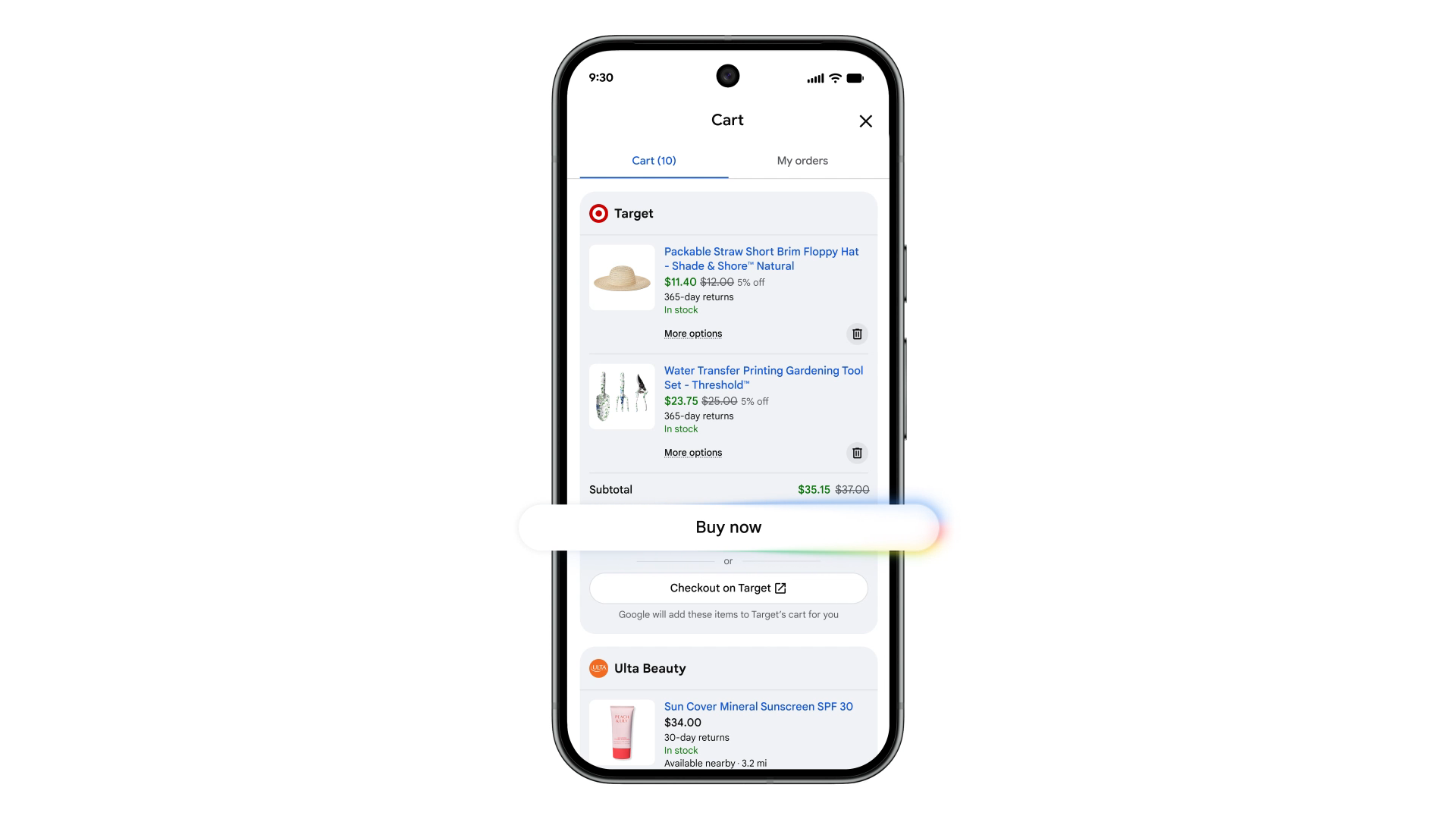
The underlying enabler is Universal Commerce Protocol (UCP), a technical standard that lets Google’s systems communicate directly with merchants’ backend systems. Google lists launch partners including Sephora, Target, Nike, Ulta Beauty, Walmart, Wayfair, and Shopify, while noting that merchants still legally own the transactions completed via Universal Cart.
Strategically, this shifts Google’s role from referral engine to transaction facilitator. Even if clicking out remains possible, the default path can become “discover, decide, buy” without leaving Google’s interfaces, which changes how brands think about landing pages, site speed, and on-site conversion optimization as the primary conversion lever.
AI Mode ad formats and the new “explainer” layer
Within AI Mode, Google is adding new ad formats built for a Gemini-powered results experience.
One format, “Conversational Discovery” units, is positioned as a direct response to a user’s query. Google’s example: if someone searches for easy ways to make their home smell like a spa, Gemini evaluates the prompt context and generates custom ad creative from a relevant brand.
Google is also introducing “Highlighted Answers” ads, where sponsored placements can appear within AI-generated lists of recommendations.
A notable addition is an in-ad “explainer” feature that synthesizes information about the service or product to provide additional context. Google frames this as a trust and usefulness feature, but it also adds a new intermediary voice between advertiser and customer. That raises operational questions marketers will need to pressure-test: what sources the explainer pulls from, how it handles edge cases, and how discrepancies are resolved when an explainer’s summary conflicts with brand positioning or legal language.
Google also says more AI-backed ad units are coming, including ads with a built-in brand agent that users can chat with, and AI-powered Shopping ads in some searches.
Ask Advisor: agentic orchestration across Google’s marketing stack
Ask Advisor is an AI-powered experience layer intended to work across Google Ads, Google Marketing Platform, Google Analytics, and eventually Merchant Center. It is positioned as a way to manage workflows and orchestrate multiple agents across products.
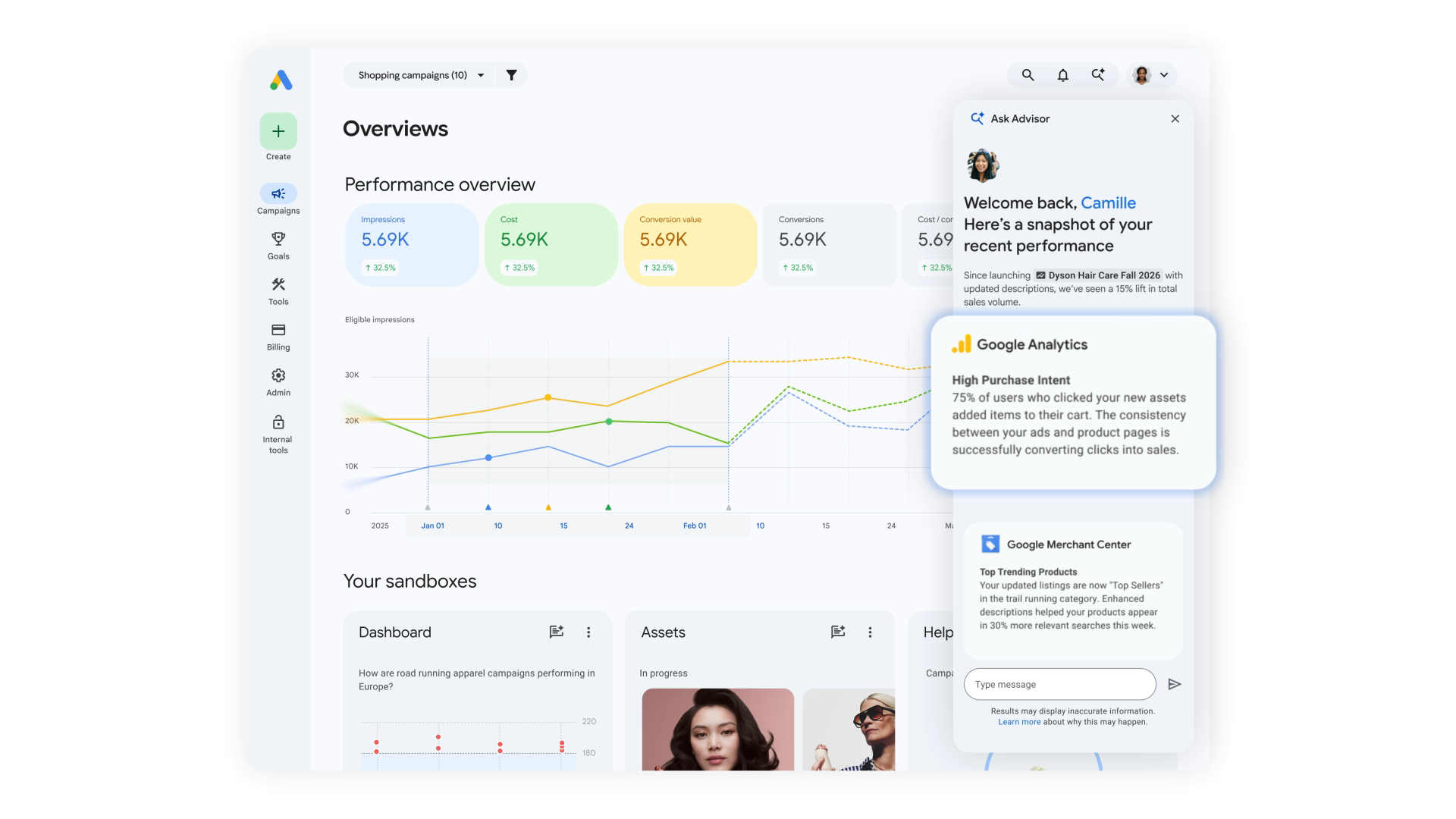
In practice, that means a marketer could ask for help creating a campaign for a new audience segment, or request an on-demand performance report. Google describes it as pulling product details from Merchant Center to help set up campaigns in Google Ads, and surfacing cross-platform insights that connect ad performance with analytics outcomes. Ask Advisor is in beta for English-language accounts, with more features expected to roll out over time.
For teams, the value proposition is less about “automation of tasks” and more about a unified control plane: fewer context switches across tools, and more system-guided decisioning about what to do next inside Google’s stack.
Practical implications for advertisers: feeds, measurement, and brand control
If checkout and product consideration increasingly happen inside Google’s surfaces, advertisers may need to treat Merchant Center data quality and product information hygiene as conversion-critical infrastructure. When creative, recommendations, explainers, and shopping flows depend on structured inputs, weak feeds can turn into weak AI outputs.
Measurement is also likely to get more complex. Google highlighted “Qualified Future Conversions,” a reporting metric intended to connect actions like brand-specific searches to future sales.
Marketers will need to evaluate how such metrics align with existing incrementality approaches, and how they affect optimization decisions when the journey spans AI interactions, ads, and commerce actions within Google properties.
Finally, the “explainer” layer introduces a brand control challenge: the ad experience may include AI-synthesized context that is not written by the advertiser. That increases the importance of ensuring official product information is consistent across the systems AI might reference, and of building internal review processes for AI-mediated ad experiences, especially in regulated categories.