Instacart is widening its advertising playbook beyond sponsored search and display by adding shoppable short-form video and outlining an AI shopping assistant that could later include ads. The company described the new video experience as a pilot format inside the Instacart app, built to connect inspiration and conversion in the same flow.
The details were outlined in the company’s official announcement, alongside broader updates that position Instacart’s retail media business as more full-funnel. Instacart said ad revenue rose 16% year over year to $286 million in Q1, suggesting continued investment in ad surfaces that can support both discovery and transaction.
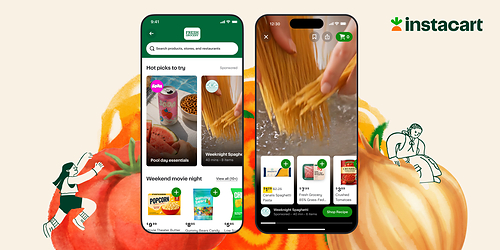
Table of contents
Jump to each section:
- What Instacart’s new Ads Studio is designed to do
- How the Immersive Feed turns vertical video into a shoppable ad unit
- Where AI ads could fit inside Instacart’s shopping assistant
- What this means for marketers
What Instacart’s new Ads Studio is designed to do
Instacart said its new Ads Studio is meant to bring brands into earlier-stage planning for campaigns tied to cultural moments, with brainstorming, execution, and measurement supported by Instacart’s first-party data. The positioning matters because it moves the retailer-media relationship away from only buying placements and toward co-developing concepts that can run across the year.
The company framed the studio as a way to connect commerce and creative, and as an extension of its advertising capabilities closer to its in-house agency, Local Produce. In practice, that implies Instacart wants to be involved before creative is finalized, not only after assets are delivered for performance activation.
For marketers, the key question is less “is this an agency?” and more “how much of the planning and measurement loop can Instacart own?” If the studio becomes a default path to access premium placements or seasonal moments, it may also influence how brands brief creative and how early retail media teams are brought into campaign planning.
How the Immersive Feed turns vertical video into a shoppable ad unit
Instacart’s Immersive Feed is a short-form vertical video feed inside the app, with videos running five to 30 seconds. Instacart compared the experience to the familiar scroll-based behavior people associate with short-form video, but with a commerce-native difference: add-to-cart capabilities are built into the format.
Instacart said brands including Hellmann’s, Kettle & Fire, Rachael Ray Nutrish, and Siete Foods are piloting the format. The stated use case is recipe and product recommendation content that can drive discovery and transactions without forcing a jump to a separate landing page or retailer site.
The company also said it plans to expand the feed to include organic content through partnerships and sponsored creator integrations. That is an important signal for how inventory and storytelling could evolve: moving from brand-supplied assets toward a mix of brand, creator, and partner content that still sits inside a purchase-oriented environment.
Instacart also shared performance benchmarks for existing inspiration formats: Recipe Ads delivered an average of 78% out-of-aisle impressions and 43% new-to-brand sales, while Occasion Ads drove an average of 90% out-of-aisle impressions and 36% new-to-brand sales. Those numbers help explain why the company is leaning into upper-funnel style formats that still preserve measurability.
Where AI ads could fit inside Instacart’s shopping assistant
Instacart also outlined a vision for an AI-powered shopping assistant, positioned around problem-solving such as gluten-free meal planning for a family of four. The company said it will likely begin experimenting with ads in the program later in the second half of this year, but also emphasized a deliberate approach that incorporates user feedback rather than rushing to monetize.
From an ad product perspective, the assistant introduces a different kind of intent signal than search. Instead of “find ketchup,” prompts might reflect needs, constraints, and occasions. Instacart floated potential ad use cases including sponsored recipes, occasion-based planning (like building a shopping list for a barbecue), surfacing deals and offers, and promoting product exploration.
Instacart also acknowledged that where the assistant ultimately sits in the funnel remains to be seen. If consumer behavior leans toward discovery and planning, ad formats could look more like inspiration and consideration than last-click performance. That creates opportunities, but it also raises governance questions around relevance, disclosure, and user trust when ads appear inside a conversational or assistive interface.
What this means for marketers
Instacart’s updates point to retail media acting more like a full-funnel channel, with creative surfaces that look familiar to social video but are directly connected to shopping behavior.
- Retail media is pushing upward without abandoning conversion
Immersive Feed keeps the commerce endpoint (add-to-cart) while borrowing discovery mechanics from short-form video. Brands should treat it as a hybrid placement, not purely awareness or purely performance. - Creative and media planning may converge earlier
Ads Studio is designed to involve brands before concepts are finalized. That can shorten the distance between creative idea and measurable retail outcome, but it may also require earlier stakeholder alignment across brand, shopper, and retail media teams. - First-party data becomes part of the creative feedback loop
Instacart positioned first-party data as a support layer for ideation, execution, and measurement. The practical implication is that measurement is not only a reporting function, it can shape which creative themes get repeated across cultural moments. - AI assistants could create a new “occasion layer” for ads
If the assistant becomes a common way to plan meals and shopping lists, ads may shift toward occasion and problem-solving contexts rather than keyword triggers. Marketers should consider how their products show up in recipes, constraints, and planning scenarios. - User trust will likely determine ad load and format constraints
Instacart signaled it will move deliberately on ads inside the assistant. That suggests early experiments may be limited in placement frequency, disclosure format, or categories, and brands should be prepared for evolving rules.
Stepping back, Instacart is building ad surfaces that look closer to content and assistance than traditional retail media units. For marketers, the opportunity is to connect storytelling with measurable cart behavior inside one environment.
At the same time, these formats tend to reward brands that can produce consistent vertical video and recipe or occasion content, and that can test creative quickly. As more retail media platforms introduce similar “inspiration-to-purchase” mechanics, the differentiator may become less about access to inventory and more about how well a brand can operationalize content that is native to commerce moments.